Question
Read the passage given below and answer the following questions:
Most important crystal lattices are the simple cubic, body centred cubic and face centred cubic. In simple cubic lattice, all the atoms are present at all the corners of the cube. In body-centred cubic lattice, atoms are present at all the corners and at the body-centre. In face-centred cubic lattice, atoms are present at the corners and at the centers of all six faces. In the formation of crystals, the constituent particles get closely packed together. The closely packed arrangement is that in which maximum available space is occupied, leaving minimum vacant space. The most efficient close packing, can be achieved in two ways, one which is called hexagonal close packing.(hcp) and the other, cubic close packing (ccp or fcc)
In these questions (Q. No. i-iv) a statement of assertion followed by a statement of reason is given. Choose the correct answer out of the following choices.
  1. Assertion and reason both are correct statements, and reason is correct explanation for assertion.
  2. Assertion and reason both are correct statements, but reason is not correct explanation for assertion.
  3. Assertion is correct statement, but reason is wrong statement.
  4. Assertion is wrong statement, but reason is correct statement.
  1. Assertion: Face centred cubic cell has $4$ atoms per unit cell.
Reason: ln fee unit cell, there are $8$ atoms at the corners and $ 6$ atoms at face centres
  1. Assertion: CsCl has body-centred cubic arrangement.
Reason: CsCl has one $Cs^+$ ion and $8$ $CI^-$ ions in its unit cell.
  1. Assertion: fcc and hcp have same packing efficiency.
Reason: bcc and fcc both have same number of atoms per unit cell and same arrangement.
  1. Assertion: The total number of atoms present in a simple cubic unit cell is one.
Reason: Simple cubic unit cell has atoms at its corners, each of which is shared between eight adjacent unit cells.
  1. Assertion: The packing efficiency is maximum for the fee structure.
Reason: The coordination number is $12$ in fcc structures.

Answer

  1. (a) Assertion and reason both are correct statements, and reason is correct explanation for assertion.
  2. (a) Assertion and reason both are correct statements, and reason is correct explanation for assertion.
Explanation:

CsCl has body-centred cubic arrangement in which atoms are present at the corners and at the body center. Now, $Cs^+$ is present at the body centre while$ Cl$ ions are present at the corners. So, number of $Cl^- ions = 8$ Number of $Cs^+ ion = 1$
  1. (c) Assertion is correct statement, but reason is wrong statement.
Explanation:

fcc and hcp both have $74\%$ packing efficiency. In bee there are $2$ atoms per unit cell while in fee there are $4$ atoms per unit cell and both have different arrangements.
  1. (a) Assertion and reason both are correct statements, and reason is correct explanation for assertion.
  2. (b) Assertion and reason both are correct statements, but reason is not correct explanation for assertion.
Explanation:

The no. of atoms in fee structure is $4$ per unit cell, which provides a maximum efficiency as $74\%.$

Need a full question paper?

Generate a complete, print-ready paper with questions like this in minutes — across 16+ boards, with answer keys.

Start Generating Free

Similar questions

Read the passage given below and answer the following questions:
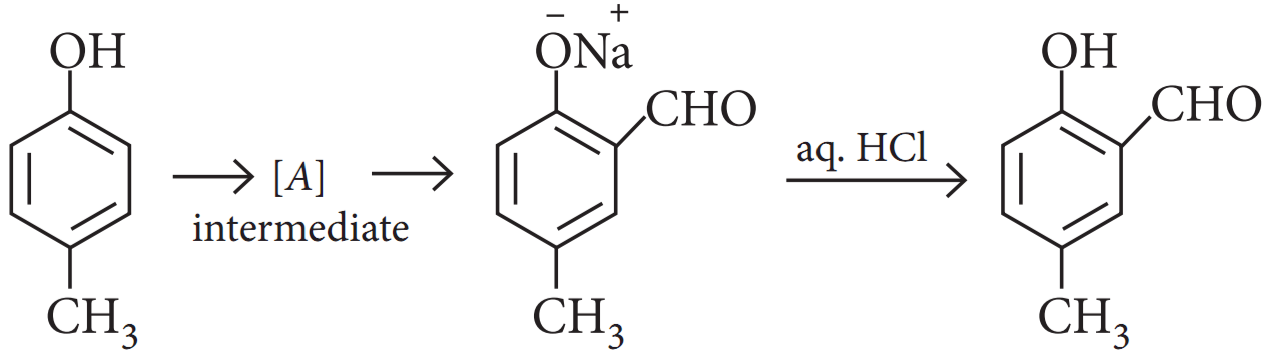
Reimer-Tiemann reaction introduces an aldehyde group, on aromatic ring of phenol, ortho to the hydroxyl group. This is a general method for the synthesis of substituted salicylaldehydes as depicted below.

The following questions are multiple choice questions. Choose the most appropriate answer:
  1. Reimer-Tiemann reaction is an example of:
  1. Nucleophilic substitution reaction.
  2. Electrophilic substitution reaction.
  3. Nucleophilic addition reaction.
  4. Electrophilic addition reaction.
  1. Which of the following reagents is used in the given reaction in steps I?
  1. aq. $NaOH + CH_3Cl$
  2. aq. $NaOH + CH_2Cl_2$
  3. aq. $NaOH + CHCl_3$
  4. aq. $NaOH + CCl_4$
  1. The electrophile in this reaction (A) is:
  1. : $CHCI$
  2. $^+CHCl_2$
  3. : $CCl_2$
  4. .$CCl_3$
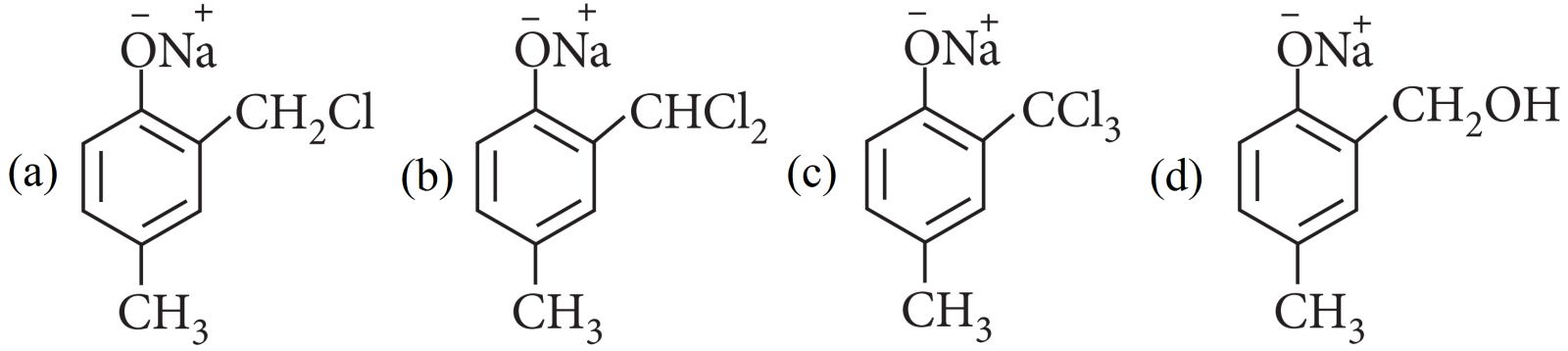
  1. The structure of the intermediate (A) is:
  1. When phenol reacts with chloroform in presence of KOH, the product formed is:
  1. Salicylic acid.
  2. Salicylaldehyde.
  3. Both (a) and (b).
  4. None of these.
In these questions, a statement of assertion followed by a statement of reason is given. Choose the correct answer out of the following choices.
Assertion: The molecules on the surface have lesser energy than the molecules inside.
Reason: During adsorption, the surface of solid is in a state of strain.
Read the passage given below and answer the following questions: An ideal solution may be defined as the solution which obeys Raoult's law exactly over the entire range of concentration. The solutions for which vapour pressure is either higher or lower than that predicted by Raoult's law are called non-ideal solutions.Non-ideal solutions can show either positive or negative deviations from Raoult's law depending on whether the A-B interactions in solution are stronger or weaker than A - A and B - B interactions. The following questions are multiple choice questions. Choose the most appropriate answer:
  1. Which of the following solutions is/are ideal solution(s)?
  1. Bromoethane and iodoethane.
  2. Acetone and chloroform
  3. Benzene and acetone
  4. n-heptane and n-hexane
  1. Only I
  2. I and II
  3. II and III
  4. I and Iv
  1. For which of the following solutions $\Delta\text{H}_{\text{mix}}$ and $\Delta\text{V}_{\text{mix}}$ is negative?
  1. Acetone and aniline
  2. Ethyl alcohol and cyclohexane
  3. Acetone and CS2
  4. Benzene and toluene
  1. Which of the following is not true for positive deviations?
  1. The A-B interactions in solution are weaker than the A - A and B - B interactions.
  2. $\text{P}_\text{A}<\text{P}\mathring{\text{A}}\ \text{x}_\text{A}$ and $\text{P}_\text{B}<\text{P}\mathring{\text{B}}\ \text{x}_\text{B}$
  3. Carbon tetrachloride and chloroform mixture is an example of positive deviations.
  4. All of these.
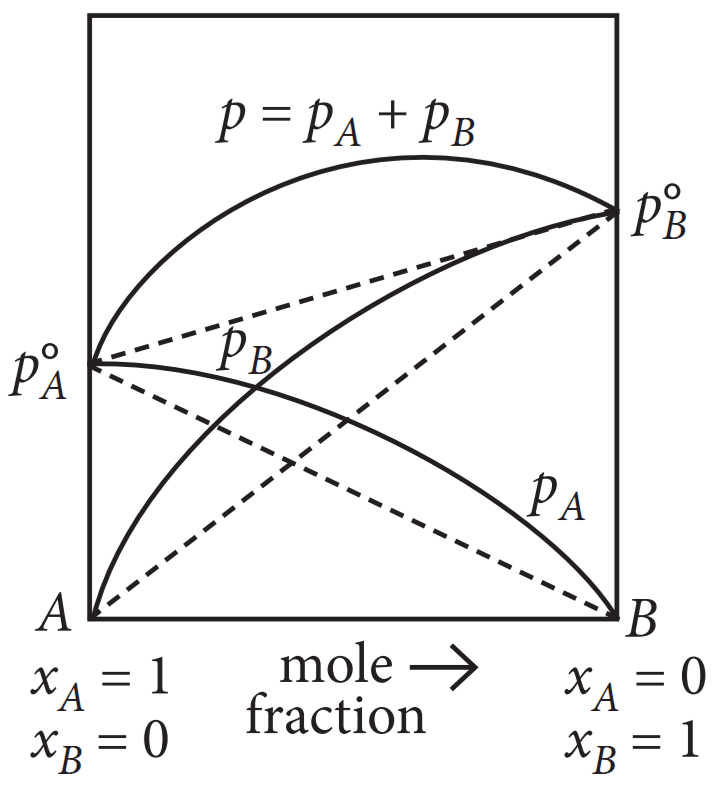
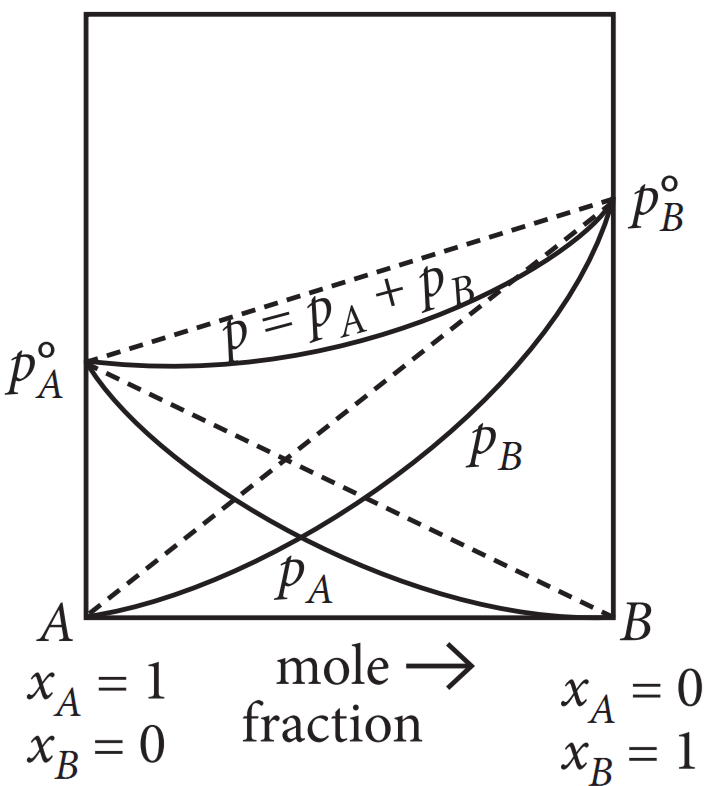
  1. For water and nitric acid mixture, which of the given graph is correct?
  1.  
  1.  
  1. Both of these
  2. None of these
  1. Water-HCI mixture.
  1. Shows positive deviations.
  2. Forms minimum boiling azeotrope.
  3. Shows negative deviations.
  4. Forms maximum boiling azeotrope.
  1. I and II
  2. I and III
  3. I and IV
  4. III and IV

Read the passage given below and answer the following questions:
The aryl halides are relatively less reactive towards nucleophilic substitution reactions as compared to alkyl halides. This low reactivity can be attributed to the following factors:
  • The $C - X$ bond in halobenzene has a partial double bond character due to involvement of halogen electrons in resonance with benzene ring.
  • The $C - X$ bond in aryl halides is less polar as compared to that in alkyl halides as $sp^2$ hyridised carbon is more electronegative than $sp^3$ hybridised carbon.
In these questions (Q. No. i-Iv), a statement of assertion followed by a statement of reason is given. Choose the correct answer out of the following choices.
  1. Assertion and reason both are correct statements and reason is correct explanation for assertion.
  2. Assertion and reason both are correct statements but reason is not correct explanation for assertion.
  3. Assertion is correct statement but reason is wrong statement.
  4. Assertion is wrong statement but reason is correct statement.
  1. Assertion: Primary benzylic halides are more reactive than primary alkyl halides towards $S_N1$ reactions.
Reason: Reactivity depends upon the nature of the nucleophile and the solvent.
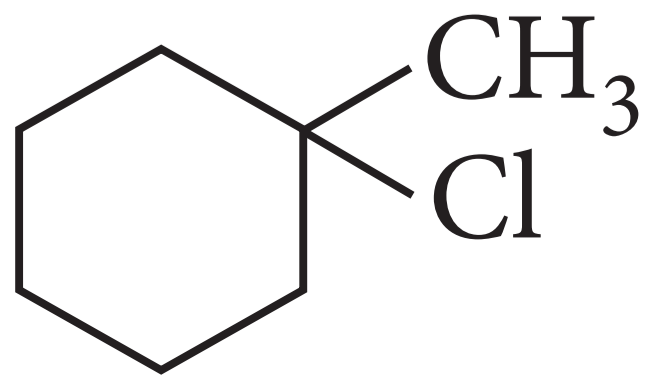
  1. Assertion: is more reactive than towards nucleophilic substitution reactions.
Reason: Tertiary alkyl halides react predominantly by $S_N1$ mechanism.
  1. Assertion: Chlorobenzene is more reactive than p-chloroanisole to nucleophilic substitution reactions.
Reason: Greater the stability of carbanion, greater is its ease of formation and hence, more reactive is the aryl halide.
  1. Assertion: $4-$Nitrochlorobenzene undergoes nucleophilic substitution more readily than chlorobenzene.
Reason: Chlorobenzene undergoes nucleophilic substitution by elimination-addition mechanism while 4-nitrochlorobenzene undergoes nucleophilic substitution by addition-elimination mechanism.
  1. Assertion: Chlorobenzene is less reactive than benzene towards the electrophilic substitution reaction.
Reason: Resonance destabilises the carbocation.
Read the passage given below and answer the following questions:
Arrangement of ligands in order of their ability to cause splitting $(\Delta)$ is called spectrochemical series. Ligands which cause large splitting (large $\Delta$) are called strong field ligands while those which cause small splitting (small $\Delta$) are called weak field ligands. When strong field ligands approach metal atom/ ion, the value of $\Delta_0$ is large, so that electrons are forced to get paired up in lower energy $t_{2g}$ orbitals. Hence, a low-spin complex is resulted from strong field ligand. When weak field ligands approach metal atom/ ion, the value of $\Delta_0$ is small, so that electrons enter high energy $e_g$ orbitals rather than pairing in low energy $t_{2g}$ orbitals. Hence, a high-spin complex is resulted from weak field ligands. Strong field ligands have tendency to form inner orbital complexes by forcing the electrons to pair up. Whereas weak field ligands have tendency to form outer orbital complex because inner electrons generally do not pair up.
In these questions (Q. No. i-iv), a statement of assertion followed by a statement ofreason is given. Choose the correct answer out of the following choices.
  1. Assertion and reason both are correct statements and reason is correct explanation for assertion.
  2. Assertion and reason both are correct statements but reason is not correct explanation for assertion.
  3. Assertion is correct statement but reason is wrong statement.
  4. Assertion is wrong statement but reason is correct statement.
The following questions are multiple choice questions. Choose the most appropriate answer:
  1. Assertion: In tetrahedral coordination entity formation, the d orbital splitting is inverted and is smaller as compared to the octahedral field splitting.
Reason: Spectrochemical series is based on the absorption of light by complexes with different ligands.
  1. Assertion: In high spin situation, configuration of $d^5$ ions will be $\text{t}^3_{2\text{g}}\text{e}^2_\text{g}.$
Reason: In high spin situation, pairing energy is less than crystal field energy.
  1. Assertion: $F^-$ ion is a weak field ligand and fonns outer orbital complex.
Reason: $F^-$ ion cannot force the electrons of $d_{z^2}$ and $d_{x^2-y^2}$ orbitals of the inner shell to occupy $d_{xy}, d_{yz}$ and $d_{zx}$ orbitals of the same shell.
  1. Assertion: The crystal field model is successful in explaining the formation, structures, colour and magnetic properties of coordination compounds.
Reason: In spectrochemical series, ligands are arranged in a series of increasing field strength.
  1. Assertion: $NF_3$ is a weaker ligand than $N(CH_3)_3$.
Reason: $NF_3$ ionizes to give $F^-$ ions in aqueous solution.
Read the passage given below and answer the following questions: Boiling point or freezing point of liquid solution would be affected by the dissolved solids in the liquid phase. A soluble solid in solution has the effect of raising its boiling point and depressing its freezing point. The addition of non-volatile substances to a solvent decreases the vapor pressure and the added solute particles affect the formation of pure solvent crystals. According to many researches the decrease in freezing point directly correlated to the concentration of solutes dissolved in the solvent. This phenomenon is expressed as freezing point depression and it is useful for several applications such as freeze concentration of liquid food and to find the molar mass of an unknown solute in the solution. Freeze concentration is a high quality liquid food concentration method where water is removed by forming ice crystals. This is done by cooling the liquid food below the freezing point of the solution. The freezing point depression is referred as a colligative property and it is proportional to the molar concentration of the solution (m), along with vapor pressure lowering, boiling point elevation, and osmotic pressure. These are physical characteristics of solutions that depend only on the identity of the solvent and the concentration of the solute. The characters are not depending on the solute’s identity.
  1. When a non volatile solid is added to pure water it will:
  1. boil above 100°C and freeze above 0°C
  2. boil below 100°C and freeze above 0°C
  3. boil above 100°C and freeze below 0°C
  4. boil below 100°C and freeze below 0°C
  1. Colligative properties are:
  1. dependent only on the concentration of the solute and independent of the solvent’s and solute’s identity.
  2. dependent only on the identity of the solute and the concentration of the solute and independent of the solvent's identity.
  3. dependent on the identity of the solvent and solute and thus on the concentration of the solute.
  4. dependent only on the identity of the solvent and the concentration of the solute and independent of the solute’s identity.
  1. Assume three samples of juices A, B and C have glucose as the only sugar present in them. The concentration of sample A, B and C are 0.1M, 5M and 0.2 M respectively. Freezing point will be highest for the fruit juice:
  1. A
  2. B
  3. C
  4. All have same freezing point
  1. Identify which of the following is a colligative property:
  1. freezing point
  2. boiling point
  3. osmotic pressure
  4. all of the above
Read the passage given below and answer the following questions: Aniline activates the benzene ring by increasing electron density at ortho- and para-positions. Hence, it is o-, p-directing. -NH2 group strongly activates the ring therefore it is difficult to stop the reaction at monosubstitution stage. Among electrophilic substitution reaction, direct nitration of aniline is not done to get o- and p-nitroaniline because lone pair of electrons present at nitrogen atom will accept proton from nitrating mixture to give anilinium ion which is meta-directing. Aniline with $NaNO_2$ and HCI forms benzene diazonium chloride at very low temperature. Aromatic amines react with nitrous acid to form a yellow oily liquid known as N-nitrosoamines. A statement of assertion followed by a statement of reason is given. Choose the correct answer out of the following choices.
  1. Assertion and reason both are correct statements and reason is correct explanation for assertion.
  2. Assertion and reason both are correct statements but reason is not correct explanation for assertion.
  3. Assertion is correct statement but reason is wrong statement.
  4. Assertion is wrong statement but reason is correct statement.
  1. Assertion: Nitrating mixture used for carrying out nitration of benzene consists of cone. $HNO_3$ + cone. $H_2SO_4$.
Reason: In presence of $H_2SO_4, HNO_3$ acts as a base and produces $\text{NO}^+_2$ ions.
  1. Assertion: Anilinium chloride is more acidic than ammonium chloride.
Reason: Anilinium ion is not resonance-stabilised.
  1. Assertion: Nitrobenzene can be prepared from benzene by using mixture of cone. $HNO_3$ and cone. $H_2SO_4$.
Reason: In the mixture, $H_2SO_4$ act as a acid.
  1. Assertion: In strongly acidic solution, aniline becomes less reactive towards electrophilic reagents.
Reason: The amino group being completely protonated in strongly acidic solution, the lone pair of electrons on the nitrogen is no longer available for resonance.
  1. Assertion: Nitration of aniline can be done conveniently by protecting $-NH_2$ group through acetylation.
Reason: Acetylation of aniline results in the increase of electron density in the benzene ring.
Read the passage given below and answer the following questions:
The concentration of a solute is very important in studying chemical reactions because it determines how often molecules collide in solution and thus indirectly determine the rate of reactions and the conditions at equilibrium. There are several ways to express the amount of solute present in a solution. The concentration of a solution is a measure of the amount of solute that has been dissolved in a given amount of solvent or solution. Concentration can be expressed in terms of molarity, molality, parts per million, mass percentage, volume percentage, etc.
The following questions are multiple choice questions. Choose the most appropriate answer:
  1. A solution is prepared using aqueous Kl which is turned out to be $20\%$ w/w Density of Kl is $1.202$ g/mL the molality of the given solution and mole fraction of solute are respectively.
  1. $1.95m, 0.120$
  2. $1.5m, 0.0263$
  3. $2.5m, 0.0569$
  4. $3.0m, 0.0352$
  1. The molarity $($in $mol\ L^{-1})$ of the given solution will be.
  1. $1.56$
  2. $1.89$
  3. $0.263$
  4. $1.44$
  1. Which of the following is correct relationship between mole fraction and molality?
  1. $\text{x}_2=\frac{\text{mM}_1}{1+\text{mM}_1}$
  2. $\text{x}_2=\frac{\text{mM}_1}{1-\text{mM}_1}$
  3. $\text{x}_2=\frac{1+\text{mM}_1}{\text{mM}_1}$
  4. $\text{x}_2=\frac{1-\text{mM}_1}{\text{mM}_1}$
  1. Which of the following is temperature dependent?
  1. Molarity
  2. Molality
  3. Mole fraction
  4. Mass percentage
  1. Which of the following is true for an aqueous solution of the solute in terms of concentration?
  1. $1M = 1m$
  2. $1M > 1m$
  3. $1M < 1m$
  4. Cannot be predicted
ln a reaction, the rates of disappearance of different reactants or rates of formation of different products may not be equal but rate of reaction at any instant of time has the same value expressed in terms of any reactant or product. Further, the rate of reaction may not depend upon the stoichiometric coefficients of the balanced chemical equation. The exact powers of molar concentrations of reactants on which rate depends are found experimentally and expressed in terms of 'order of reaction'. Each reaction has a characteristic rate constant depends upon temperature. The units of the rate constant depend upon the order of reaction.
The following questions are multiple choice questions. Choose the most appropriate answer:
  1. The rate constant of a reaction is found to be $3 \times 10^{-3} mol^{-2}\ L^2 sec^{-1}$. The order of the reaction is:
  1. $0.5$
  2. $2$
  3. $3$
  4. $1$
  1. ln the reaction, $A + 3B \rightarrow 2C$, the rate of formation of $C$ is:
  1. The same as rate of consumption of A.
  2. The same as the rate of consumption of B.
  3. Twice the rate of consumption of A.
  4. $\frac{3}{2}$ times the rate of consumption of B.
  1. Rate of a reaction can be expressed by following rate expression, Rate $= k[A]^2 [B]$, if concentration of A is increased by $3$ times and concentration of B is increased by $2$ times, how many times rate of reaction increases?
  1. $9$ times
  2. $27$ times
  3. $18$ times
  4. $8$ times
  1. The rate of a certain reaction is given by, rate $= k[H^+]^n$.The rate increases $100$ times when the pH changes from $3$ to $1$. The order $(n)$ of the reaction is:
  1. $2$
  2. $0$
  3. $1$
  4. $1.5$
  1. ln a chemical reaction $A + 2B \rightarrow $ products, when concentration of $A$ is doubled, rate of the reaction increases $4$ times and when concentration of $B$ alone is doubled rate continues to be the same. The order of the reaction is:
  1. $1$
  2. $2$
  3. $3$
  4. $4$
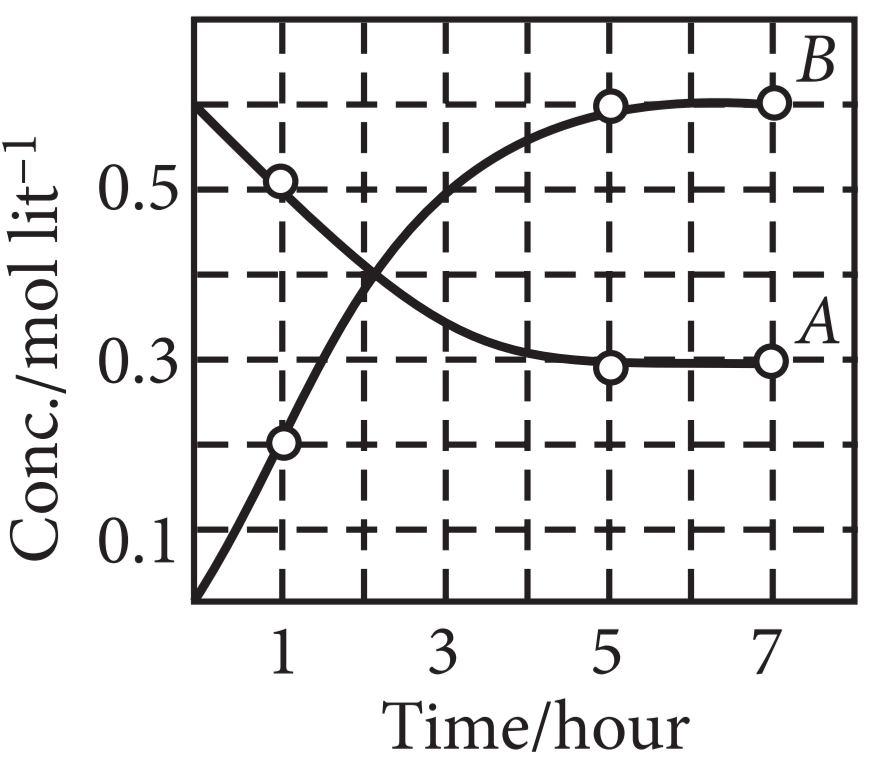
The progress of the reaction, $\text{A}\rightleftharpoons\text{nB}$ with time is represented in the following figure:

The following questions are multiple choice questions. Choose the most appropriate answer:
  1. What is the value of n?
  1. 1
  2. 2
  3. 3
  4. 4
  1. Find the value of the equilibrium constant.
  1. 0.6M
  2. 1.2M
  3. 0.3M
  4. 2.4M
  1. The initial rate of conversion of A will be:
  1. $0.1 mol ~L^{-1}hr^{-1}$
  2. $0.2 mol ~L^{-1}hr^{-1}$
  3. $0.4 mol ~L^{-1}hr^{-1}$
  4. $0.8 mol ~L^{-1}hr^{-1}$
  1. For the reaction, if $\frac{\text{d}[\text{B}]}{\text{dt}}=2\times10^{-4},$ value of $-\frac{\text{d}[\text{A}]}{\text{dt}}$ will be:
  1. $2 \times 10^{-4}$
  2. $10^{-4}$
  3. $4 \times 10^{-4}$
  4. $0.5 \times 10^{-4}$
  1. Which factor has no effect on rate of reaction?
  1. Temperature.
  2. Nature of reactant.
  3. Concentration of reactant.
  4. Molecularity.