Question
Read the passage given below and answer the following questions: Proteins are high molecular mass complex biomolecules of amino acids. The important proteins required for our body are enzymes, hormones, antibodies, transport proteins, structural proteins, contractile proteins etc. Except for glycine, all $\alpha$-amino acids have chiral carbon atom and most of them have L-configuration. The amino acids exists as dipolar ion called zwitter ion, in which a proton goes from the carboxyl group to the amino group. A large number of $\alpha$-amino acids are joined by peptide bonds forming polypeptides. The peptides having very large molecular mass (more than 10,000) are called proteins. The structure of proteins is described as primary structure giving sequence of linking of amino acids; secondary structure giving manner in which polypeptide chains are arranged and folded; tertiary structure giving folding, coiling or bonding polypeptide chains producing three dimensional structures and quaternary structure giving arrangement of sub-units in an aggregate protein molecule. A statement of assertion followed by a statement of reason is given. Choose the correct answer out of the following choices.
  1. Assertion and reason both are correct statements and reason is correct explanation for assertion.
  2. Assertion and reason both are correct statements but reason is not correct explanation for assertion.
  3. Assertion is correct statement but reason is wrong statement.
  4. Assertion is wrong statement but reason is correct statement.
  1. Assertion: Except glycine, all naturally occurring CL-amino acids are optically active.
Reason: All naturally occurring CL-amino acids, except glycine, has at least one asymmetric carbon.
  1. Assertion: All amino acids are optically active.
Reason: Amino acids contain asymmetric carbon atoms.
  1. Assertion: In $\alpha$-helix structure, intramolecular H-bonding takes place whereas in $\beta$-pleated structure, intermolecular H-bonding takes place.
Reason: An egg contains a soluble globular protein called albumin which is present in the white part.
  1. Assertion: Secondary structure of protein refers to regular folding patterns of continuos portions of the polypeptide chain.
Reason: Out of 20 amino acids, only 12 amino acids can be synthesised by human body.
  1. Assertion: The helical structure of protein is stabilised by intramolecular hydrogen bond between -NH and carbonyl oxygen.
Reason: Sanger's reagent is used for the identification of N-tenninal amino acid of peptide chain.

Answer

  1.  (a) Assertion and reason both are correct statements and reason is correct explanation for assertion.
  1. (d) Assertion is wrong statement but reason is correct statement.
Explanation:
All amino acids except glycine are optically active because they contain, asymmetric carbon atom. They exist in both D and L-forms. Most naturally occurring amino acids have L-configuration.
  1. (b) Assertion and reason both are correct statements but reason is not correct explanation for assertion.
Explanation:
In $\alpha$-helix structure, the formation of hydrogen bonds takes place between -CO- and -NH groups, whereas in $\beta$-pleated structure, hydrogen bonds are formed between amide groups of two different chains.
  1. (c) Assertion is correct statement but reason is wrong statement.
Explanation:
Out of 20 amino acids, only 10 amino acids can be synthesised by human body.
  1.  (b) Assertion and reason both are correct statements but reason is not correct explanation for assertion. 

Need a full question paper?

Generate a complete, print-ready paper with questions like this in minutes — across 16+ boards, with answer keys.

Start Generating Free

Similar questions

A reaction is said to be of the first order if the rate of the reaction depends upon one concentration term only. For a first order reaction of the type $A \rightarrow$ Products, the rate of the reaction is given as: rate $= k[A]$. The differential rate law is given as : $\frac{\text{dA}}{\text{dt}}=-\text{k}[\text{A}].$ The integrated rate law is : In $\frac{[\text{A}]}{[\text{A}]_0}=-\text{kt}, [A]$ is the concentration of reactant left at time $t$ and $[A]_0$ is the initial concentration of the reactant$, k$ is the rate constant.
The following questions are multiple choice questions. Choose the most appropriate answer :
  1. The unit of rate constant for a first order reaction is:
  1. $S^{-1}$
  2. $mol\ L^{-1} s^{-1}$
  3. $L\ mol^{-1} s^{-1}$
  4. $L^2\ mol^{-2} s^{-1}$
  1. Half$-$life period of a first order reaction is $10$ min. Starting with initial concentration $12M,$ the rate after $20$ min is:
  1. $0.693 \times 3M\ min^{-1}$
  2. $0.0693 \times 4M\ min^{-1}$
  3. $0.0693 \times M\ min^{-1}$
  4. $0.0693 \times 3M\ min^{-1}$
  1. $50\%$ of a first order reaction is complete in $23$ minutes. Calculate the ti me required to complete $90\%$ of the reaction.
  1. $70.4$ minutes.
  2. $76.4$ minutes.
  3. $38.7$ minutes.
  4. $35.2$ minutes.
  1. For a first order reaction$, (A) \rightarrow$ products, the concentration of $A$ changes from $0.1M$ to $0.025M$ in $40$ minutes. The rate of reaction when the concentration of $A$ is $0.01M,$ is:
  1. $3.47 \times 10^{-4} M/ min$
  2. $3.47 \times 10^{-5} M/ min$
  3. $1.73 \times 10^{-4} M/ min$
  4. $1.73 \times 10^{-5} M/ min$
  1. The half$-$life period ofa $1^{st}$ order reaction is $60$ minutes. What percentage will be left over after $240$ minutes?
  1. $6.25\%$
  2. $4.25\%$
  3. $5\%$
  4. $6\%$
Read the passage given below and answer the following questions: The sequence of bases along the DNA and RNA chain establishes its primary structure which controls the specific properties of the nucleic acid. An RNA molecule is usually a single chain ofribose-containing nucleotide. On the basis of X-ray analysis of DNA, J.D., Watson and EH.C. crick (shared noble prize in 1962) proposed a three dimensional secondary structure for DNA. DNA molecule is a long and highly complex, spirally twisted, double helix, ladder like structure. The two polynucleotide chains or strands are linked up by hydrogen bonding between the nitrogeneous base molecules of their nucleotide monomers. Adenine (purine) always links with thymine (pyrimidine) with the help of two hydrogen bonds and guanine (purine) with cytosine (pyrimidine) with the help of three hydrogen bonds. Hence, the two strands extend in opposite directions, i.e., are antiparallel and complimentary.
  1. Assertion and reason both are correct statements and reason is correct explanation for assertion.
  2. Assertion and reason both are correct statements but reason is not correct explanation for assertion.
  3. Assertion is correct statement but reason is wrong statement.
  4. Assertion is wrong statement but reason is correct statement.
  1. Assertion: DNA molecules and RNA molecules are found in the nucleus of a cell.
Reason: There are two types of nitrogenous bases, purines and pyrimidines. Adenine (A) and guanine (G) are substituted purines; cytosine (C), thymine (T) and uracil (U) are substituted pyrimidines.
  1. Assertion: In both DNA and RNA, heterocyclic base and phosphate ester linkages are at C-1' and C-5' respectively of the sugar molecule.
Reason: Nucleotides and nucleosides mainly differ from each other in presence of phosphate units.
  1. Assertion: The backbone of RNA molecule is a linear chain consisting of an alternating units of a heterocylic base, D-ribose and a phosphate.
Reason: The segment of DNA which acts as the instruction manual for the synthesis of protein is ribose.
  1. Assertion: The double helical structure of DNA was proposed by Emil Fischer.
Reason: A nucleoside is an N-glycoside of heterocyclic base.
  1. Assertion: In DNA, the complementary bases are, adenine and guanine; thymine and cytosine.
Reason: The phenomenon of mutation is chemical change in DNA molecule.
Number of molecules which must collide simultaneously to give product is called molecularity. It is equal to sum of coefficients of reactants present in stoichiometric chemical equation. For reaction, $m_1A + m_2B \rightarrow$ Product Molecularity $= [m_1 + m_2]$ ln complex reaction each step has its own molecularity which is equal to the sum of coefficients of reactants present in a particular step. Molecularity is a theoretical property. Its value is any whole number. Number of concentration terms on which rate of reaction depends is called order of reaction or sum of powers of concentration terms present in the rate equation is called order of reaction. If rate equation ofreaction is: Rate $=\text{k}\cdot\text{C}^{\text{m}_1}_\text{A}\cdot\text{C}^{\text{m}_2}_\text{B}$ Then order of reaction $= m_1 + m_2.$ ln simple reaction, order and molecularity are same. ln complex reaction, order of slowest step is the order ofover all reaction. This step is known as rate determining step. Order is an experimental property. Its value may be zero, fractional or negative. The following questions are multiple choice questions. Choose the most appropriate answer:
  1. Higher order $(> 3)$ reactions are rare due to:
  1. Shifting of equilibrium towards reactants due to elastic collisions.
  2. Loss of active species on collision.
  3. Low probability of simultaneous collision of all the reacting species.
  4. Increase in entropy and activation energy as more molecules are involved.
  1. The molecularity of the reaction:
$6\text{FeSO}_4+3\text{H}_2\text{SO}_4+\text{KClO}_3\rightarrow\text{KCl}+3\text{Fe}_2(\text{SO}_4)_3+3\text{H}_2\text{O}$ is:
  1. $6$
  2. $10$
  3. $3$
  4. $7$
  1. Which of the following statements is false in the following?
  1. Order of a reaction may be even zero.
  2. Molecularity of a reaction is always a whole number.
  3. Molecularity and order always have same values for a reaction.
  4. Order of a reaction depends upon the mechanism of the reaction.
  1. The rate of reaction, $A + 2B \rightarrow$ products, is given by the following equation:
$-\frac{\text{d}[\text{A}]}{\text{dt}}=\text{k}[\text{A}][\text{B}]^2$
If B is present in large excess, the order of the reaction is:
  1. Zero
  2. First
  3. Second
  4. Third
  1. The rate of the reaction, $A + B + C \rightarrow$  products, is given by $\text{r}=\frac{\text{d}[\text{A}]}{\text{dt}}=\text{k}[\text{A}]^\frac{1}{2}[\text{B}]^\frac{1}{3}[\text{C}]^\frac{1}{4}.$ The order of the reaction is:
  1. $\frac{1}{3}$
  2. $\frac{1}{4}$
  3. $\frac{1}{2}$
  4. $\frac{13}{12}$
Read the passage given below and answer the following questions:
Metal carbonyl is an example of coordination compounds in which carbon monoxide $(CO)$ acts as ligand. These are also called homoleptic carbonyls. These compounds contain both $\sigma$ and $\pi$ character. Some carbonyls have metal$-$metal bonds. The reactivity of metal carbonyls is due to $(i)$ the metal centre and $(ii)$ the $CO$ ligands. $CO$ is capable of accepting an appreciable amount of electron density from the metal atom into their empty $\pi$ or $\pi-\text{orbital}.$ These types of ligands are called $\pi-\text{accepter}$ or $\pi-\text{acid}$ ligands. These interactions increases the $\Delta_0$ value.
The following questions are multiple choice questions. Choose the most appropriate answer:
  1. What is the oxidation state of metal in $\ce{[Mn_2(CO)_{10}]}?$
  1. $+1$
  2. $-1$
  3. $+2$
  4. $0$
  1. Among the following metal carbonyls, the $C-O$ bond order is lowest in:
  1. $\ce{[Mn(CO)_6]^+}$
  2. $\ce{[Fe(CO)_5]}$
  3. $\ce{[Cr(CO)_6]}$
  4. $\ce{[V(CO)_6]^-}$
  1. Which of the following can be reduced easily?
  1. $\ce{V(CO)_6}$
  2. $\ce{Mo(CO)_6}$
  3. $\ce{[Co(CO)_4]^-}$
  4. $\ce{Fe(CO)_5}$
  1. The oxidation state of cobalt in $\ce{K[Co(CO)_4]}$ is:
  1. $+1$
  2. $+3$
  3. $-1$
  4. $0$
  1. Structure of decacarbonyl manganese is:
  1. Trigonal bipyramidial
  2. Octahedral
  3. Tetrahedral
  4. Square pyramidal
What change in the concentration of H₂ will triple the rate of reaction?
(c). Suppose a reaction between A and B, was experimentally found to be first order with respect to both A and B. So the rate equation is:
Rate = k[A][B]
Which of these two mechanisms is consistent with this experimental finding? Why?
Mechanism 1
A → C + D (slow)
B+C → E (fast)
Mechanism 2
A+B →C + D (slow)
C → E (fast)
Read the passage given below and answer the following questions:
Haloarenes are less reactive than haloalkanes. The low reactivity of haloarenes can be attributed to:
  • Resonance effect.
  • $sp^2$ hybridisation of $C - X$ bond.
  • Polarity of $C - X$ bond
  • Instability of phenyl cation $($formed by self$-$ionisation of haloarene$).$
  • Repulsion between the electron rich attacking nucleophiles and electron rich arenes.
Reactivity of haloarenes can be increased or decreased by the presence of certain groups at certain positions for example, nitro $(-NO_{^2})$ group at o/ p positions increases the reactivity of haloarenes towards nucleophilc substitution reactions.
The following questions are multiple choice questions Choose the most appropriate answer:
  1. Aryl halides are less reactive towards nucleophilic substitution reaction as compared to alkyl halides due to
  1. The formation of less stable carbonium ion.
  2. Resonance stabilisation.
  3. Larger carbon$-$halogen bond.
  4. Inductive effect.
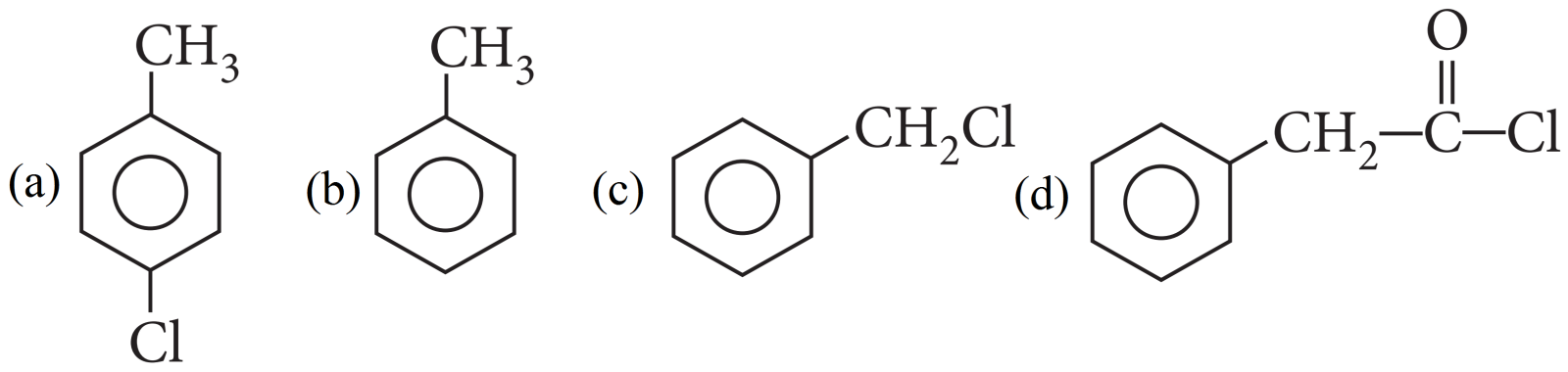
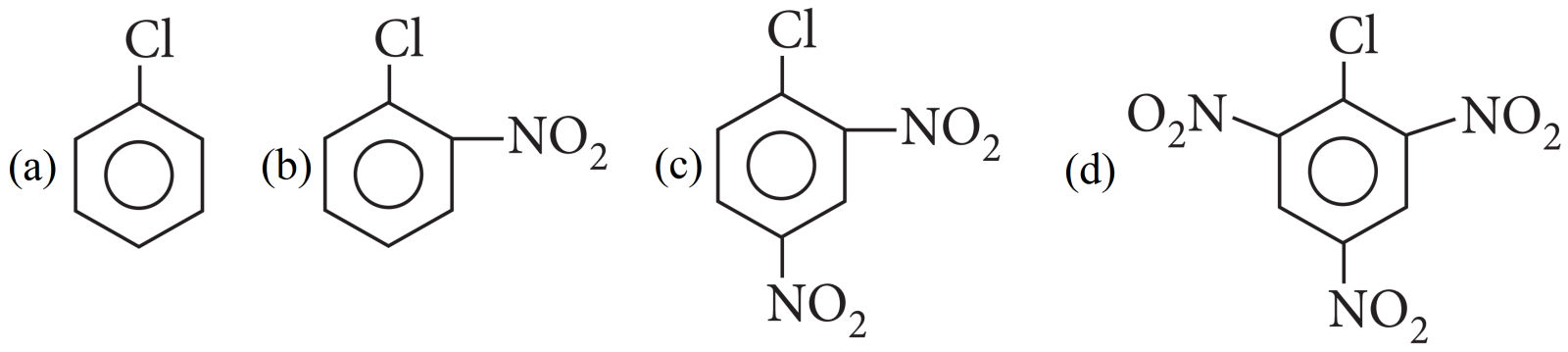
  1. Which of the following aryl halides is the most reactive towards nucleophilic substitution?
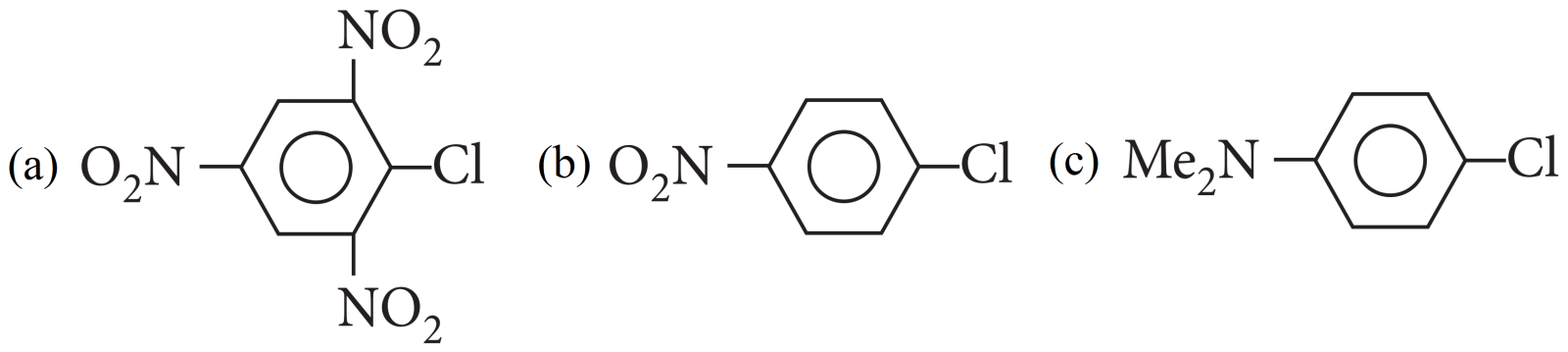
  1. Which one of the following will react fastest with aqueous $\text{NaOH}$?
  1. Which chloro derivative of benzene among the followings would undergo hydrolysis most readily with aqueous sodium hydroxide to furnish the corresponding hydroxy derivative?
  1. $\ce{C_6H_5Cl}$
  1. The reactivity of the compounds $\ce{(i)\ MeBr, (ii)\ PhCH_2Br, (iii)\ MeCI, (iv)\ p-MeOC_6H_4Br}$ decreases as:
  1. $\ce{(i) > (ii) > (iii) > (iv)}$
  2. $\ce{(iv) > (ii) > (i) > (iii)}$
  3. $\ce{(iv) > (iii) > (i) > (ii)}$
  4. $\ce{(ii) > (i) > (iii) > (iv)}$
Read the passage given below and answer the following questions:
The solubility of gases increases with increase of pressure. William Henry made a systematic investigation of the solubility of a gas in a liquid. According to Henry's law "the mass of a gas dissolved per unit volume of the solvent at constant temperature is directly proportional to the pressure of the gas in equilibrium with the solution". Dalton during the same period also concluded independently that the solubility of a gas in a ti quid solution depends upon the partial pressure of the gas. If we use the mole fraction of gas in the solution as a measure of its solubility, then Henry's law can be modified as "the partial pressure of the gas in the vapour phase is directly proportional to the mole fraction of the gas in the solution"
The following questions are multiple choice questions. Choose the most appropriate answer:
  1. Henry's law constant for the solubility of methane in benzene at $298K$ is $4.27 \times 10^5\ mm\ Hg$. The solubility of methane in benzene at $298K$ under $760\ mm\ Hg$ is :
  1. $4.27 \times 10^{-5}$
  2. $1.78 \times 10^{-3}$
  3. $4.27 \times 10^{-3}$
  4. $1.78 \times 10^{-5}$
  1. The partial pressure of ethane over a saturated solution containing $6.56 \times 10^{-2}g$ of ethane is $I$ bar. If the solution contains $5.00 \times 10^{-2}g$ of ethane then what will be the partial pressure $($in bar$)$ of the gas?
  1. $0.762$
  2. $1.312$
  3. $3.81$
  4. $5.0$
  1. $K_H\ (K$ bar$)$ values for $\ce{Ar(g), CO2(g), HCHO(g)}$ and $\ce{CH4(g)}$ are $40.39, 1.67, 1.83 \times 10^{-5}$ and $0.413$ respectively. Arrange these gases in the order of their increasing solubility. Arrange these gases in the order of their increasing solubility.
  1. $\ce{HCHO < CH4 < CO2 < Ar}$
  2. $\ce{HCHO < CO2 < CH4 < Ar}$
  3. $\ce{Ar < CO2 < CH4 < HCHO}$
  4. $\ce{Ar < CH4 < CO2 < HCHO}$
  1. When a gas is bubbled through water at $298K,$ a very dilute solution of the gas is obtained. Henry's law constant for the gas at $298K$ is $150k$ bar. If the gas exerts a partial pressure of $2$ bar, the number of millimoles of the gas dissolved in $IL$ of water is :
  1. $0.55$
  2. $0.87$
  3. $0.37$
  4. $0.66$
  1. Which of the following statements is correct?
  1. $K_H$ increases with increase of temperature.
  2. $K_H$ decreases with increase of temperature.
  3. $K_H$ remains constant with increase of temperature.
  4. $K_H$ first increases then decreases, with increase of temperature.
What is fructose? Explain the structure of fructose.
Read the passage given below and answer the following questions: Werner, a Swiss chemist in $1892$ prepared and characterised a large number of coordination compounds and studied their physical and chemical behaviour. He proposed that, in coordination compounds, metals possess two types of valencies, viz. primary valencies, which are normally ionisable and secondary valencies which are non $-$ ionisable. ln a series of compounds of cobalt $(III)$ chloride with ammonia, it was found that some of the chloride ions could be precipitated as $\text{AgCl}$ on adding excess of $\ce{AgNO_3}$ solution in cold, but some remained in solution. The number ofions furnished by a complex in a solution can be determined by precipitation reactions. The measurement of molar conductance of solutions of coordination compounds helps to estimate the number of ions furnished by the compound in solution. In these questions $(Q$. No. $i-iv),$ a statement of assertion followed by a statement ofreason is given. Choose the correct answer out of the following choices.
  1. Assertion and reason both are correct statements and reason is correct explanation for assertion.
  2. Assertion and reason both are correct statements but reason is not correct explanation for assertion.
  3. Assertion is correct statement but reason is wrong statement.
  4. Assertion is wrong statement but reason is correct statement.
The following questions are multiple choice questions. Choose the most appropriate answer:
  1. Assertion : The complex $[\ce{Co(NH_3)_3Cl_3]}$ does not give precipitate with silver nitrate solution.
Reason : The given complex is non-ionisable.
  1. Assertion : The complex $\ce{[Co(NH_3)_4Cl_2]Cl}$ gives precipitate corresponding to $2$ mol of $\ce{AgCl}$ with $\ce{AgNO_3}$ solution.
Reason : It ionises as $\ce{[Co(NH_3)_4Cl_2]^+ + Cl}^-.$
  1. Assertion : $\ce{CoCl_3. 4NH_3}$ gives $1$ mol of $\ce{AgCl}$ on reacting with $\ce{AgNO_3},$ its secondary valency is $6$.
Reason : Secondary valency corresponds to coordination number.
  1. Assertion : $1$ mol of $\ce{[CrCl_2(H_2O)_4]Cl· 2H_2O}$ will give $1$ mol of $\ce{AgCl}$ on treating with $\ce{AgNO_3}.$
Reason : $ Cl^-$ ions satisfying secondary valanceis will not be precipitated.
  1. Assertion : $\ce{CoCl_3. 3NH_3}$ is not conducting while $\ce{CoCl_3. 5NH_3}$ is conducting.
Reason : The complex of $\ce{CoCl_3. 3NH_{3 }}$ is $\ce{[CoCl_3(NH_3)_3]}$ while that of $\ce{CoCl_3· 5NH_3}$ is $\ce{[CoCl(NH_3)_5]Cl_3}.$
Read the passage given below and answer the following questions:
Both alcohols and phenols are acidic in nature, but phenols are more acidic than alcohols. Acidic strength of alcohols mainly depends upon the inductive effect. Acidic strength of phenols depends upon a combination of both inductive effect and resonance effects of the substituent and its position on the benzene ring. Electron withdrawing groups increases the acidic strength of phenols whereas electron donating groups decreases the acidic strength of phenols. Phenol is a weaker acid than carboxylic acid.
The following questions are multiple choice questions. Choose the most appropriate answer:
  1. Phenols are highly acidic as compare to alcohols due to:
  1. The higher molecular mass of phenols.
  2. The stronger hydrogen bonds in phenols.
  3. Alkoxide ion is a strong conjugate base.
  4. Phenoxide ion is resonance stabilised.
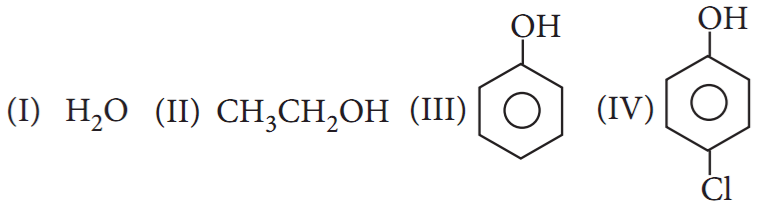
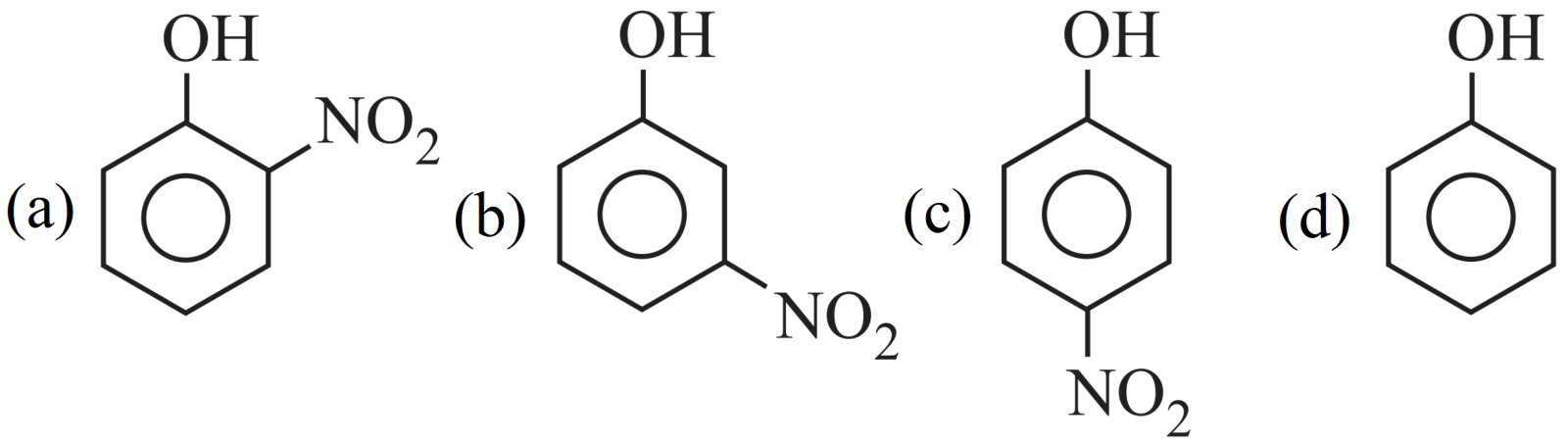
  1. The correct order of acidic strength among the following is:
  1. $(III) > (IV) > (II) > (I)$
  2. $(IV) > (III) > (I) > (II)$
  3. $(IV) > (III) > (II) > (I)$
  4. $(I) > (II) > (IV) > (III)$
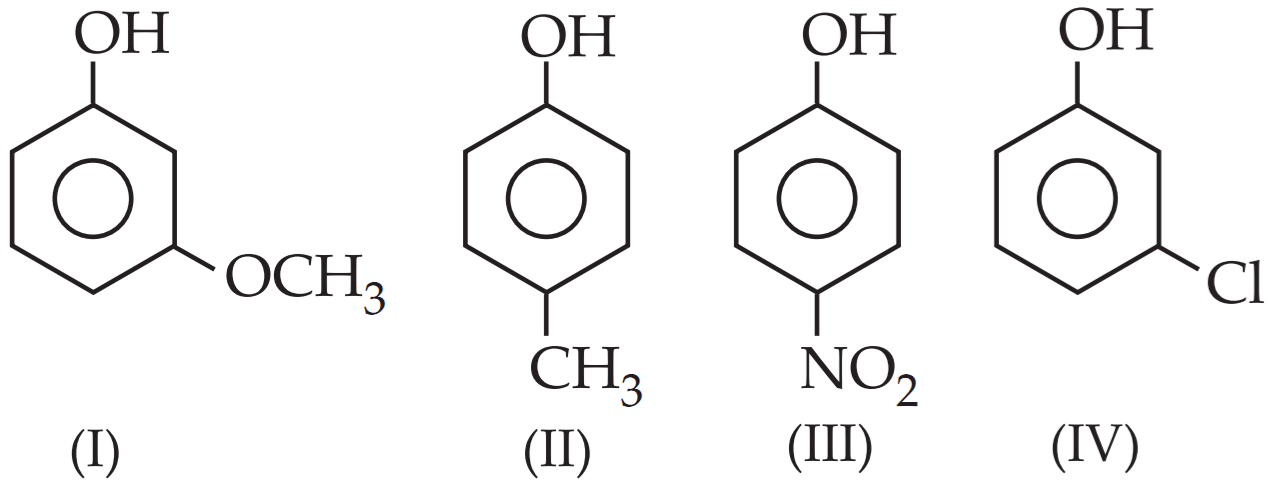
  1. The correct decreasing order of $pK_a$ value is:
  1. $II > IV > I > III$
  2. $IV > II > III > I$
  3. $II I> II > IV > I$
  4. $IV > I > II > III$
  1. The compound that does not liberate $CO_2,$ on treatment with aqueous sodium bicarbonate solution is:
  1. Benzoic acid.
  2. Benzenesulphonic acid.
  3. Salicylic acid.
  4. Carbolic acid.
  1. Most acidic amongst the following is: