Question
Read the passage given below and answer the following questions:
Proteins are high molecular mass complex biomolecules of amino acids. The important proteins required for our body are enzymes, hormones, antibodies, transport proteins, structural proteins, contractile proteins etc. Except for glycine, all $\alpha$-amino acids have chiral carbon atom and most of them have L-configuration. The amino acids exists as dipolar ion called zwitter ion, in which a proton goes from the carboxyl group to the amino group. A large number of $\alpha$-amino acids are joined by peptide bonds forming polypeptides. The peptides having very large molecular mass (more than 10,000) are called proteins. The structure of proteins is described as primary structure giving sequence of linking of amino acids; secondary structure giving manner in which polypeptide chains are arranged and folded; tertiary structure giving folding, coiling or bonding polypeptide chains producing three dimensional structures and quaternary structure giving arrangement of sub-units in an aggregate protein molecule.
A statement of assertion followed by a statement of reason is given. Choose the correct answer out of the following choices.
  1. Assertion and reason both are correct statements and reason is correct explanation for assertion.
  2. Assertion and reason both are correct statements but reason is not correct explanation for assertion.
  3. Assertion is correct statement but reason is wrong statement.
  4. Assertion is wrong statement but reason is correct statement.
  1. Assertion: Except glycine, all naturally occurring CL-amino acids are optically active.
Reason: All naturally occurring CL-amino acids, except glycine, has at least one asymmetric carbon.
  1. Assertion: All amino acids are optically active.
Reason: Amino acids contain asymmetric carbon atoms.
  1. Assertion: In $\alpha$-helix structure, intramolecular H-bonding takes place whereas in $\beta$-pleated structure, intermolecular H-bonding takes place.
Reason: An egg contains a soluble globular protein called albumin which is present in the white part.
  1. Assertion: Secondary structure of protein refers to regular folding patterns of continuos portions of the polypeptide chain.
Reason: Out of 20 amino acids, only 12 amino acids can be synthesised by human body.
  1. Assertion: The helical structure of protein is stabilised by intramolecular hydrogen bond between -NH and carbonyl oxygen.
Reason: Sanger's reagent is used for the identification of N-tenninal amino acid of peptide chain.

Answer

  1. (a) Assertion and reason both are correct statements and reason is correct explanation for assertion.
  1. (d) Assertion is wrong statement but reason is correct statement.
Explanation:

All amino acids except glycine are optically active because they contain, asymmetric carbon atom. They exist in both D and L-forms. Most naturally occurring amino acids have L-configuration.
  1. (b) Assertion and reason both are correct statements but reason is not correct explanation for assertion.
Explanation:

In $\alpha$-helix structure, the formation of hydrogen bonds takes place between -CO- and -NH groups, whereas in $\beta$-pleated structure, hydrogen bonds are formed between amide groups of two different chains.
  1. (c) Assertion is correct statement but reason is wrong statement.
Explanation:

Out of 20 amino acids, only 10 amino acids can be synthesised by human body.
  1. (b) Assertion and reason both are correct statements but reason is not correct explanation for assertion.

Need a full question paper?

Generate a complete, print-ready paper with questions like this in minutes — across 16+ boards, with answer keys.

Start Generating Free

Similar questions

Number of molecules which must collide simultaneously to give product is called molecularity. It is equal to sum of coefficients of reactants present in stoichiometric chemical equation.
For reaction, $m_1A + m_2B \rightarrow$ Product
Molecularity $= [m_1 + m_2]$
ln complex reaction each step has its own molecularity which is equal to the sum of coefficients of reactants present in a particular step. Molecularity is a theoretical property. Its value is any whole number. Number of concentration terms on which rate of reaction depends is called order of reaction or sum of powers of concentration terms present in the rate equation is called order of reaction.
If rate equation ofreaction is: Rate $=\text{k}\cdot\text{C}^{\text{m}_1}_\text{A}\cdot\text{C}^{\text{m}_2}_\text{B}$
Then order of reaction $= m_1 + m_2.$
ln simple reaction, order and molecularity are same.
ln complex reaction, order of slowest step is the order ofover all reaction. This step is known as rate determining step. Order is an experimental property. Its value may be zero, fractional or negative.
The following questions are multiple choice questions. Choose the most appropriate answer:
  1. Higher order$(> 3)$ reactions are rare due to:
  1. Shifting of equilibrium towards reactants due to elastic collisions.
  2. Loss of active species on collision.
  3. Low probability of simultaneous collision of all the reacting species.
  4. Increase in entropy and activation energy as more molecules are involved.
  1. The molecularity of the reaction:
$6\text{FeSO}_4+3\text{H}_2\text{SO}_4+\text{KClO}_3\rightarrow\text{KCl}+3\text{Fe}_2(\text{SO}_4)_3+3\text{H}_2\text{O}$ is:
  1. $6$
  2. $10$
  3. $3$
  4. $7$
  1. Which of the following statements is false in the following?
  1. Order of a reaction may be even zero.
  2. Molecularity of a reaction is always a whole number.
  3. Molecularity and order always have same values for a reaction.
  4. Order of a reaction depends upon the mechanism of the reaction.
  1. The rate of reaction, $A + 2B →$ products, is given by the following equation:
$-\frac{\text{d}[\text{A}]}{\text{dt}}=\text{k}[\text{A}][\text{B}]^2$

If $B$ is present in large excess, the order of the reaction is:
  1. Zero
  2. First
  3. Second
  4. Third
  1. The rate of the reaction, $A + B + C →$ products, is given by $\text{r}=\frac{\text{d}[\text{A}]}{\text{dt}}=\text{k}[\text{A}]^\frac{1}{2}[\text{B}]^\frac{1}{3}[\text{C}]^\frac{1}{4}.$ The order of the reaction is:
  1. $\frac{1}{3}$
  2. $\frac{1}{4}$
  3. $\frac{1}{2}$
  4. $\frac{13}{12}$
Read the passage given below and answer the following questions:
The solubility of gases increases with increase of pressure. William Henry made a systematic investigation of the solubility of a gas in a liquid. According to Henry's law "the mass of a gas dissolved per unit volume of the solvent at constant temperature is directly proportional to the pressure of the gas in equilibrium with the solution". Dalton during the same period also concluded independently that the solubility of a gas in a ti quid solution depends upon the partial pressure of the gas. If we use the mole fraction of gas in the solution as a measure of its solubility, then Henry's law can be modified as "the partial pressure of the gas in the vapour phase is directly proportional to the mole fraction of the gas in the solution"
The following questions are multiple choice questions. Choose the most appropriate answer:
  1. Henry's law constant for the solubility of methane in benzene at $298K$ is $4.27 x 10^5$mm Hg. The solubility of methane in benzene at $298K$ under $760$mm Hg is:
  1. $4.27 \times 10^{-5}$
  2. $1.78 \times 10^{-3}$
  3. $4.27 \times 10^{-3}$
  4. $1.78 \times 10^{-5}$
  1. The partial pressure of ethane over a saturated solution containing $6.56 \times 10^{-2}g$ of ethane is I bar. If the solution contains $5.00 \times 10^{-2}g$ of ethane then what will be the partial pressure (in bar) of the gas?
  1. 0.762
  2. 1.312
  3. 3.81
  4. 5.0
  1. $K_H (K$ bar$)$ values for $Ar_{(g),} CO_{2(g),} HCHO_{(g)}$ and $CH_{4(g)}$ are $40.39, 1.67, 1.83 \times 10^{-5}$ and $0.413$ respectively. Arrange these gases in the order of their increasing solubility. Arrange these gases in the order of their increasing solubility.
  1. $HCHO < CH_4 < CO_2 < Ar$
  2. $HCHO < CO_2 < CH_4 < Ar$
  3. $Ar < CO_2 < CH_4 < HCHO$
  4. $Ar < CH_4 < CO_2 < HCHO$
  1. When a gas is bubbled through water at $298K$, a very dilute solution of the gas is obtained. Henry's law constant for the gas at 298K is 150 kbar. If the gas exerts a partial pressure of $2$ bar, the number of millimoles of the gas dissolved in IL of water is:
  1. $0.55$
  2. $0.87$
  3. $0.37$
  4. $0.66$
  1. Which of the following statements is correct?
  1. $K_H$ increases with increase of temperature.
  2. $K_H$ decreases with increase of temperature.
  3. $K_H$ remains constant with increase of temperature.
  4. $K_H$ first increases then decreases, with increase of temperature.
In these questions, a statement of assertion followed by a statement of reason is given. Choose the correct answer out of the following choices.
Assertion: Gases are easily adsorbed on the surface of metals especially transition metals.
Reason: Transition metals have free valencies.
Read the passage given below and answer the following questions: Amines are alkyl or aryl derivatives of ammonia formed by replacement of one or more hydrogen atoms. Alkyl derivatives are called aliphatic amines and aryl derivatives are known as aromatic amines. The presence of aromatic amines can be identified by performing dye test. Aniline is the simplest example of aromatic amine. It undergoeselectrophilic substitution reactions in which $-NH_2$ group strongly activates the aromatic ring through delocalisation of lone pair of electrons of N-atom. Aniline undergoes electrophilic substitution reactions. Ortho and para positions to the $-NH_2$ group become centres of high electrons density. Thus, $-NH_2$ group is ortho and para-directing and powerful activating group. The following questions are multiple choice questions. Choose the most appropriate answer:
  1. Cyclohexylamine and aniline can be distinguished by:
  1. Hinsberg test.
  2. carbylamine test.
  3. Lassaigne test.
  4. azo dye test.
  1. Which of the following compounds gives dye test?
  1. Aniline.
  2. Methyl amine.
  3. Diphenyl amine.
  4. Ethyl amine.
  1. Aniline when acetylated, the major product on nitration followed by alkaline hydrolysis gives:
  1. Acetanilide.
  2. o-nitroacetanitide.
  3. p-nitroaniline.
  4. m-nitroanitine.
  1. Oxidation of aniline with manganese dioxide and sulphuric acid produces:
  1. Phenylhydroxylamine.
  2. Nitrobenzene.
  3. p-benzoquinone.
  4. Phenol.
  1. Aniline when treated with cone. $HNO_3$ and $H_2S0_4$ gives:
  1. p-phenylenediamine.
  2. m-nitroaniline.
  3. p-benzoquinone.
  4. Nitrobenzene.
Read the passage given below and answer the following questions:
The adjective 'crystalline' when applied to solids, implies an ideal crystal in which the structural units, termed as unit cells, are repeated regularly and indefinitely in three dimensions in space. The unit cell, containing at least one molecule, has a definite orientation and shape defined by the translational vectors, a, b and c. The unit cell therefore has a definite volume, V that contains the atoms and molecules necessary for generating the crystal. Every crystal can be classified as a member of one of the seven possible crystal systems or crystal classes that are defined by the relationships between the individual dimensions, a, b and c of the unit cell and between the individual angles, ⁣$\alpha,\beta$ and $\gamma$ of the unit cell. The structure of the given crystal may be assigned to one of the $7$ crystal systems, to one of the $14$ Bravais lattices, and to one of the 230 space groups. These uniquely define the possible ways of arranging atoms in a three-dimensional solid. Based on these observations, seven crystal systems were identified: triclinic, monoclinic, trigonal or rhombohedral, tetragonal, hexagonal, rhombic or orthorhombic and cubic.
The following questions are multiple choice questions. Choose the most appropriate answer:
  1. The crystal system of a compound with unit cell dimensions, $a = 0.38$7nm, $b = 0.387$nm and $c = 0.504$nm $\alpha=\beta=90^\circ$ and $\gamma=120^\circ$ is.
  1. Cubic
  2. Hexagonal
  3. Orthorhombic
  4. Rhombohedral.
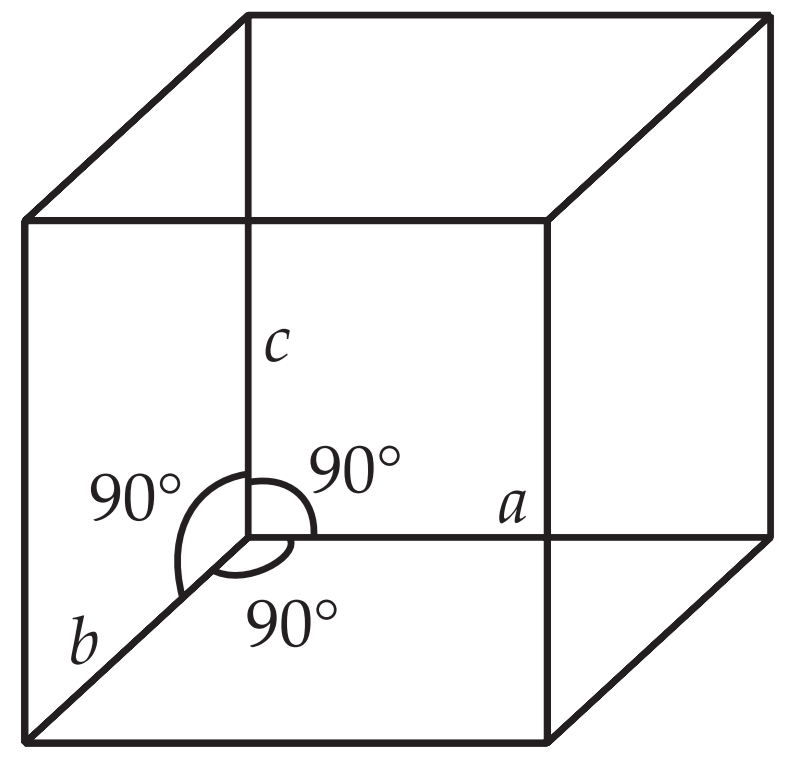
  1. The unit cell with the structure given below represents________________crystal system.
  1. Cubic
  2. Orthorhombic
  3. tetragonal
  4. trigonal
  1. In a triclinic crystal.
  1. $\text{a}=\text{b}=\text{c},\ \alpha=\beta=\gamma\neq90^\circ$
  2. $\text{a}\neq\text{b}=\text{c},\ \alpha=\beta=\gamma=90^\circ$
  3. $\text{a}\neq\text{b}\neq\text{c},\ \alpha\neq\beta\neq\gamma\neq90^\circ$
  4. $\text{a}\neq\text{b}\neq\text{c},\ \alpha=\gamma=90^\circ\beta\neq90^\circ$
  1. The unit cell with dimensions $\alpha=\beta=\gamma=90^\circ,\ \text{a}=\text{b}\neq\text{c}$ is.
  1. Cubic
  2. Triclinic
  3. Hexagonal
  4. Tetragonal.
  1. An example of orthorhombic crystal system is.
  1. $SnO_2$
  2. $KN0_3$
  3. $ZnO$
  4. $K_2Cr_2O_7$
Read the passage given below and answer the following questions:
Fehling's reagent: Fehling's reagent is a mixture of two solutions. Fehllng's solution A is aqueous copper sulphate solution. Fehling's solution Bis alkaline sodium potassium tartarate (Rochelle salt).
$\ \ \ \ \ \ \ \ \ \ \ \ \ \ \ \ \ \ \ \ \text{CH(OH)COONa}\\\text{CuSo}_{4\text{(aq)}}+|\\\ \ \ \ \ \ \ \ \ \ \ \ \ \ \ \ \ \ \ \ \text{CH(OH)COOK}$
It is a mild oxidising agent. It is weaker than Tollens' reagent. It oxidises only aliphatic aldehydes to carboxylate ions and itself gets reduced to reddish brown precipitate of cuprous oxide. Aromatic aldehydes do not respond to Fehling's test. This reaction is used for the test of aliphatic aldehydes known as Fehling's reagent test.
In these questions (Q. No. l-iv), a statement of assertion followed by a statement ofreason is given. Choose the correct answer out of the following choices.
  1. Assertion and reason both are correct statements and reason is correct explanation for assertion.
  2. Assertion and reason both are correct statements but reason is not correct explanation for assertion.
  3. Assertion is correct statement but reason is wrong statement.
  4. Assertion is wrong statement but reason is correct statement.
  1. Assertion: Fehling's solution can be used to distinguish between acetaldehyde and acetone.
Reason: Fehling's reagent is a mixture of two solutions.
  1. Assertion: Aromatic aldehydes can be distinguished from aliphatic aldehydes by Fehling's solution.
Reason: Aromatic aldehydes reduce Fehling's solution, but aliphatic aldehydes do not.
  1. Assertion: Fehling's solution oxidises acetaldehyde to acetic acid but not benzaldehyde to benzoic acid.
Reason: The $C-H$ bond of $-CHO$ group in benzaldehyde is stronger than in acetaldehyde.
  1. Assertion: $CH_3CHO$ and $C_6H_5CH_2CHO$ cannot be distinguished chemically by Fehling's solution.
Reason: $CH_3CHO$ and $C_6H_5CH_2CHO$ cannot be distinguished chemically by Fehling's solution.
  1. Assertion: Formaldehyde, when heated with Fehling's reagent produces a reddish brown ppt, of Cu.
Reason: Fehling's reagent oxidises fonnaldehyde to formate ion.
Nemst equation relates the reduction potential of an electrochemical reaction to the standard potential and activities of the chemical species undergoing oxidation and reduction.
Let us consider the reaction, $\text{M}^{\text{n+}}_{(\text{aq})}\xrightarrow{\ \ \ \ \ \ \ \ }\text{nM}_\text{(s)}$
For this reaction, the electrode potential measured with respect to standard hydrogen electrode can be given as
$\text{E}_{\Big(\frac{\text{M}^{\text{n+}}}{\text{M}}\Big)}=\text{E}^\circ_{\Big(\frac{\text{M}^\text{n+}}{\text{M}}\Big)}-\frac{\text{RT}}{\text{nF}}\text{ln}\frac{[\text{M}]}{[\text{M}^{\text{n}+}]}$
In these questions (Q. No. i-iv), a statement of assertion followed by a statement ofreason is given. Choose the correct answer out of the following choices.
  1. Assertion and reason both are correct statements and reason is correct explanation for assertion.
  2. Assertion and reason both are correct statements but reason is not correct explanation for assertion.
  3. Assertion is correct statement but reason is wrong statement.
  4. Assertion is wrong statement but reason is correct statement.
  1. Assertion: For concentration cell, $\text{Zn}_{(\text{s})}|\text{ Zn}^{2+}_{\text{(aq)}}||\text{ Zn}^{2+}_{(\text{aq})}|\text{ Zn}\\\ \ \ \ \ \ \ \ \ \ \ \ \text{C}_1\ \ \ \ \ \ \ \ \text{C}_2$
For spontaneous cell reaction, $C_1 < C_2$
Reason: For concentration cell, $\text{E}_\text{cell}=\frac{\text{RT}}{\text{nF}}\log\frac{\text{C}_2}{\text{C}_1}$
For spontaneous reaction, $\text{E}_\text{cell}=+\text{ve}\Rightarrow\text{C}_2>\text{C}_1$
  1. Assertion: For the cell reaction, $\text{Zn}_{(\text{s})}+\text{Cu}^{2+}_{(\text{aq})}\xrightarrow{\ \ \ \ \ }\text{Zn}^{2+}_{(\text{aq})}+\text{Cu}_{(\text{s})}$ voltmeter gives zero reading at equilibrium.
Reason: At the equilibrium, there is no change in concentration of Cu2+ and Zn2+ ions.
  1. Assertion: The Nernst equation gives the concentration dependence of emf of the cell.
Reason: In a cell, current flows from cathode to anode.
  1. Assertion: Increase in the concentration of copper half cell in a cell, increases the emfofthe cell.
Reason: $\text{E}_\text{cell}=\text{E}^\circ_\text{cell}+\frac{0.059}{2}\log\frac{[\text{Cu}^{2+}]}{[\text{Zn}^{2+}]}$
  1. Assertion: Electrode potential for the electrode $\frac{\text{Mn}^+}{\text{Mn}}$ with concentration is given by the expression under STP conditions.
$\text{E}=\text{E}^\circ+\frac{0.059}{\text{n}}\log[\text{Mn}^{+}]$
Reason: STP conditions require the temperature to be 273K.
Read the passage given below and answer the following questions:
Werner, a Swiss chemist in $1892$ prepared and characterised a large number of coordination compounds and studied their physical and chemical behaviour. He proposed that, in coordination compounds, metals possess two types of valencies, viz. primary valencies, which are normally ionisable and secondary valencies which are non-ionisable. ln a series of compounds of cobalt (III) chloride with ammonia, it was found that some of the chloride ions could be precipitated as $AgCl$ on adding excess of $AgNO_3$ solution in cold, but some remained in solution. The number ofions furnished by a complex in a solution can be determined by precipitation reactions. The measurement of molar conductance of solutions of coordination compounds helps to estimate the number of ions furnished by the compound in solution.
In these questions (Q. No. i-iv), a statement of assertion followed by a statement ofreason is given. Choose the correct answer out of the following choices.
  1. Assertion and reason both are correct statements and reason is correct explanation for assertion.
  2. Assertion and reason both are correct statements but reason is not correct explanation for assertion.
  3. Assertion is correct statement but reason is wrong statement.
  4. Assertion is wrong statement but reason is correct statement.
The following questions are multiple choice questions. Choose the most appropriate answer:
  1. Assertion: The complex $[Co(NH_3)_3Cl_3]$ does not give precipitate with silver nitrate solution.
Reason: The given complex is non-ionisable.
  1. Assertion: The complex $[Co(NH_3)_4Cl_2]Cl$ gives precipitate corresponding to 2 mol of AgCl with $AgNO_3$ solution.
Reason: It ionises as $[Co(NH_3)_4Cl_2]^+ + Cl^-.$
  1. Assertion: $CoCl_3. 4NH_3$ gives 1 mol of AgCl on reacting with $AgNO_3$​​​​​​​, its secondary valency is 6.
Reason: Secondary valency corresponds to coordination number.
  1. Assertion: 1 mol of $[CrCl_2(H_2O)_4]Cl· 2H_2O$ will give 1 mol of AgCl on treating with $AgNO_3$​​​​​​​.
Reason: $Cl^-$ ions satisfying secondary valanceis will not be precipitated.
  1. Assertion: $CoCl_3. 3NH_3$ is not conducting while $CoCl_3. 5NH_3$​​​​​​​ is conducting.
Reason: The complex of $CoCl_3. 3NH_3$ is $[CoCl_3(NH_3)_3]$ while that of $CoCl_3· 5NH_3$ is $[CoCl(NH_3)_5]Cl_3$.
Read the passage given below and answer the following questions:
At $298\ K$, the vapour pressure of pure benzene, $C_6, H_6$ is $0.256$ bar and the vapour pressure of pure toluene $C_6 H_5 CH_3$ is $0.0925$ bar. Two mixtures were prepared as follows:
  1. $7.8g of C_6 H_6 + 9.2g$ of toluene
  2. $3.9g of C_6 H_6 + 13.8g$ of toluene
The following questions are multiple choice questions. Choose the most appropriate answer:
  1. The total vapour pressure (bar) of solution I is.
  1. $0.128$
  2. $0.174$
  3. $0.198$
  4. $0.258$
  1. Which of the given solutions have higher vapour pressure?
  1. $I$
  2. $II$
  3. Both have equal vapour pressure
  4. Cannot be predicted
  1. Mole fraction of benzene in vapour phase in solution I is.
  1. $0.128$
  2. $0.174$
  3. $0.734$
  4. $0.266$
  1. Which of the following statements is/are correct?
  1. Mole fraction of toluene in vapour phase is more in solution I.
  2. Mole fraction of toluene in vapour phase is less in solution I.
  3. Mole fraction of benzene in vapour phase is less in solution I.
  1. Only II
  2. Only I
  3. I and III
  4. II and III
  1. Solution I is an example of a/an.
  1. Ideal solution.
  2. Non-ideal solution with positive deviation.
  3. Non-ideal solution with negative deviation.
  4. Can't be predicted.
Read the passage given below and answer the following questions:
Amines are basic in nature. The basic strength of amines can be expressed by their dissociation constant, $K_b$ or $pK_b$.
$\text{RNH}_2+\text{H}_2\text{O}\rightleftharpoons\text{RNH}^+_3+\text{OH}^-$
$\text{k}_\text{b}=\frac{[\text{RNH}^+_3][\text{OH}^-]}{[\text{RNH}_2]}\text{and}\text{ pk}_\text{b}=-\log\text{k}_\text{b}$
Greater the $K_b$ value or smaller the $pK_b$​​​​​​​ value, more is the basic strength of a mine. Aryl amines such as aniline are less basic than aliphatic amines due to the involvement of lone pair of electrons on N-atom with the resonance in benzene. In derivatives of aniline, the electron releasing groups increase the basic strength while electron withdrawing groups decrease the basic strength. The base weakening effect of electron withdrawing group and base strengthening effect of electron releasing group is more marked at p-position than at m-position. a-Substituted aniline is less basic than aniline due to ortho effect and is probable due to combination of electronic and steric effect.
The following questions are multiple choice questions. Choose the most appropriate answer:
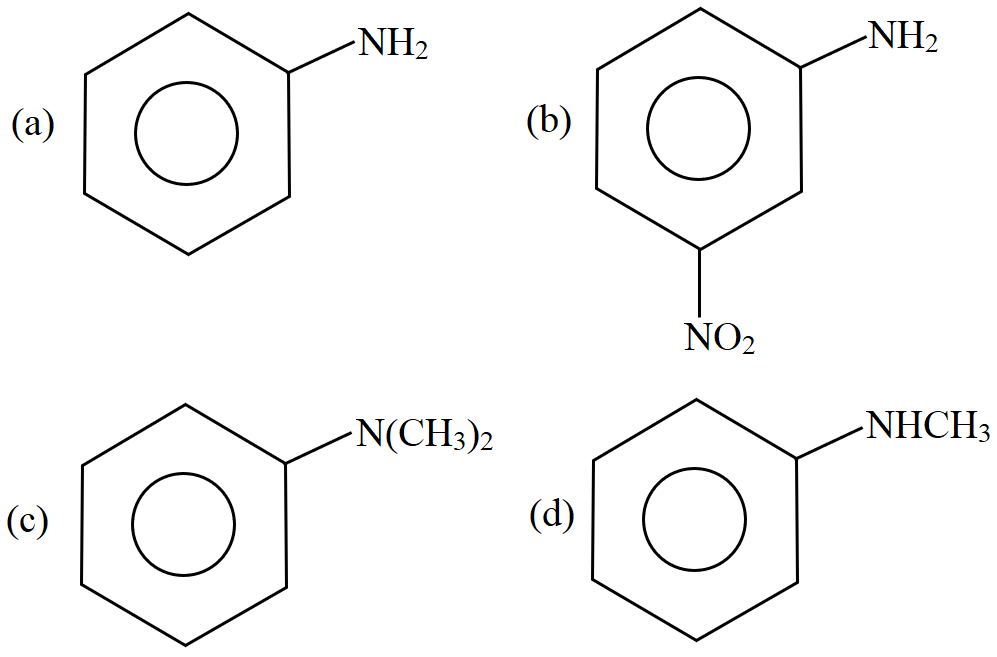
  1. Which of the following has lowest $pK_b$ value?
  1. The strongest base among the following is:
  1. $C_6H_5NH_2$
  2. $p-NO_2 - C_6H_4NH_2$
  3. $m-NO_2 - C_6H_4NH_2$
  4. $C_6H_5CH_2NH_2$
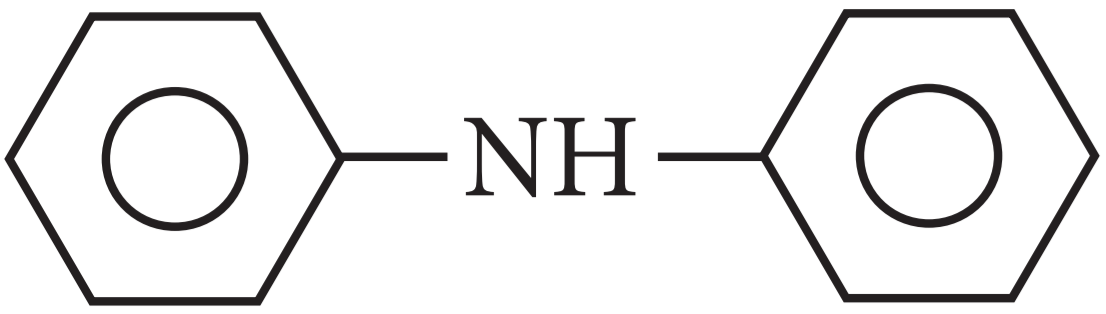
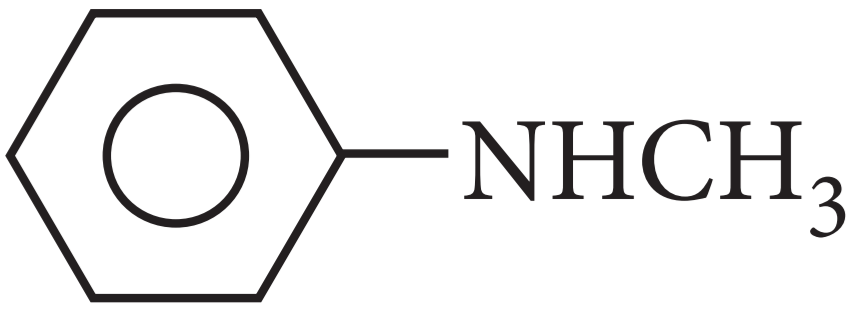
  1. Maximum $pK_b​​​​​​​$​​​​​​​ value of:
  1.  
  1.  
  1. $(CH_3CH_2)_2NH$
  2. $(CH_3)_2NH$
  1. The order of basic strength among the following amines in benzene solution is:
  1. Methylamine is more basic than $NH_3$.
  2. Amines form hydrogen bonds.
  3. Ethylamine has higher boiling point than propane.
  4. Dimethylamine is less basic than methylamine.
  1. $CH_3CH_2NH_2$ contains a basic $-NH_2$ group, but $CH_3CONH_2$​​​​​​​ does not because:
  1. Acetamide is amphoteric in character.
  2. In ethylamine the electron pair on N-atom is delocalised by resonance.
  3. In ethylamine there is no resonance while in acetamide the lone pair of electrons on N-atom is delocalised and is less available for protonation.
  4. None of these.