Question
Read the passage given below and answer the following questions:
The transition elements have incompletely filled d-subshells in their ground state or in any of their oxidation states. The transition elements occupy position in betweens- and p-blocks in groups 3-12 of the Periodic table. Starting from fourth period, transition elements consists of four complete series : Sc to Zn, Y to Cd and La, Hf to Hg and Ac, Rf to Cn. In general, the electronic configuration of outer orbitals of these elements is (n - 1)d1-10 n1-2. The electronic configurations of outer orbitals of Zn, Cd, Hg and Cn are represented by the general formula (n - 1)d10ns2. All the transition elements have typical metallic properties such as high tensile strength, ductility, malleability. Except mercury, which is liquid at room temperature, other transition elements have typical metallic structures. The transition metals and their compounds also exhibit catalytic property and paramagnetic behaviour. Transition metal also forms alloys. An alloy is a blend of metals prepared by mixing the components. Alloys may be homogeneous solid solutions in which the atoms of one metal are distributed randomly among the atoms of the other.
The following questions are multiple choice questions. Choose the most appropriate answer:
  1. Which of the following characteristics of transition metals is associated with higher catalytic activity?
  1. High enthalpy of atomisation.
  2. Variable oxidation states.
  3. Paramagnetic behaviour.
  4. Colour of hydrated ions.
  1. Transition elements form alloys easily because they have.
  1. Same atomic number.
  2. Same electronic configuration.
  3. Nearly same atomic size.
  4. Same oxidation states.
  1. The electronic configuration of tantalum (Ta) is:
  1. [Xe]4f05d16s2
  2. [Xe]4f145d26s2
  3. [Xe]4f145d36s2
  4. [Xe]4f145d46s2
  1. Which one of the following outer orbital configurations may exhibit the largest number of oxidation states?
  1. 3d54s1
  2. 3d54s2
  3. 3d24s2
  4. 3d34s2
  1. The correct statement(s) among the following is/ are:
  1. All d and f-block elements are metals.
  2. All d and f-block elements form coloured ions.
  3. All d and f-block elements are paramagnetic.
  1. (I) only
  2. (I) and (II) only
  3. (II) and (III) only
  4. (I), (II) and (III)

Answer

  1. (b) Variable oxidation states.

Explanation:

The transition metals and their compounds are known for their catalytic activity. This activity is ascribed to their ability to adopt multiple oxidation states to form complexes.

  1. (c) Nearly same atomic size.

Explanation:

Because of similar radii and other characteristics of transition metals, alloys are readily formed by these metals.

  1. (c) [Xe]4f145d36s2
  2. (b) 3d54s2

Explanation:

Greater the number of valence electrons, more will be the number of oxidation states exhibited by the element.

  1. (a) (i) only

Explanation:

All the d-block elements are metals, they exhibit most properties of metals like lustre, malleability, ductility, high density, high melting and boiling point, hardness, conduction of heat and electricity, etc. All the f-block elements are also metals but they are not good conductors of heat and electricity.

Need a full question paper?

Generate a complete, print-ready paper with questions like this in minutes — across 16+ boards, with answer keys.

Start Generating Free

Similar questions

Read the passage given below and answer the following questions:

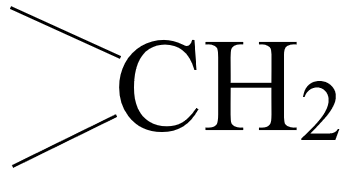
Aldehydes and ketones are reduced to primary and secondary alcohols respectively by NaBH4 or LiAlH4 as well as catalytic hydrogenation. The carbonyl group of aldehydes and ketones is reduced to  group on treatment with Zn-Hg and cone. HCl (Clemmensen reduction) or with hydrazine followed by NaOH or KOH in highly boiling solvent such as ethylene glycol (Wolff-Kishner reduction).Aldehydes differ from ketones in their oxidation reactions. Aldehydes are easily oxidised to carboxylic acids on treatment with HNO3, KMnO4, K2Cr2O7 etc. Even mild oxidising agents mainlyTollens' reagent and Fehling's solution also oxidise aldehydes. Ketones are generally oxidised under vigorous conditions i.e., strong oxidising agents and at elevated temperatures, to give mixture of carboxylic acids having lesser number of C-atoms than the parent ketone.
The following questions are multiple choice questions. Choose the most appropriate answer:

  1. Which of the following cannot be made by reduction of ketone or aldehyde with NaBH4 in methanol?
  1. 1-Butanol
  2. 2-Butanol
  3. 2-Methyl-1-propanol
  4. 2-Methyl-2-propanol
  1. The carbonyl compound producing an optically active product by reaction with LiAlH4 is:
  1. Propanone
  2. Butanone
  3. 3-pentanone
  4. Benzophenone
  1. A substance C4H10O (X) yields on oxidation a compound C4H8O which gives an oxime and a positive iodoform test. The substance X on treatment with cone. H2SO4 gives C4H8. The structure of the compound (X) is:
  1. CH3CH2CH2CH2OH
  2. CH3CH(OH)CH2CH3
  3. (CH3)3COH
  4. CH3CH- O - CH2CH3
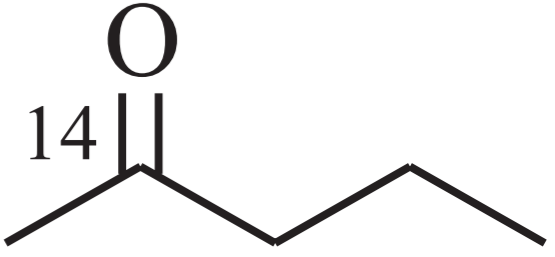
  1. In the oxidation of  by acidified K2Cr2O7, the products are:
  1. $\ \ \ \ \ \ \ \ \ \ \ \ \ \ \ \ \text{O}\\\ \ \ \ \ \ \ \ \ \ \ \ \ \ \ \ ||\\\text{CH}_3-\ ^\text{14}\text{C}-\text{OH}$ and $\text{CH}_3\text{CH}_2\text{COOH}$

  2. $\ \ \ \ \ \ \ \ \ \ \ \ \ \ \ \ \ \ \ \ \ \ \ \ \ \ \ \ \ \ \ \ \ \ \ \ \text{O}\\ \ \ \ \ \ \ \ \ \ \ \ \ \ \ \ \ \ \ \ \ \ \ \ \ \ \ \ \ \ \ \ \ \ \ \ \ \ ||\\\text{CH}_3(\text{CH}_2)_2\text{COOH}-\text{C}-\text{OH}$ and $ \ \ \ \ \ \ \ 14\\\text{CH}_3\text{CH}_2\text{COOH}$

  3. $\ \ \ \ \ \ \ \ \ \ \ \ \ \ \ \ \ \ \ \ \ \ \ \ \ \ \ \ \ \ \ \ \ \ \ \ \ \ \ \ \ \ 14\\\text{CH}_3\text{CH}_2\text{CH}_2\text{COOH}+\text{HCOOH}$

  4. None of these.

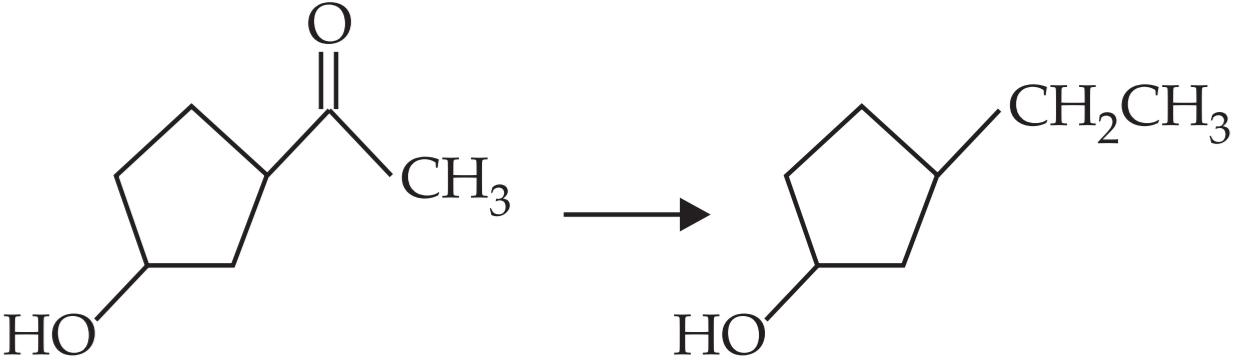
  1. The appropriate reagent for the following transformation is:

  1. $\text{Na}_2\text{NH}_2,^-\text{OH}$

  2. $\text{NaBH}_4$

  3. $\frac{\text{H}_2}{\text{Ni}}$

  4. $\text{AICl}_3$

Read the passage given below and answer the following questions:
At 298 K, the vapour pressure of pure benzene, C6, H6 is 0.256 bar and the vapour pressure of pure toluene C6 H5 CH3 is 0.0925 bar. Two mixtures were prepared as follows:
  1. 7.8g of C6 H6 + 9.2g of toluene
  2. 3.9g of C6 H6 + 13.8g of toluene
The following questions are multiple choice questions. Choose the most appropriate answer:
  1. The total vapour pressure (bar) of solution I is.
  1. 0.128
  2. 0.174
  3. 0.198
  4. 0.258
  1. Which of the given solutions have higher vapour pressure?
  1. I
  2. II
  3. Both have equal vapour pressure
  4. Cannot be predicted
  1. Mole fraction of benzene in vapour phase in solution I is.
  1. 0.128
  2. 0.174
  3. 0.734
  4. 0.266
  1. Which of the following statements is/are correct?
  1. Mole fraction of toluene in vapour phase is more in solution I.
  2. Mole fraction of toluene in vapour phase is less in solution I.
  3. Mole fraction of benzene in vapour phase is less in solution I.
  1. Only II
  2. Only I
  3. I and III
  4. II and III
  1. Solution I is an example of a/an.
  1. Ideal solution.
  2. Non-ideal solution with positive deviation.
  3. Non-ideal solution with negative deviation.
  4. Can't be predicted.
Read the passage given below and answer the following questions:

Carboxylic acids having an $\alpha$-hydrogen atom when treated with chlorine or bromine in the presence of small amount of red phosphorus gives $\alpha$-halocarboxytic acids. The reaction is known as Hell-Volhard-Zelinsky reaction.

$\text{R}-\text{CH}_2-\text{COOH}+\text{X}_2\xrightarrow{\text{red p}}\text{R}-\text{CH}-\text{COOH}\\ \ \ \ \ \ \ \ \ \ \ \ \ \ \ \ \ \ \ \ \ \ \ \ \ \ \ \ \ \ \ \ \ \ \ \ \ \ \ \ \ \ \ \ \ \ \ \ \ \ \ \ \ \ \ \ \ \ \ \ \ \ |\\ \ \ \ \ \ \ \ \ \ \ \ \ \ \ \ \ \ \ \ \ \ \ \ \ \ \ \ \ \ \ \ \ \ \ \ \ \ \ \ \ \ \ \ \ \ \ \ \ \ \ \ \ \ \ \ \ \ \ \ \ \text{X}\\ \ \ \ \ \ \ \ \ \ \ \ \ \ \ \ \ \ \ \ \ \ \ \ \ \ \ \ \ \ \ \ \ \ \ \ \ \ \ \ \ \ \ \ \ \ \ \ \ \ \ \ \ \ \ (\text{X = Cl, Br)}$

When sodium salt of carboxylic acid is heated with soda lime it loses carbon dioxide and gives hydrocarbon with less number of C-atoms.

$\text{R}-\text{COOH}\xrightarrow{\text{NaOH}}\text{R}-\text{COONa}\xrightarrow[\Delta]{\text{NaOH}+\text{CaO}}\text{R}-\text{H}+\text{Na}_2\text{CO}_3\\\text{Carboxylic}\ \ \ \ \ \ \ \ \ \ \ \ \ \ \ \ \ \ \ \ \ \text{Sod.}\ \ \ \ \ \ \ \ \ \ \ \ \ \ \ \ \ \ \ \ \ \ \ \ \ \ \ \ \ \text{Alkane}\\\ \ \ \ \ \text{acid}\ \ \ \ \ \ \ \ \ \ \ \ \ \ \ \ \ \ \ \ \ \ \text{carboxylate}$

In these questions (Q. No. l-iv), a statement of assertion followed by a statement ofreason is given. Choose the correct answer out of the following choices.

  1. Assertion and reason both are correct statements and reason is correct explanation for assertion.
  2. Assertion and reason both are correct statements but reason is not correct explanation for assertion.
  3. Assertion is correct statement but reason is wrong statement.
  4. Assertion is wrong statement but reason is correct statement.
  1. Assertion: (CH3)3CCOOH does not give H.V.Z reaction.

Reason: (CH3)3CCOOH does not have $\alpha$-hydrogen atom.

  1. Assertion: H.V.Z. reaction involves the treatment of carboxylic acids having $\alpha$-hydrogens with Cl2 or Br2 in presence of small amount of red phosphorus.

Reason: Phosphorus reacts with halogens to form phosphorus trihalides.

  1. Assertion: Propionic acid with $\frac{\text{Br}_2}{\text{P}}$ yields CH2Br - CHBr - COOH.

Reason: Propionic acid has two $\alpha$-hydrogen atoms.

  1. Assertion: C6H5COCH2COOH undergoes decarboxylation easily than C6H5COCH2COOH.

Reason: C6H5COCH2COOH is $\beta$-keto acid.

  1. Assertion: On heating 3-methylbutanoic acid with soda lime, isobutane is obtained.

Reason: Soda lime is a mixture of NaOH + CaO in the ratio 3 : 1.

Read the passage given below and answer the following questions:

Transition elements are elements that have partially filled d-orbitals. The configuration of these elements corresponds to (n - 1)d1-10ns1-2. It is important to note that the elements mercury, cadmium and zinc are not considered transition elements because of their electronic configurations, which corresponds to (n - 1)d10ns2. Some general properties of transition elements are:

These elements can fonn coloured compounds and ions due to d-d transition;

These elements exhibit many oxidation states;

A large variety of ligands can bind themselves to these elements, due to this, a wide variety of stable complexes formed by these ions. The boiling and melting point of these elements are high. These elements have a large ratio of charge to the radius.

In these questions (Q. No. i-iv), a statement of assertion followed by a statement ofreason is given. Choose the correct answer out of the following choices.

  1. Assertion and reason both are correct statements and reason is correct explanation for assertion.
  2. Assertion and reason both are correct statements but reason is not correct explanation for assertion.
  3. Assertion is correct statement but reason is wrong statement.
  4. Assertion is wrong statement but reason is correct statement.
  1. Assertion: Tungsten has very high melting point.

Reason: Tungsten is a covalent compound.

  1. Assertion: Zn, Cd and Hg are normally not considered transition metals.

Reason: d-Orbitals in Zn, Cd and Hg elements are completely filled, hence these metals do not show the general characteristics properties of the transition elements.

  1. Assertion: Copper metal gets readily corroded in acidic aqueous solution such as HCl and dil. H2SO4.

Reason: Free energy change for this process is positive.

  1. Assertion: Tailing of mercury occurs on passing ozone through it.

Reason: Due to oxidation of mercury.

  1. Assertion: Transition metals are poor reducing agents.

Reason: Transition metals fonn numerous alloys with other metals.

Read the passage given below and answer the following questions:
When a protein in its native form, is subjected to physical changes like change in temperature or chemical changes like change in pH, the hydrogen bonds are disturbed. Due to this, globules unfold and helix get uncoiled and protein loses its biological activity. This is called denaturation of protein.
The denaturation causes change in secondary and tertiary structures but primary structures remains intact. Examples of denaturation of protein are coagulation of egg white on boiling, curdling of milk, formation of cheese when an acid is added to milk.
The following questions are multiple choice questions. Choose the most appropriate answer:
  1. Mark the wrong statement about denaturation of proteins.
  1. The primary structure of the protein does not change.
  2. Globular proteins are converted into fibrous proteins.
  3. Fibrous proteins are converted into globular proteins.
  4. The biological activity of the protein is destroyed.
  1. Which structure(s) of proteins remains(s) intact during denaturation process?
  1. Both secondary and tertiary structures.
  2. Primary structure only.
  3. Secondary structure only.
  4. Tertiary structure only.
  1. $\alpha$-helix and $\beta$-pleated structures of proteins are classified as:
  1. Primary structure.
  2. Secondary structure.
  3. Tertiary structure.
  4. Quaternary structure.
  1. Cheese is a:
  1. Globular protein.
  2. Conjugated protein.
  3. Denatured protein.
  4. Derived protein.
  1. Secondary structure of protein refers to:
  1. Mainly denatured proteins and structure of prosthetic groups.
  2. Three-dimensional structure, especially the bond between amino acid residues that are distant from each other in the polypeptide chain.
  3. Linear sequence of amino acid residues in the polypeptide chain.
  4. Regular folding patterns of continuous portions of the polypeptide chain.
Read the passage given below and answer the following questions:

Fehling's reagent: Fehling's reagent is a mixture of two solutions. Fehllng's solution A is aqueous copper sulphate solution. Fehling's solution Bis alkaline sodium potassium tartarate (Rochelle salt).

$\ \ \ \ \ \ \ \ \ \ \ \ \ \ \ \ \ \ \ \ \text{CH(OH)COONa}\\\text{CuSo}_{4\text{(aq)}}+|\\\ \ \ \ \ \ \ \ \ \ \ \ \ \ \ \ \ \ \ \ \text{CH(OH)COOK}$

It is a mild oxidising agent. It is weaker than Tollens' reagent. It oxidises only aliphatic aldehydes to carboxylate ions and itself gets reduced to reddish brown precipitate of cuprous oxide. Aromatic aldehydes do not respond to Fehling's test. This reaction is used for the test of aliphatic aldehydes known as Fehling's reagent test.

In these questions (Q. No. l-iv), a statement of assertion followed by a statement ofreason is given. Choose the correct answer out of the following choices.

  1. Assertion and reason both are correct statements and reason is correct explanation for assertion.
  2. Assertion and reason both are correct statements but reason is not correct explanation for assertion.
  3. Assertion is correct statement but reason is wrong statement.
  4. Assertion is wrong statement but reason is correct statement.
  1. Assertion: Fehling's solution can be used to distinguish between acetaldehyde and acetone.

Reason: Fehling's reagent is a mixture of two solutions.

  1. Assertion: Aromatic aldehydes can be distinguished from aliphatic aldehydes by Fehling's solution.

Reason: Aromatic aldehydes reduce Fehling's solution, but aliphatic aldehydes do not.

  1. Assertion: Fehling's solution oxidises acetaldehyde to acetic acid but not benzaldehyde to benzoic acid.

Reason: The C-H bond of -CHO group in benzaldehyde is stronger than in acetaldehyde.

  1. Assertion: CH3CHO and C6H5CH2CHO cannot be distinguished chemically by Fehling's solution.

Reason: CH3CHO and C6H5CH2CHO cannot be distinguished chemically by Fehling's solution.

  1. Assertion: Formaldehyde, when heated with Fehling's reagent produces a reddish brown ppt, of Cu.

Reason: Fehling's reagent oxidises fonnaldehyde to formate ion.

Read the passage given below and answer the following questions
Few colligative properties are:
  1. Relative lowering of vapour pressure: depends only on molar concentration of solute (mole fraction) and independent of its nature.
  2. Depression in freezing point: it is proportional to the molal concentration of solution.
  3. Elevation of boiling point: it is proportional to the molal concentration of solute.
  4. Osmotic pressure: it is proportional to the molar concentration of solute
A solution of glucose is prepared with 0.052 g at glucose in 80.2 g of water.(KJ = 1.86K kg mol-1 and Kb = 5.2K kg mol-1)
The following questions are multiple choice questions. Choose the most appropriate answer:
  1. Molality of the given solution is.
  1. 0.0052m
  2. 0.0036m
  3. 0.0006m
  4. 1.29m
  1. Boiling point for the solution will be.
  1. 373.05K
  2. 373.15K
  3. 373.02K
  4. 373.02K
  1. The depression in freezing point of solution will be.
  1. 0.0187K
  2. 0.035K
  3. 0.082K
  4. 0.067K
  1. Mole fraction of glucose in the given solution is.
  1. 6.28 × 10⁻⁵
  2. 6.28 × 10⁻⁴
  3. 0.00625
  4. 0.00028
  1. If same amount of sucrose (C12 H22 O11) is taken instead of glucose, then.
  1. Elevation in boiling point will be higher.
  2. Depression in freezing point will be higher.
  3. Depression in freezing point will be lower.
  4. Both (a) and (b).
Read the passage given below and answer the following questions:
The unique behaviour of Cu, having a positive E° accounts for its inability to liberate H2 from acids. Only oxidising acids (nitric and hot concentrated sulphuric acid) react with Cu, the acids being reduced. The stability of the half-filled (d5) subshell in Mn2+ and the completely filled (d10) configuration in Zn2+ are related to their $\text{E}^\circ\frac{\text{M}^{3+}}{\text{M}^{2+}}$ values. The low value for Sc reflects the stability of Sc3+ which has a noble gas configuration. The comparatively high value for Mn shows that Mn2+(d5) is particularly stable, whereas a comparatively low value for Fe shows the extra stability of Fe3+(d5). The comparatively low value for Vis related to the stability of v2+ (half-filled t2g level).
The following questions are multiple choice questions. Choose the most appropriate answer:
  1. Standard reduction electrode potential of $\frac{\text{Zn}^{2+}}{\text{Zn}}$ is 0.76V. This means
  1. ZnO cannot be reduced to Zn by H2 under standard conditions.
  2. Zn cannot liberate H2 with concentrated acids.
  3. Zn is generally the anode in an electrochemical cell.
  4. Zn is generally the cathode in an electrochemical cell.
  1. $\text{E}^\circ$ values for the couples $\frac{\text{Cr}^{3+}}{\text{Cr}^{2+}}$ and $\frac{\text{Mn}^{3+}}{\text{Mn}^{2+}}$ are -0.41 and +1.51 volts respectively. These values suggest that.
  1. Cr2+ acts as a reducing agent whereas Mn3+ acts as an oxidizing agent.
  2. Cr2+ is more stable th an Cr3+ state.
  3. Mn3+ is more stable than Mn2+.
  4. Cr2+ acts as an oxidizing agent whereas Mn3+ acts as a reducing agent..
  1. The reduction potential values of M, N and O are +2.46, -1.13 and -3.13V respectively. Which of the following order is correct regarding their reducing property?
  1. O > N > M
  2. O > M > N
  3. M > N > O
  4. M > O > N
  1. Which of the following statements are true?
  1. Mn2+ compounds are more stable than Fe2+ towards oxidation to +3 state.
  2. Titanium and copper both in the first series of transition metals exhibits +1 oxidation state most frequently.
  3. Cu+ ion is stable in aqueous solutions.
  4. The $\text{E}^\circ$ value for the $\frac{\text{Mn}^{3+}}{\text{Mn}^{2+}}$ couple is much more positive than that for $\frac{\text{Cr}^{3+}}{\text{Cr}^{2+}}$ or $\frac{\text{Fe}^{3+}}{\text{Fe}^{2+}}.$.
  1. (II) and (III)
  2. (I) and (IV)
  3. (I) and (III)
  4. (II) and (IV)
  1. The stability of $\text{Cu}^{2+}_\text{(aq)}$ rather than $\text{Cu}^{+}_\text{(aq)}$ is due to.
  1. More negative $\Delta_\text{hyd}\text{H}^\circ$ of $\text{Cu}^{2+}_\text{(aq)}.$
  2. Less negative $\Delta_\text{hyd}\text{H}^\circ$ of $\text{Cu}^{2+}_\text{(aq)}.$
  3. More positive $\Delta_\text{hyd}\text{H}^\circ$ of $\text{Cu}^{2+}_\text{(aq)}.$
  4. Less positive $\Delta_\text{hyd}\text{H}^\circ$ of $\text{Cu}^{2+}_\text{(aq)}.$
For a first order reaction, A → Products, $\text{k}=\frac{2.303}{\text{t}}\log\frac{\text{a}}{\text{a}-\text{x}},$ where a is the initial concentration of A and (a - x) is the concentration of A after time t. k is rate constant. Its value is constant at constant temperature for a reaction. The time in which half of the reactant is consumed is called half-life period. Half-life period of a first order reaction is constant. Its value is independent of initial concentration or any other external conditions.

In these questions (Q. No. i-iv), a statement of assertion followed by a statement ofreason is given. Choose the correct answer out of the following choices.

  1. Assertion and reason both are correct statements and reason is correct explanation for assertion.
  2. Assertion and reason both are correct statements but reason is not correct explanation for assertion.
  3. Assertion is correct statement but reason is wrong statement.
  4. Assertion is wrong statement but reason is correct statement.
  1. Assertion: Rate of reaction doubles when concentration of reactant is doubled if it is a first order reaction.

Reason: Rate constant also doubles.

  1. Assertion: For the first order reaction, half-life period is expressed as $\text{t}_\frac{1}{2}=\frac{2.303}{\text{k}}\log2.$

Reason: The half-life time of a first order reaction is not always constant and it depends upon the initial concentration of reactants.

  1. Reason: The half-life time of a first order reaction is not always constant and it depends upon the initial concentration of reactants.

Reason: Acid only acts as a catalyst whereas alkali acts as one of the reactants.

  1. Assertion: For a first order reaction, the concentration of the reactant decreases exponentially with time.

Reason: Rate of reaction at any time depends upon the concentration of the reactant at that time.

  1. Assertion: Half-life period for a first order reaction is independent of initial concentration of the reactant.

Reason: For a first order reaction, $\text{t}_\frac{1}{2}=\frac{0.693}{\text{k}},$ where k is rate constant.