Question
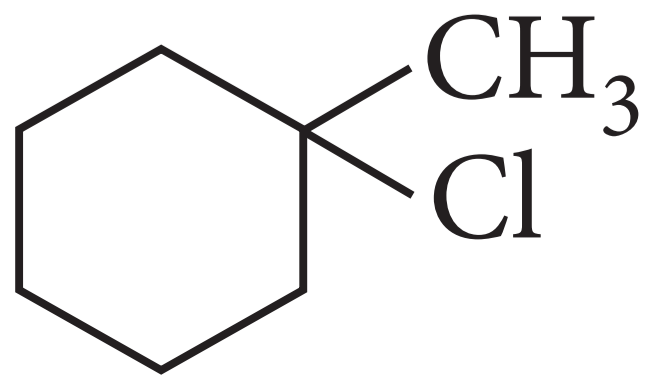 is more reactive than
 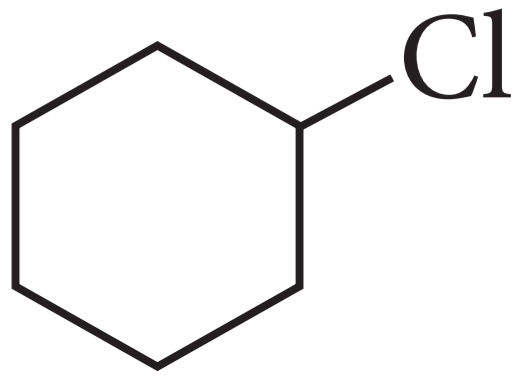 towards nucleophilic substitution reactions.
✓
Answer
- (b) Assertion and reason both are correct statements but reason is not correct explanation for assertion.
Explanation:
Primary benzylic halides show higher reactivity in SN1 reactions than primary alkyl halides. This is due to the greater stabilisation of the benzylic carbocation intermediates by resonance.
- (a) Assertion and reason both are correct statements and reason is correct explanation for assertion.
- (a) Assertion and reason both are correct statements and reason is correct explanation for assertion.
Explanation:
On comparing the relative stabilities of carbanion of chlorobenzene and p-chloroanisole,
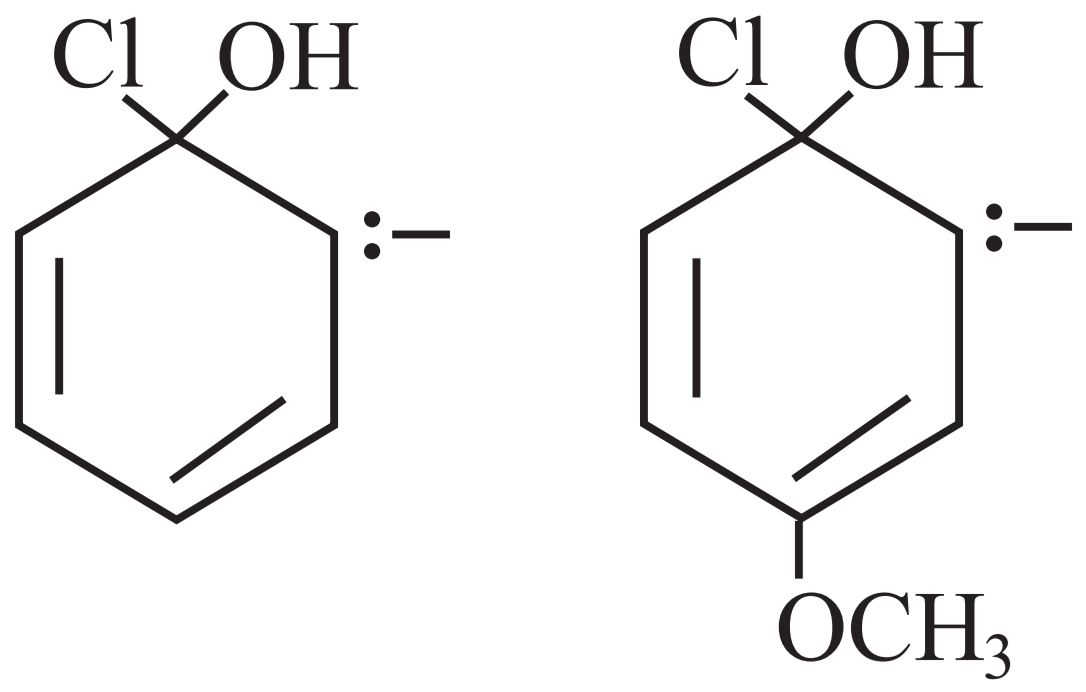
The electron donating group (OCH3) in anisole tends to intensify the negative charge relative to carbanion in chlorobenzene. Thus, p-chloroanisole is less reactive than chlorobenzene.
- (b) Assertion and reason both are correct statements but reason is not correct explanation for assertion.
Explanation:
As compared to chlorobenzene, the intermediate carbanion resulting from 4-nitrochlorobenzene is stabilized by-R-effect of the N02 group.
- (c) Assertion is correct statement but reason is wrong statement.
Explanation:
Chlorobenzene is less reactive than benzene towards the electrophilic substitution reactions due to -I effect.
Need a full question paper?
Generate a complete, print-ready paper with questions like this in minutes — across 16+ boards, with answer keys.
Explore more
Similar questions
→→→
→


The half-life of a reaction is the time required for the concentration of reactant to decrease by half, i.e.,
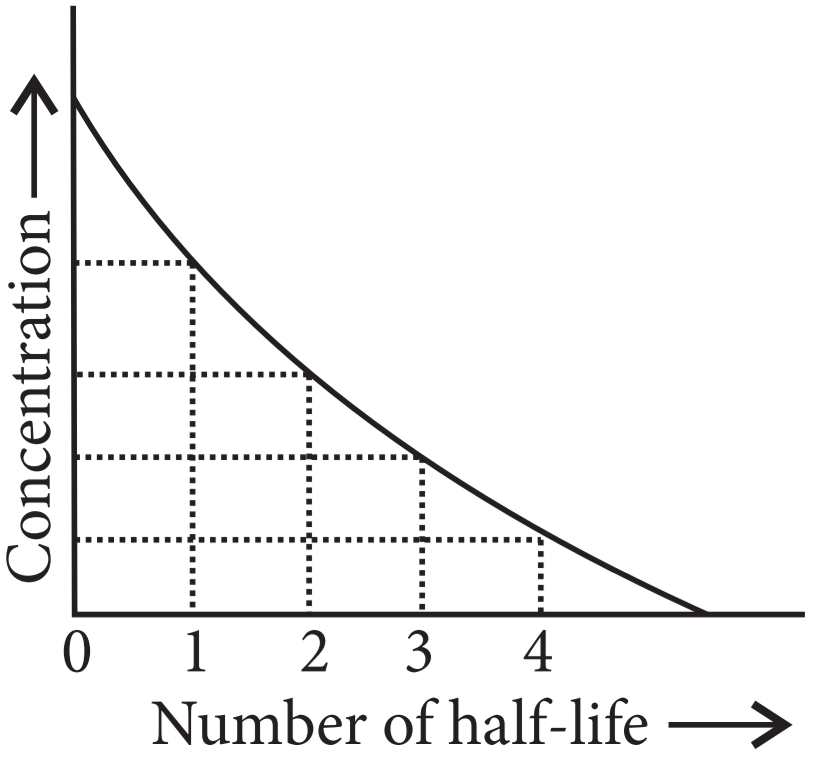
$[\text{A}]_\text{t}=\frac{1}{2}[\text{A}]$
For first order reaction,
$\text{t}_\frac{1}{2}=\frac{0.693}{\text{k}}$
this means $\text{t}\frac{1}{2}$ is independent of initial concentration. Figure shows that typical variation of concentration of reactant exhibiting first order kinetics. It may be noted that though the major portion of the first order kinetics may be over in a finite time, but the reaction will never cease as the concentration of reactant will be zero only at infinite time.
The following questions are multiple choice questions. Choose the most appropriate answer:
- A first order reaction has a rate constant k = 3.01 × 10⁻³ /s. How long it will take to decompose half of the reactant?
- 2.303s
- 23.03s
- 230.3s
- 2303s
- The rate constant for a first order reaction is 7.0 × 10⁻⁴ s-1. If initial concentration ofreactant is 0.080 M, what is the half life of reaction?
- 990s
- 79.2s
- 12375s
- 10.10 × 10⁻⁴s
- For the half-life period of a first order reaction, which one of the following statements is generally false?
- It is independent of initial concentration.
- It is independent of temperature.
- It decreases with the introduction of a catalyst.
- None of these.
- The rate of a first order reaction is 0.04 mol L-1 s-1 at 10 minutes and 0.03 mol L-1 s-1 at 20 minutes after initiation. The half-life of the reaction is:
- 4.408 min
- 44.086 min
- 24.086 min
- 2.408 min
The plot of $\text{t}_\frac{1}{2}$ vs initial concentration [A]0 for a first order reaction is given by:

Explain the structure of nucleic acid compounds.
For the reaction : $2\text{NO}_\text{(g)}+\text{Cl}_{2\text{(g)}}\rightarrow2\text{NOCl}_\text{(g)},$ the following data were collected. All the measurements were taken at 263K.
The following questions are multiple choice questions. Choose the most appropriate answer:
→→→| Experiment No. | Initial [NO] (M) | Initial [Cl2] (M) | Initial rate of disapp. of Cl2 (M/ min) |
| 1. | 0.15 | 0.15 | 0.60 |
| 2. | 0.15 | 0.30 | 1.20 |
| 3. | 0.30 | 0.15 | 2.40 |
| 4. | 0.25 | 0.25 | ? |
- The molecularity of the reaction is:
- 1
- 2
- 3
- 4
- The expression for rate law is:
- $\text{r}=\text{k}[\text{NO}][\text{Cl}_2]$
- $\text{r}=\text{k}[\text{NO}]^2[\text{Cl}_2]$
- $\text{r}=\text{k}[\text{NO}][\text{Cl}_2]^2$
- $\text{r}=\text{k}[\text{NO}]^2[\text{Cl}_2]^2$
- The overall order of the reaction is:
- 2
- 0
- 1
- 3
- The value of rate constant is:
- 150.32 M-2 min-1
- 200.08 M-1 min-1
- 177.77 M-2 min-1
- 155.75 M-1 min-1
- The initial rate of disappearance of Cl2 in experiment 4 is:
- 1.75M min-1
- 3.23M min-1
- 2.25M min-1
- 2.77M min-1
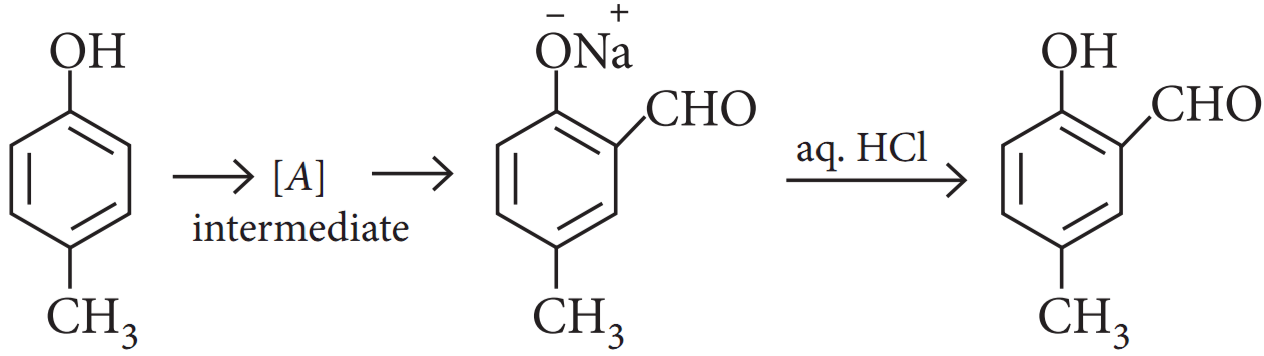
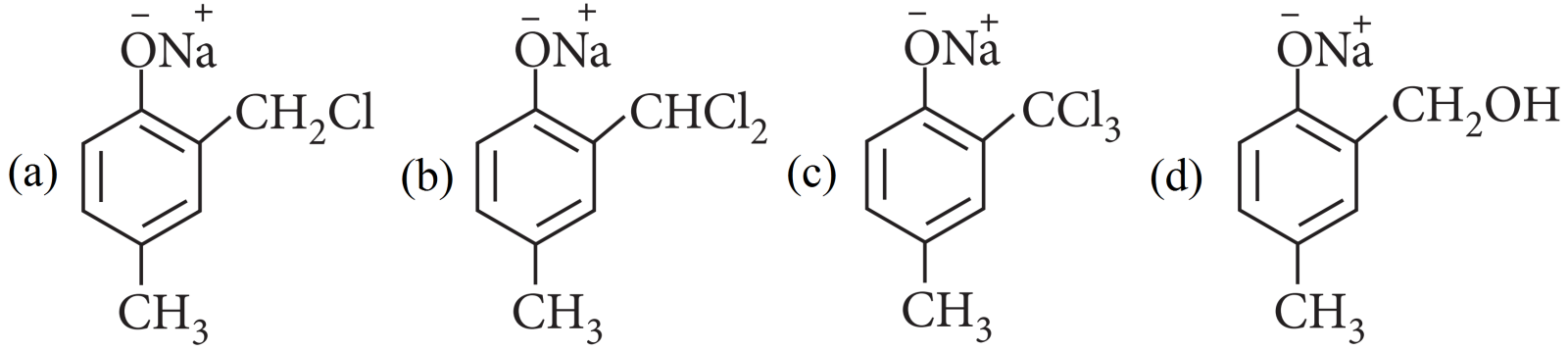
Read the passage given below and answer the following questions:
In haloalkanes, when a nucleophile stronger than the halide ion approaches the positively charged carbon atom of an alkyl halide, the halogen atom along with its bonding electron pair gets displaced and a new bond with the carbon and the nucleophile is formed. These reactions are called nucleophilic substitution reactions.
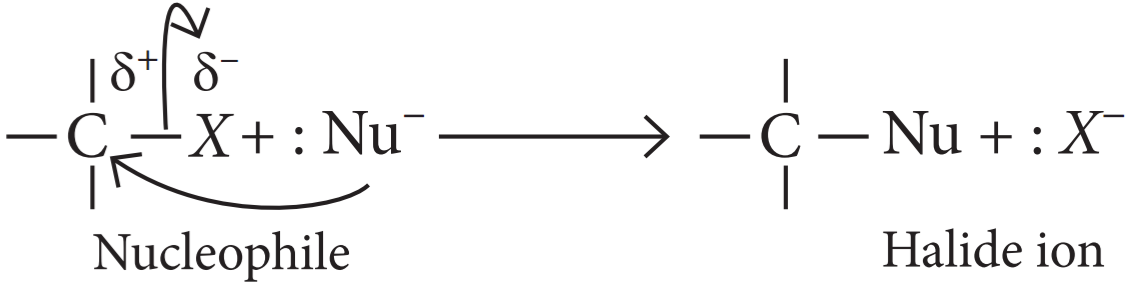
In these reactions the atom or group of atoms which loses its bond from carbon and takes on an additional pair of electrons is called leaving group. Halide ions are good leaving groups. Some important nucleophilic substitution reactions ofhaloalkanes with common nucleophiles are given in the table below.
Reagent | Nucleophile (Nu-) | Substitution product R-Nu | Class of main product | |
1. | NaOH or KOH or moist Ag2O | -OH | ROH | Alcohol |
2. | H2O | H2O | ROH | Alcohol |
3. | Nal | I- | R – I | Alkyl iodide |
4. | R'NH2 | $\text{R'}\ddot{\text{N}}\text{H}_2$ | RNHR' | Sec. amine |
5. | KCN | $\overline{\text{C}}\equiv\text{N}:$ | RCN | Nitrile (cyanide) |
6. | KNO2 | O = N – O- | R – O – N = O | Alkvl nitrite |
In these questions (Q. No. i-iv), a statement of assertion followed by a statement ofreason is given. Choose the correct answer out of the following choices.
- Assertion and reason both are correct statements and reason is correct explanation for assertion.
- Assertion and reason both are correct statements but reason is not correct explanation for assertion.
- Assertion is correct statement but reason is wrong statement.
- Assertion is wrong statement but reason is correct statement.
- Assertion: Alkyl halides are hydrolysed to alcohols by moist silver oxide.
Reason: RCI is hydrolysed to ROH easily but reactions slow down on addition of KI.
- Assertion: Alkyl halides fonn alkenes when heated above 300ºC.
Reason: CH3CH21 reacts slowly with strong base as compared to CD3CH2I.
- Assertion: RBr reacts with AgNO2 to give nitroalkane.
Reason: Silver nitrite (AgNO2) is an ionic compound, therefore the negative charge on nitrogen is the attacking site.
- Assertion: The nucleophilic substitution of vinyl chloride is difficult than ethyl chloride.
Reason: Vinyl group is electron donating group.
- Assertion: 2-Bromobutane on reaction with sodium ethoxide in ethanol gives 1-butene as the major product.
Reason: 1-Butene is less stable than 2-butene.
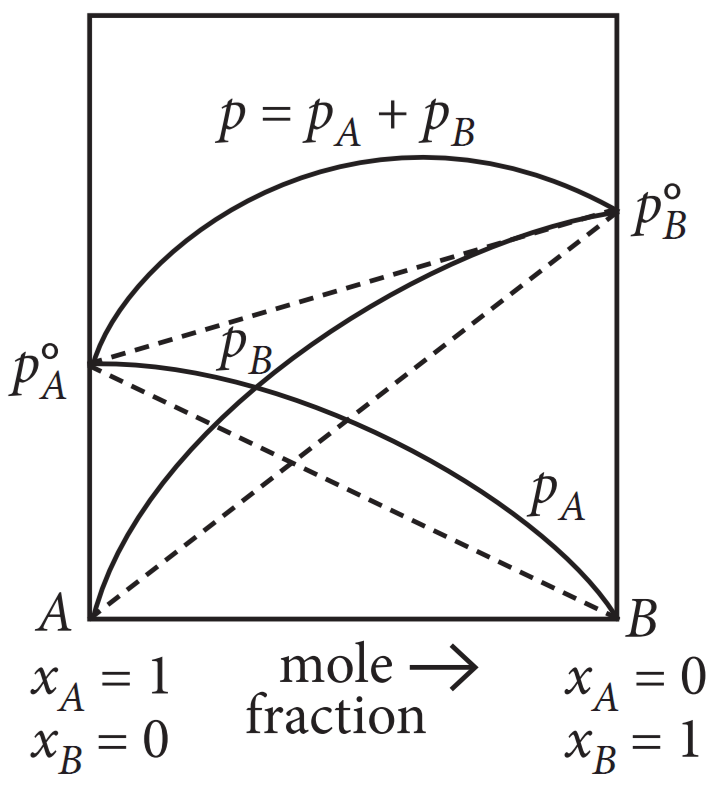
Read the passage given below and answer the following questions: An ideal solution may be defined as the solution which obeys Raoult's law exactly over the entire range of concentration. The solutions for which vapour pressure is either higher or lower than that predicted by Raoult's law are called non-ideal solutions.Non-ideal solutions can show either positive or negative deviations from Raoult's law depending on whether the A-B interactions in solution are stronger or weaker than A - A and B - B interactions. The following questions are multiple choice questions. Choose the most appropriate answer:
→- Which of the following solutions is/are ideal solution(s)?
- Bromoethane and iodoethane.
- Acetone and chloroform
- Benzene and acetone
- n-heptane and n-hexane
- Only I
- I and II
- II and III
- I and Iv
- For which of the following solutions $\Delta\text{H}_{\text{mix}}$ and $\Delta\text{V}_{\text{mix}}$ is negative?
- Acetone and aniline
- Ethyl alcohol and cyclohexane
- Acetone and CS2
- Benzene and toluene
- Which of the following is not true for positive deviations?
- The A-B interactions in solution are weaker than the A - A and B - B interactions.
- $\text{P}_\text{A}<\text{P}\mathring{\text{A}}\ \text{x}_\text{A}$ and $\text{P}_\text{B}<\text{P}\mathring{\text{B}}\ \text{x}_\text{B}$
- Carbon tetrachloride and chloroform mixture is an example of positive deviations.
- All of these.
- For water and nitric acid mixture, which of the given graph is correct?
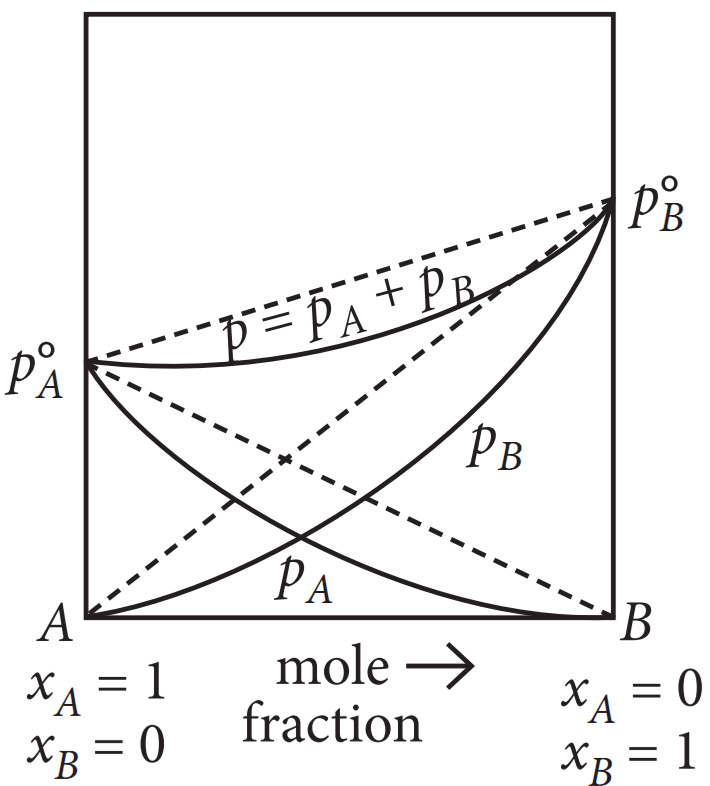
- Both of these
- None of these
- Water-HCI mixture.
- Shows positive deviations.
- Forms minimum boiling azeotrope.
- Shows negative deviations.
- Forms maximum boiling azeotrope.
- I and II
- I and III
- I and IV
- III and IV
Read the passage given below and answer the following questions:
Valence bond theory considers the bonding between the metal ion and the ligands as purely covalent. On the other hand, crystal field theory considers the metal-ligand bond to be ionic arising from electrostatic interaction between the metal ion and the ligands. In coordination compounds, the interaction between the ligand and the metal ion causes the five d-orbitals to split-up. This is called crystal field splitting and the energy difference between the two sets of energy level is called crystal field splitting energy. The crystal field splitting energy $(\Delta_0)$ depends upon the nature of the ligand. The actual configuration of complexes is divided by the relative values of $\Delta_0$ and P (pairing energy).
If $\Delta_0<\text{P},$ then complex will be high spin.
If $\Delta_0>\text{P},$ then complex will be low spin
The following questions are multiple choice questions. Choose the most appropriate answer:
→Valence bond theory considers the bonding between the metal ion and the ligands as purely covalent. On the other hand, crystal field theory considers the metal-ligand bond to be ionic arising from electrostatic interaction between the metal ion and the ligands. In coordination compounds, the interaction between the ligand and the metal ion causes the five d-orbitals to split-up. This is called crystal field splitting and the energy difference between the two sets of energy level is called crystal field splitting energy. The crystal field splitting energy $(\Delta_0)$ depends upon the nature of the ligand. The actual configuration of complexes is divided by the relative values of $\Delta_0$ and P (pairing energy).
If $\Delta_0<\text{P},$ then complex will be high spin.
If $\Delta_0>\text{P},$ then complex will be low spin
The following questions are multiple choice questions. Choose the most appropriate answer:
- Which of the following ligand has lowest $\Delta_0$ value?
- CN-
- CO
- F-
- NH3
- The crystal field splitting energy for octahedral $(\Delta_0)$ and tetrahedral $(\Delta_t)$ complex is related as:
- $\Delta_\text{t}=\frac{1}{2}\Delta_0$
- $\Delta_\text{t}=\frac{4}{9}\Delta_0$
- $\Delta_\text{t}=\frac{3}{5}\Delta_0$
- $\Delta_\text{t}=\frac{2}{5}\Delta_0$
- On the basis of crystal field theory, the electronic configuration of d4 in two situations : (i) t.0 > P and (ii) t.0
| (i) | (ii) | |
| (a) | $\text{t}^4_{2\text{g}}\text{e}^0_\text{g}$ | $\text{t}^3_{2\text{g}}\text{e}^1_\text{g}$ |
| (b) | $\text{t}^3_{2\text{g}}\text{e}^1_\text{g}$ | $\text{t}^4_{2\text{g}}\text{e}^0_\text{g}$ |
| (c) | $\text{t}^3_{2\text{g}}\text{e}^1_\text{g}$ | $\text{t}^3_{2\text{g}}\text{e}^1_\text{g}$ |
| (d) | $\text{t}^4_{2\text{g}}\text{e}^0_\text{g}$ | $\text{t}^4_{2\text{g}}\text{e}^0_\text{g}$ |
- Using crystal field theory, calculate magnetic moment of central metal ion of [FeF6]4-.
- 1.79B.M.
- 2.83B.M.
- 3.85B.M.
- 4.9B.M.
- Electronic configuration of d-orbitals in [Ti(H2O)6]3+ ion in an octahedral crystal field is:
- $\text{t}^1_{2\text{g}}\text{e}^0_\text{g}$
- $\text{t}^2_{2\text{g}}\text{e}^0_\text{g}$
- $\text{t}^0_{2\text{g}}\text{e}^1_\text{g}$
- $\text{t}^1_{2\text{g}}\text{e}^1_\text{g}$
A reaction in which rate ofreaction is independent of concentration of the reactants is called zero order reaction. Photochemical combination of hydrogen and chlorine to give hydrogen chloride is an example of zero order reaction. The rate constant of a zero order reaction is equal to the rate of reaction. The half life period of a zero order reaction is directly proportional to initial concentration of the reactant. For a zero order reaction, $\text{k}=\frac{1}{\text{t}}\left\{[\text{A}]-[\text{A}]\right\}$ In these questions (Q. No. i-iv), a statement of assertion followed by a statement of reason is given. Choose the correct answer out of the following choices.
→- Assertion and reason both are correct statements and reason is correct explanation for assertion.
- Assertion and reason both are correct statements but reason is not correct explanation for assertion.
- Assertion is correct statement but reason is wrong statement.
- Assertion is wrong statement but reason is correct statement.
- Assertion: For a zero order reaction, plot of rate vs concentration will be a straight line parallel to concentration axis.
Reason: For a zero order reaction, rate is independent of concentration.
- Assertion: Photochemical combination of hydrogen and chlorine to give hydrogen chloride is an example of zero order reaction.
Reason: The rate of reaction depends on the concentration of hydrogen and independent of concentration of chlorine.
- Assertion: If in a zero order reaction, the concentration of the reactant is doubled, the half-life period is also doubled.
Reason: For a zero order reaction, the rate of reaction is independent of initial concentration.
- Assertion: ln a reaction A → products, the concentration of the reactant is reduced to zero after a finite time.
Reason: The order of reaction is zero.
- Assertion: Rate constant of a zero order reaction has same units as the rate of reaction.
Reason: Rate constant of a zero order reaction does not depend on the unit of concentration.