Question
Read the passage given below and answer the following questions:
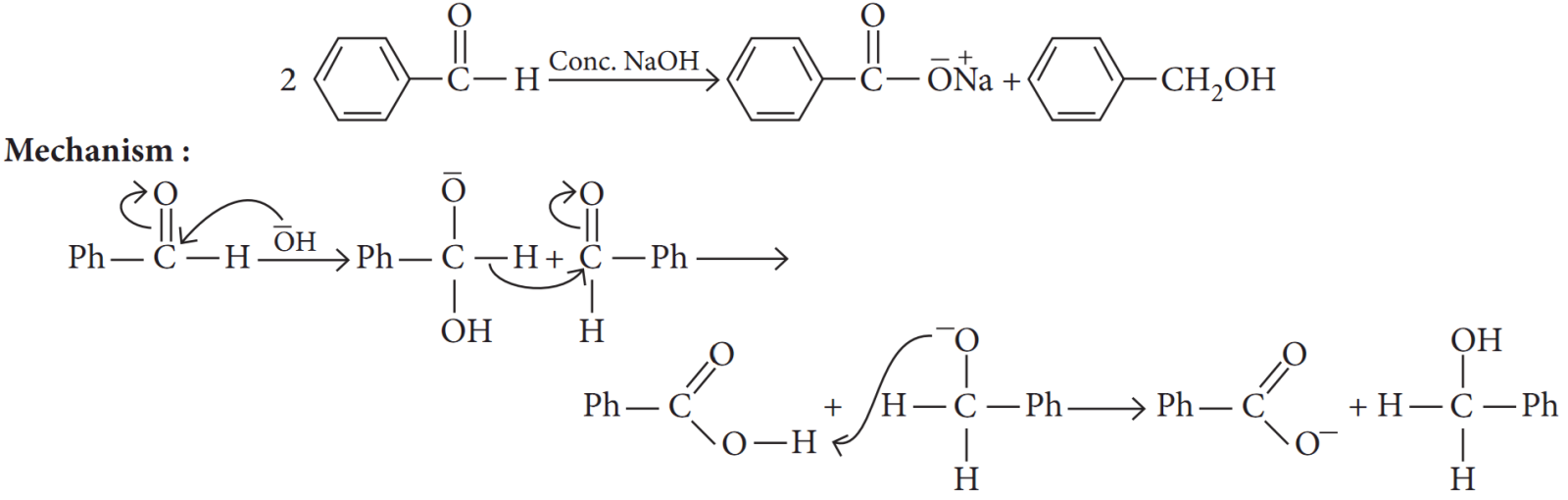
When an aldehyde with no et-hydrogen reacts with concentrated aqueous $NaOH$, half the aldehyde is converted to carboxylic acid salt and other half is converted to an alcohol. In other words, half of the reactant is oxidized and other half is reduced. This reaction is known as Cannizzaro reaction.
The following questions are multiple choice questions. Choose the most appropriate answer:
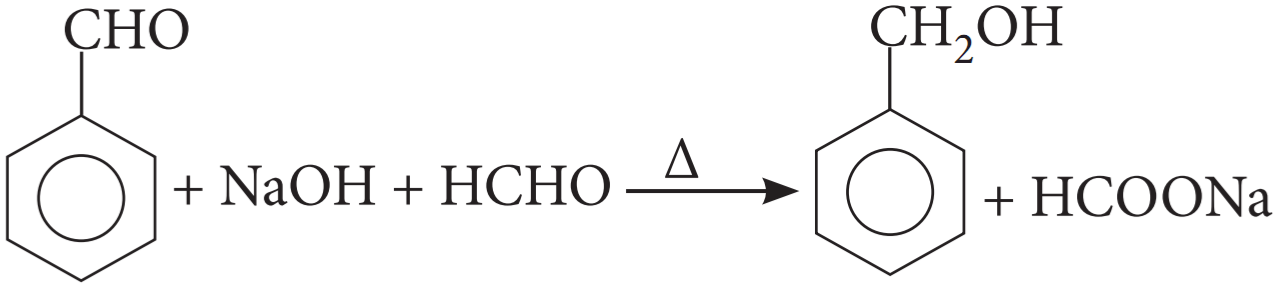
  1. A mixture of benzaldehyde and formaldehyde on heating with aqueous $NaOH$ solution gives:
  1. Benzyl alcohol and sodium formate.
  2. Sodium benzoate and methyl alcohol.
  3. Sodium benzoate and sodium formate.
  4. Benzyl alcohol and methyl alcohol.
  1. Which of the following compounds will undergo Cannizzaro reaction?
  1. $CH_3CHO$
  2. $CH_3COCH_3$
  3. $C_6H_5CHO$
  4. $C_6H_5CH_2CHO$
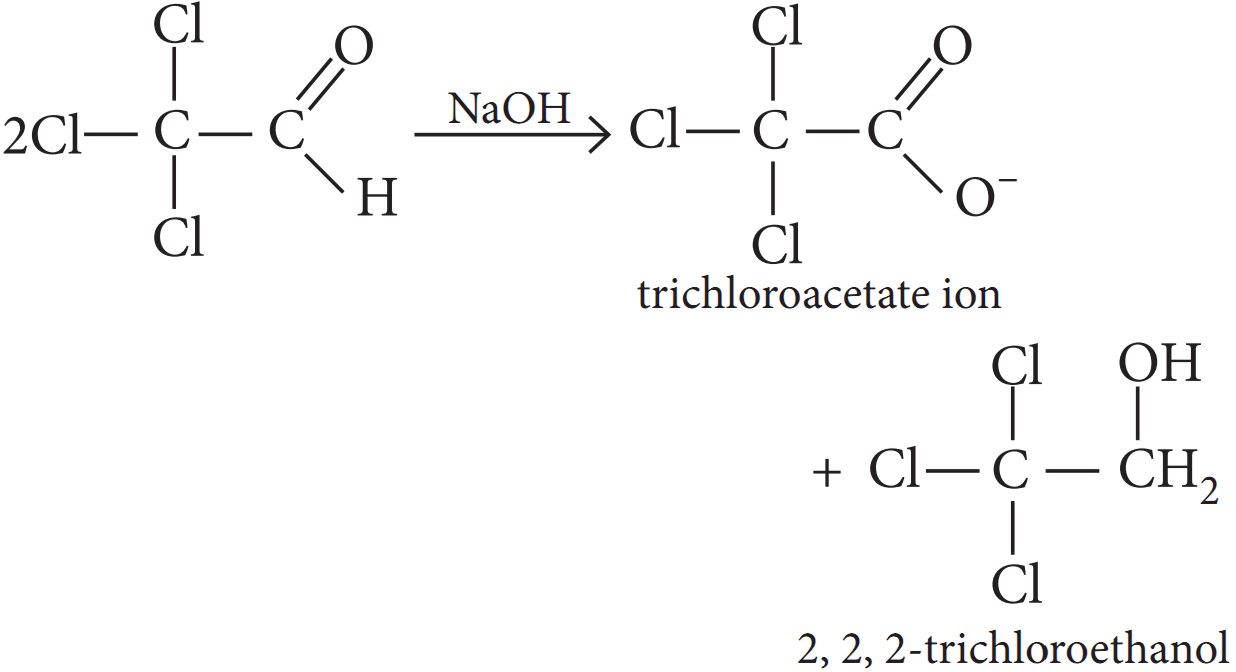
  1. Trichloroacetaldehyde is subjected to Cannizzaro's reaction by using NaOH. The mixture of the products contains sodium trichloroacetate ion and another compound. The other compounds is:
  1. 2, 2, 2-trichloroethanol.
  2. Trichloromethanol.
  3. 2, 2, 2-trichloropropanol.
  4. Chloroform.
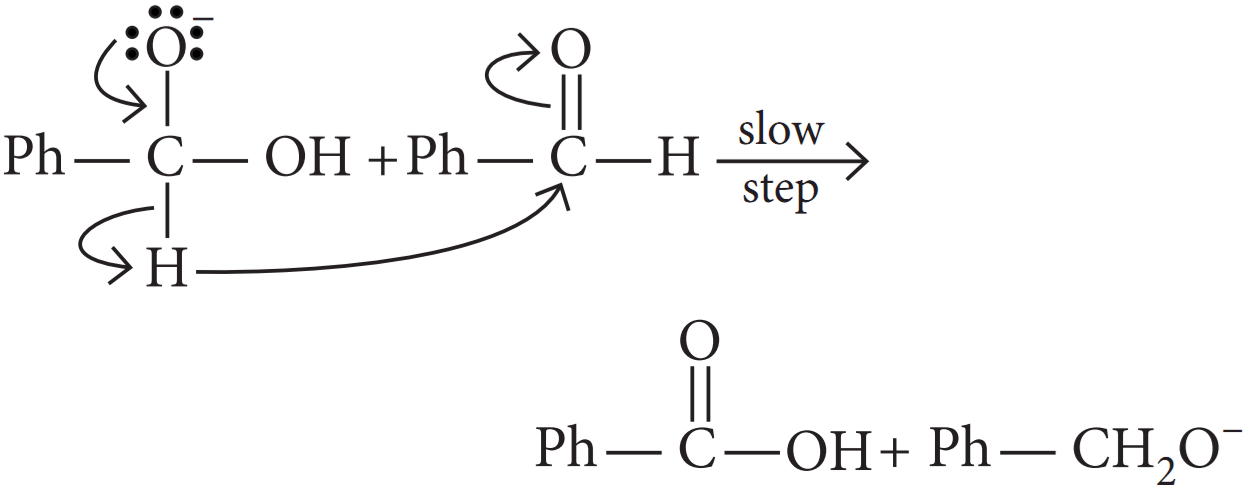
  1. In Cannizzaro reaction given below:
$2\text{PhCHO}\xrightarrow{\stackrel{-}{\hbox{ OH}}}\text{PhCH}_2+\text{OH}+\text{PhCO}_2^-$ the slowest step is:
  1. The attack $^-OH$ at the carboxyl group.
  2. The transfer of hydride to the carbonyl group.
  3. The abstraction of proton from the carboxylic group.
  4. The deprotonation of $PhCH_2OH$.
  1. Which of the following reaction will not result in the formation of carbon-carbon bonds?
  1. Cannizzaro reaction.
  2. Wurtz reaction.
  3. Reimer-Tiemann reaction.
  4. Friedel-Crafts' acylation.

Answer

  1. (a) Benzyl alcohol and sodium formate.
Explanation:
It is an example of cross Cannizzaro reaction where aromatic aldehyde gets reduced to alcohol and aliphatic aldehyde gets oxidised to its sodium salt (both aldehydes must not contain any $\propto-$hydrogen).
  1. (c) $C_6H_5CHO$
  2. (a) 2, 2, 2-trichloroethanol.
Explanation:

The Cannizzaro product of given reaction yields 2, 2, 2-trichloroethanol.
  1. (b) The transfer of hydride to the carbonyl group.
​​​​​​​Explanation:
Hydride transfer is the slowest step.
  1. (a) Cannizzaro reaction.
​​​​​​​​​​​​​​​​​​​​​​​​​​​​Explanation:
C-C bond is not formed in Cannizzaro reaction while other reactions result in the formation of C-C bond.

Need a full question paper?

Generate a complete, print-ready paper with questions like this in minutes — across 16+ boards, with answer keys.

Start Generating Free

Similar questions

Read the passage given below and answer the following questions:
The f-block elements are those in which the differentiating electron enters the $(n -2)f$ orbital. There are two series of F-block elements corresponding to filling of $4f $ and $5f-$orbitals. The series of $4f-$orbitals is called lanthanides. Lanthanides show different oxidation states depending upon stability of $f^0, f^7$ and $F^{14}$ configurations, though the most conunon oxidation states is $+3$. There is a regular decrease in size oflanthanides ions with increase in atomic number which is known as lanthanide contraction.
The following questions are multiple choice questions. Choose the most appropriate answer:
  1. The atomic numbers of three lanthanide elements $X, Y$ and $Z$ are $65, 68$ and $70$ respectively, their $Ln^{3+}$ electronic configuration is:
  1. $4f^8, 4f^{11}, 4f^{13}$
  2. $4f^{11}, 4f^8, 4f^{13}$
  3. $4f^0, 4f^2, 4f^{11}$
  4. $4f^3, 4f^7, 4f^9$
  1. Lanthanide contraction is observed in:
  1. $Gd$
  2. $At$
  3. $Xe$
  4. $Te$
  1. Which of the following is not the configuration oflanthanoid?
  1. $[Xe]4f^{10}6s^2$
  2. $[Xe]4f^15d^16s^2$
  3. $[Xe]4d^{14}5d^{10}6s^2$
  4. $[Xe]4f^75d^16s^2$
  1. Name a member of the lanthanoid series which is well known to exhibit +4 oxidation state.
  1. Cerium $(Z = 58)$
  2. Europium $(Z = 63)$
  3. Lanthanum $(Z = 57)$
  4. Gadolinium $(Z = 64)$
  1. Identify the incorrect statement among the following.
  1. Lanthanoid contraction is the accumulation of successive shrinkages.
  2. The different radii of $Zr$ and $Hf$ due to consequence of the lanthanoid contraction.
  3. Shielding power of $4f$ electrons is quite weak.
  4. There is a decrease in the radii of the atoms or ions as one proceeds from La to Lu.
Read the passage given below and answer the following questions:
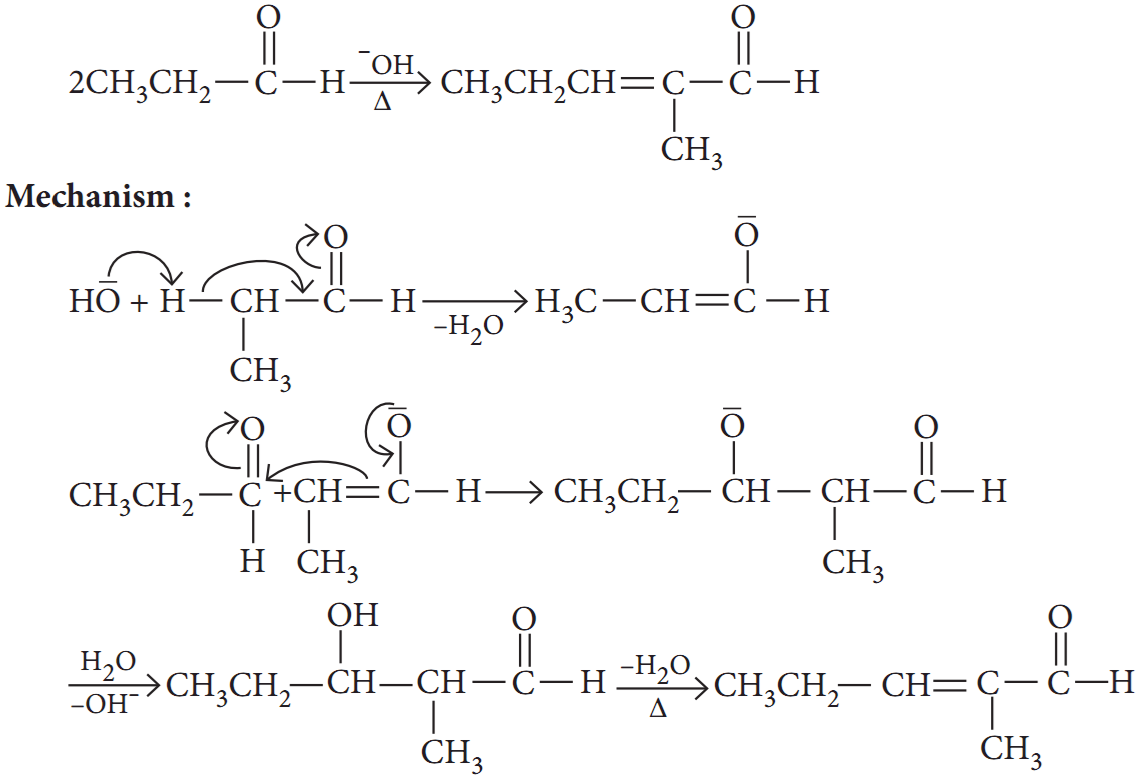
The addition reaction of enol or enolate to the carbonyl functional group of aldehyde or ketone is known as aldol addition. The $\beta-$ hydroxyaldehyde or $\beta-$hydroxyketone so obtained undergo dehydration in second step to produce a conjugated enone. The first part of reaction is an addition reaction and the second part is an elimination reaction. Carbonyl compound having $\propto-$hydrogen undergoes aldol condensation reaction.

The following questions are multiple choice questions. Choose the most appropriate answer:
  1. Condensation reaction is the reverse of which of the following reaction?
  1. Lock and key hypothesis.
  2. Oxidation.
  3. Hydrolysis.
  4. Glycogen formation.
  1. Which of the following compounds would be the main product of an aldol condensation of acetaldehyde and acetone?
  1. $CH_3CH = CHCHO$
  2. $CH_3CH = CHCOCH_3$
  3. $(CH_3)_2C = CHCHO$
  4. $(CH_3)_2C = CHCOCH_3$
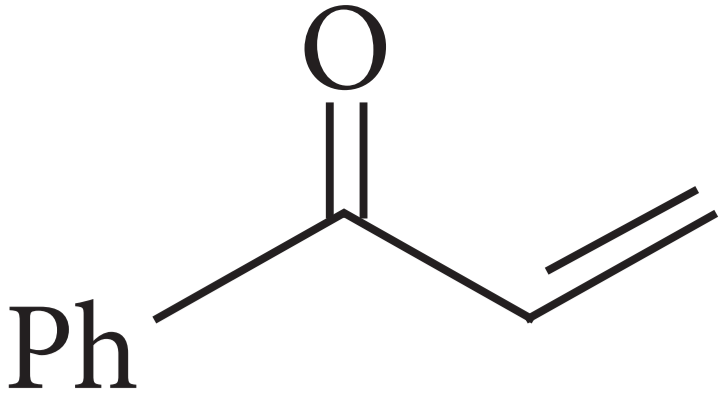
  1. Which combination of carbonyl compounds gives phenyl vinyl ketone by an aldol condensation?
  1. Acetophenone and Formaldehyde.
  2. Acetophenone and acetaldehyde.
  3. Benzaldehyde and acetaldehyde.
  4. Benzaldehyde and acetone.
  1. Which of the following will undergo aldol condensation?
  1. $HCHO$
  2. $CH_3CH_2OH$
  3. $C_6H_5CHO$
  4. $CH_3CH_2CHO$
  1. Which of the following does not undergo aldol condensation?
  1. $CH_3CHO$
  2. $CH_3CH_2CHO$
  3. $CH_3COCH_3$
  4. $C_3H_2CHO$
In these questions, a statement of assertion followed by a statement of reason is given. Choose the correct answer out of the following choices.
Assertion: Aqueous gold colloidal solution is red in colour.
Reason: The colour arises due to scattering of tight by colloidal gold particles.
What change in the concentration of H₂ will triple the rate of reaction?
(c). Suppose a reaction between A and B, was experimentally found to be first order with respect to both A and B. So the rate equation is:
Rate = k[A][B]
Which of these two mechanisms is consistent with this experimental finding? Why?
Mechanism 1
A → C + D (slow)
B+C → E (fast)
Mechanism 2
A+B →C + D (slow)
C → E (fast)
Explain the structure of nucleic acid compounds.
Decrease in concentration of reactant or increase in concentration of product per unit time is called rate of reaction. lt is of two types:
  1. Instantaneous rate of reaction: Rate of change of concentration of reactant or product at a particular time is called instantaneous rate of reaction.
$\text{r}_\text{inst.}=\frac{\text{dC}}{\text{dt}}$
where, dC = infinitely small change in concentration
dt = infinitely small change in time.
  1. Average rate of reaction: Ratio of change in concentration and time required for the change is average rate of reaction.
$\text{r}_\text{av}=\frac{\triangle\text{x}}{\triangle\text{t}}=\frac{\text{Change in concentration}}{\text{Time required for the change}}$
For a reaction of the type, $m_1A + m_2B → n_1C + n_2D$
Rate of reaction is given as
$\frac{1}{\text{m}_1}\frac{\text{d[A]}}{\text{dt}}=-\frac{1}{\text{m}_2}\frac{\text{d[B]}}{\text{dt}}=+\frac{1}{\text{n}_1}\frac{\text{d[C]}}{\text{dt}}=+\frac{1}{\text{n}_2}\frac{\text{d[D]}}{\text{dt}}$
In these questions (Q. No. i-iv), a statement of assertion followed by a statement ofreason is given. Choose the correct answer out of the following choices.
  1. Assertion and reason both are correct statements and reason is correct explanation for assertion.
  2. Assertion and reason both are correct statements but reason is not correct explanation for assertion.
  3. Assertion is correct statement but reason is wrong statement.
  4. Assertion is wrong statement but reason is correct statement.
  1. Assertion: The kinetics of the reaction, $\text{mA}+\text{nB}+\text{pC}\rightarrow\text{m}'\text{ X}+\text{n}'\text{ Y}+\text{p}'\text{ Z}$ obey the rate expression as $\frac{\text{dx}}{\text{dt}}=\text{k}[\text{A}]^\text{m}[\text{B}]^\text{n}.$
Reason: The rate of the reaction does not depend upon the concentration of C.
  1. Assertion: Instantaneous rate of reaction is equal to $\frac{\text{dx}}{\text{dt}}.$
Reason: lt is the rate of reaction at any particular instant of time.
  1. Assertion: For the reaction, $\text{RCl}+\text{NaOH}\rightarrow\text{ROH}+\text{NaCl},$ the rate of reaction is reduced to half on reducing the concentration of RCl to half.
Reason: The rate of reaction is represented by k[RCl].
  1. Assertion: ln rate law, unlike in the expression for equilibrium constants, the exponents for concentrations do not necessarily match the stoichiometric coefficients.
Reason: It is the mechanism and not the balanced chemical equation for the overall change that governs the reaction rate.
  1. Assertion: ln a reaction, $2A + B → A_2B$, the reactant B will disappear at twice the rate as A will decrease.
Reason: The rate of disappearance of reactant will be $-\frac{1}{2}\frac{\text{d[A]}}{\text{dt}}=-\frac{\text{d[B]}}{\text{dt}}$
Read the passage given below and answer the following questions
Few colligative properties are:
  1. Relative lowering of vapour pressure: depends only on molar concentration of solute (mole fraction) and independent of its nature.
  2. Depression in freezing point: it is proportional to the molal concentration of solution.
  3. Elevation of boiling point: it is proportional to the molal concentration of solute.
  4. Osmotic pressure: it is proportional to the molar concentration of solute
A solution of glucose is prepared with $0.052$ g at glucose in $80.2$ g of water. $\left(\mathrm{KJ}=1.86 \mathrm{~K} \mathrm{~kg} \mathrm{~mol}^{-1}\right.$ and $\left.\mathrm{K}_{\mathrm{b}}=5.2 \mathrm{~K} \mathrm{~kg} \mathrm{~mol}^{-1}\right)$ The following questions are multiple choice questions. Choose the most appropriate answer:
  1. Molality of the given solution is.
  1. $0.0052m$
  2. $0.0036m$
  3. $0.0006m$
  4. $1.29m$
  1. Boiling point for the solution will be.
  1. $373.05K$
  2. $373.15K$
  3. $373.02K$
  4. $373.02K$
  1. The depression in freezing point of solution will be.
  1. $0.0187K$
  2. $0.035K$
  3. $0.082K$
  4. $0.067K$
  1. Mole fraction of glucose in the given solution is.
  1. $6.28 \times 10^{-5}$
  2. $6.28 \times 10^{-4}$
  3. $0.00625$
  4. $0.00028$
  1. If same amount of sucrose $(C_{12} H_{22} O_{11})$ is taken instead of glucose, then.
  1. Elevation in boiling point will be higher.
  2. Depression in freezing point will be higher.
  3. Depression in freezing point will be lower.
  4. Both $(a)$ and $(b).$
Read the passage given below and answer the following questions:
Glucose is known as dextrose because it occurs in nature as the optically active dextrorotatory isomer. lt is essential constituent of human blood. The blood normally contains $65$ to $110mg$ of glucose per 100mL (hence named Blood sugar). The level may be much higher in diabetic persons. The urine of diabetic persons also contain considerable amount of glucose. ln combined form, it occurs in cane sugar and polysaccharides such as starch and cellulose.
Glucose has an aldehyde group $(-CHO)$, one primary alcoholic group $(-CH_2OH)$ and four secondary alcoholic groups $(-CHOH)$ in their structure. Due to the presence five hydroxyl groups $(-OH)$. glucose undergoes acetylation. Glucose also undergoes oxidation with mild oxidising agents like bromine water as well as with strong oxidising agents like nitric acid. Since glucose is readily oxidised, it acts as a strong reducing agent and reduces Tollen's reagent and Fehling solution. Glucose exists in two crystalline forms: $\alpha$-D-glucose and $\beta$-D-glucose. If either of the two forms is dissolved in water and allowed to stand, the specific rotation of the solution changes gradually, until a constant value is obtained. This change is called mutarotation.
A statement of assertion followed by a statement of reason is given. Choose the correct answer out of the following choices.
  1. Assertion and reason both are correct statements and reason is correct explanation for assertion.
  2. Assertion and reason both are correct statements but reason is not correct explanation for assertion.
  3. Assertion is correct statement but reason is wrong statement.
  4. Assertion is wrong statement but reason is correct statement.
  1. Assertion: A diabetic person carries a packet of glucose with him always.
Reason: Glucose increases the blood sugar level almost instantaneously.
  1. Assertion: On oxidation with nitric acid, glucose as well as gluconic acid both yield saccharic acid.
Reason: The pentaacetate of glucose does not react with hydroxylamine indicating the absence of free $-CHO$ group.
  1. Assertion: Glucose reacts with acetyl chloride to form pentaacetyl glucose.
Reason: The formation of pentaacetyl derivative confirms the presence of five $-OH$ groups in glucose.
  1. Assertion: A certain compound gives negative test with ninhydrin and positive test with Benedict's solution, the compound is an amino acid.
Reason: Glucose is a monosaccharide.
  1. Assertion: The rapid interconversion of $\alpha$-D-glucose and $\beta$-D-glucose in solution is known as racemisation.
Reason: Hydrolysis reaction will take place when a mineral acid is treated with sugar.
What is the most suitable pKa value of the substituted propylamine formed with substituent "X" with electronegativity 3.0
(i)10.67 (ii)10.08 (iii) 10.15 (iv)11.10
Read the passage given below and answer the following questions:
In ideally ionic structures, the coordination numbers of the ions are determined by electrostatic considerations. Cations surround themselves with as many anions as possible, and vice versa. This maximizes the attractions between neighbouring ions of opposite charge and hence maximizes the lattice energy of the crystal. This requirement led to the formulation of the radius ratio rule for ionic structures, in which the ions and the structure adopted for a particular compound depend on the relative sizes of the ions. Thus, for the stable ionic crystalline structures, there is definite radius ratio limit for a cation to fit perfectly in the lattice of anions, called radius ratio rule. This depends upon the ratio of radii of two types of ions $\frac{\text{r}_+}{r}$This ratio for coordination numbers $3, 4, 6$ and $8$ are respectively $0.155 - 0.225, 0.225 - 0.414, 0.414 - 0.732$ and $0.732 - 1.000$. The coordination number of ionic solids also depends upon temperature and pressure. On applying high pressure, coordination number increases. On the other hand, on applying high temperature, it decreases.
The following questions are multiple choice questions. Choose the most appropriate answer:
  1. The ionic radii of $K^+,Rb^+$ and $Br-$ are $137, 148$ and $195$pm. The coordination number of cation in RbBr and KBr structures are respectively.
  1. $8, 6$
  2. $6, 4$
  3. $6, 8$
  4. $4, 6$
  1. For a coordination number $4,$ the maximum limiting radius ratio is.
  1. $0.414$
  2. $0.732$
  3. $0.225$
  4. $0.155$
  1. If the radius of $Na^+$ ion is 95 pm and that of $Cl^-$ ion is $181$  pm, the coordination number of $Na^+$ ion is.
  1. $6$
  2. $4$
  3. $8$
  4. $12$
  1. Which is not the correct statement for ionic solids, in which positive and negative ions are held by strong electrostatic attractive forces?
  1. The radius ratio $\frac{\text{r}_+}{r}$ increases as coordination number increases.
  2. As the difference in size of ions increases, coordination number increases.
  3. When coordination number is eight, $\frac{\text{r}_+}{r}$ ratio lies between $0.225$ to $0.414.$
  4. In ionic solid of the type AX (ZnS, wurtzite), the coordination number of $Zn^2$ and $S^2$- respectively are $4 $and $4.$
  1. If the pressure of CsCl is increased, then its coordination number will.
  1. Increase
  2. Remain the same
  3. Decrease
  4. None of these.