Question
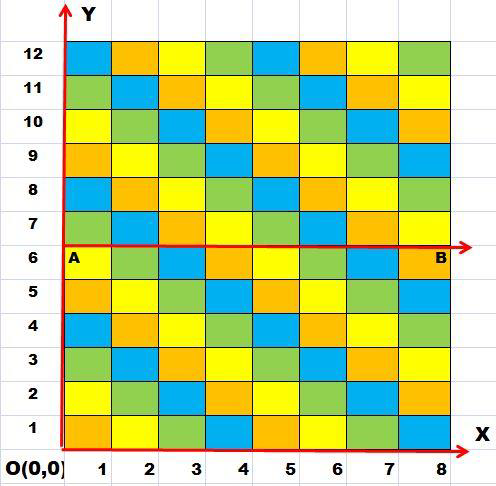
✓
Answer
| (i) | (c) | Green. |
| (ii) | (a) | Orange. |
| (iii) | (b) | Yellow. |
| (iv) | (d) | 48 foot2 |
| (v) | (b) | 12 |
Need a full question paper?
Generate a complete, print-ready paper with questions like this in minutes — across 16+ boards, with answer keys.
Explore more
Similar questions
→→→→→→
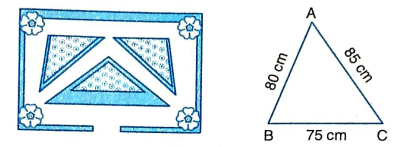
'Learning by doing' has great impact in teaching of Maths. Students also enjoy Mathematics by activity method. Mr. Paul, a Mathematics teacher has explained the topic of Lines and Angles by taking a very thin steel wire. He used steel wire and made some shapes at some specific angles and shown to students and asked questions.
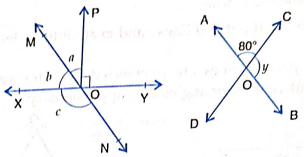
Choose the correct option in the following questions:
(i) What is the measure of $\angle B O D$ in figure?
(a) $90^{\circ}$$\quad$(b) $70^{\circ}$$\quad$(c) $80^{\circ}$$\quad$(d) $100^{\circ}$
(ii) What is measure of $\angle y$ in figure ?
(a) $110^{\circ}$$\quad$(b) $90^{\circ}$$\quad$(c) $140^{\circ}$$\quad$(d) $100^{\circ}$$\quad$
(iii) What is the measure of $\angle a$ and $\angle b$ respectively in Figure, if a : b = 2 : 3 and $O P \perp X Y$ ?
(a) $54^{\circ}, 36^{\circ}$$\quad$(b) $36^{\circ}, 54^{\circ}$$\quad$(c) $60^{\circ}, 90^{\circ}$$\quad$(d) $40^{\circ}, 60^{\circ}$
(iv) What is measure of $\angle c$ in figure ?
(a) $144^{\circ}$$\quad$(b) $90^{\circ}$$\quad$(c) $126^{\circ}$$\quad$(d) $120^{\circ}$
→Choose the correct option in the following questions:
(i) What is the measure of $\angle B O D$ in figure?
(a) $90^{\circ}$$\quad$(b) $70^{\circ}$$\quad$(c) $80^{\circ}$$\quad$(d) $100^{\circ}$
(ii) What is measure of $\angle y$ in figure ?
(a) $110^{\circ}$$\quad$(b) $90^{\circ}$$\quad$(c) $140^{\circ}$$\quad$(d) $100^{\circ}$$\quad$
(iii) What is the measure of $\angle a$ and $\angle b$ respectively in Figure, if a : b = 2 : 3 and $O P \perp X Y$ ?
(a) $54^{\circ}, 36^{\circ}$$\quad$(b) $36^{\circ}, 54^{\circ}$$\quad$(c) $60^{\circ}, 90^{\circ}$$\quad$(d) $40^{\circ}, 60^{\circ}$
(iv) What is measure of $\angle c$ in figure ?
(a) $144^{\circ}$$\quad$(b) $90^{\circ}$$\quad$(c) $126^{\circ}$$\quad$(d) $120^{\circ}$
Read the Source/ Text given below and answer these questions: In an effort to provide high-quality and safe playgrounds for kids, our reputable manufacturers adhere to the playground safety guidelines set forth by the Indian Consumer Product Safety Commission (CPSC) and the Indian Society for Advancement of Materials and Processing Engineering (ISAMPE). These organizations set the guidelines for determining the types of playground equipment that is appropriate for kids within specific age groups: 2-3 years, 3-5 years, 5-7 years, 7-10 years, 10-15 years, and 15-17 years. A random survey of the number of children of various age groups playing in a park was found as follows: 
The histogram is as given below: 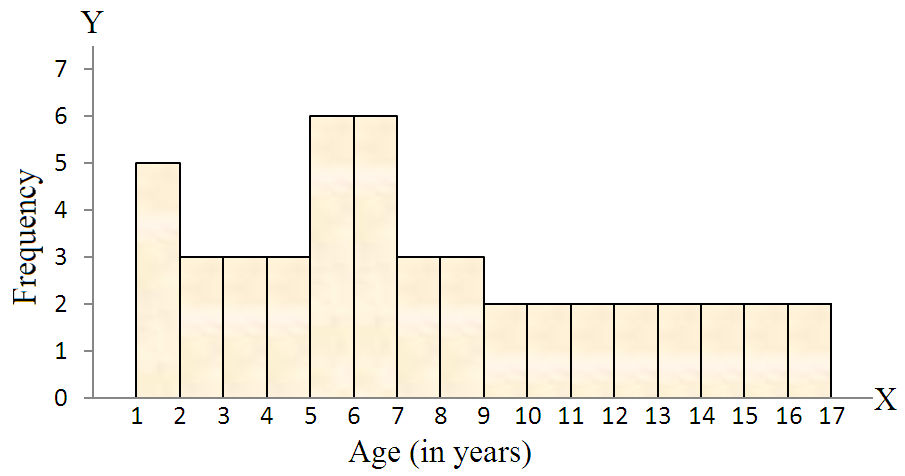
→→ | Age (in years) | Number of children |
|---|---|
| 1-2 | 5 |
| 2-3 | 3 |
| 3-5 | 6 |
| 5-7 | 12 |
| 7-10 | 9 |
| 10-15 | 10 |
| 15-17 | 4 |
- In this question, the class sizes are different. So, calculate the adjusted frequency for each class by using the following formula:
Frequency density or adjusted frequency for class:
- $\frac{\text{Minimum class size}}{\text{Class size of this class}}\times\text{Its Frequency}$
- $\frac{\text{Minimum class mark}}{\text{Class size of this class}}\times\text{Its Frequency}$
- $\frac{\text{Minimum Frequency}}{\text{Class size of this class}}\times\text{Its class size}$
- $\frac{\text{Minimum class mark}}{\text{Class mark of this class}}$
- In this question the minimum class size is:
- 0
- 1
- 2
- 3
- The class limits of third class interval 3-5:
- Lower limit = 5, upper limit = 3
- Lower limit = 5, upper limit = 7
- Lower limit = 3, upper limit = 5
- Lower limit = 7, upper limit = 5
- Adjusted Frequency for class interval 5-7 and 7-10:
- 3, 6
- 3, 3
- 6, 6
- 6, 3
- Find the class mark of class 15 - 17:
- 16
- 12
- 25
- 2
Given below is the map giving the position of four housing societies in a township connected by a circular road A.
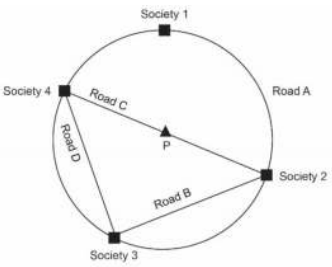
Society 2 and 3 are connected by straight road B, society 4 and 2 are connected by straight road C and society 4 and 3 are connected by road D. Point P denotes the position of a park. The park is equidistant to all four societies.
Rubina claims that it is not possible to construct another circular road connecting all four societies.
1. Which of the following options justiies Rubina’s claim?
A. Equal chords of congruent circles subtend equal angles at the centre.
B. The perpendicular from the centre of a circle to a chord bisects the chord.
C. There is a unique circle passing through three non-collinear points.
D. Points equidistant from a given point will lie on a circle.
2 What is the position of the park P with respect to road A?
A. Chord
B. Centre
C. Sector
D. Segment
3. The length of Road B is equal to the length of Road D.
Which of the following options can be true for the roads in the township?
A. Road B bisects Road D.
B. Road B and Road make an acute angle.
C. Road B, Road C and Road D are of equal length.
D. Road B and Road D subtend equal angles at society 1.
4. Alex says, “The angle made by road B on road D is a right angle.”
Jai and Angad give different justiications to support Alex’s claim.
Jai says, “Angles in the same segment of a circle are equal.”
Angad says, “The angle in a semicircle is a right angle.”
Who has given the correct justiication?
The figure below shows an equilateral triangle bounded by two straight lines.
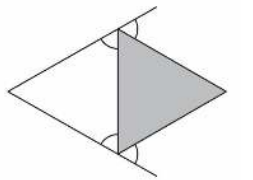
5. What is the sum of the four marked angles?
A. 180°
B. 240°
C. 270°
D. 360°
Read the passage given below and answer these questions:
Once four friends Rahul, Arun, Ajay and Vijay went for a picnic at a hill station. Due to peak season, they did not get a proper hotel in the city. The weather was fine so they decided to make a conical tent at a park. They were carrying 300m2 cloth with them. As shown in the figure they made the tent with height 10m and diameter 14m. The remaining cloth was used for the floor.
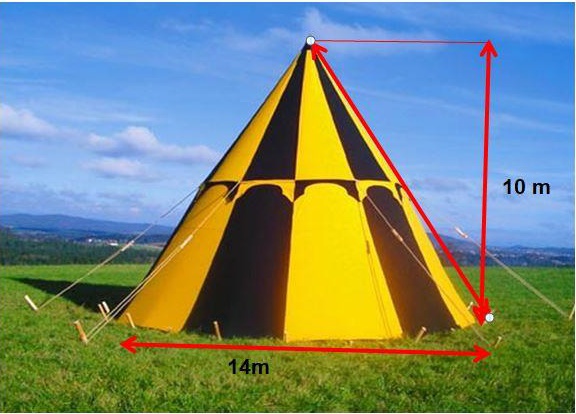
Once four friends Rahul, Arun, Ajay and Vijay went for a picnic at a hill station. Due to peak season, they did not get a proper hotel in the city. The weather was fine so they decided to make a conical tent at a park. They were carrying 300m2 cloth with them. As shown in the figure they made the tent with height 10m and diameter 14m. The remaining cloth was used for the floor.
- How much Cloth was used for the floor?
- 31.6m2
- 16m2
- 10m2
- 20m2
- What was the volume of the tent?
- 300m3
- 160m3
- 513.3m3
- 500m3
- What was the area of the floor?
- 50m2
- 100m2
- 150m2
- 154m2
- What was the total surface area of the tent?
- 400m2
- 422.4m2
- 300m2
- 400m2
- What was the latent height of the tent?
- 12m
- 12.2m
- 15m
- 17m
3. Irrational numbers can provide more precision on measuring scale.
What can be the possible arguments in favour and against this statement?
What can be the possible arguments in favour and against this statement?
In the given figure, ∆AFB ≅ ∆AFG, ∆ADE ≅ AGE and ∠EAF = 45°.
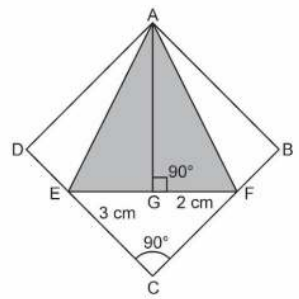
1. What is the measure of ∠DAB?
A. 60°
B. 90°
C. 120°
D. 135°
2. What is the length of AD?
3. What is the area of the shaded region?
A. 12.5 cm²
B. 15 cm²
C. 20 cm²
D. 36 cm²
Class IX students of a school in Moti Nagar, Delhi have been allotted a rectangular plot of land, adjacent to their school, for gardening activity. Saplings of Gulmohar are planted on the boundary at a distance of 1 m from each other. There is a triangular grassy lawn in the plot as shown in Fig. The students are to sow seeds of flowering plants on the remaining area of the plot. Considering A as origin, AD along $x$-axis and AB along $y$-axis, answer the following questions:
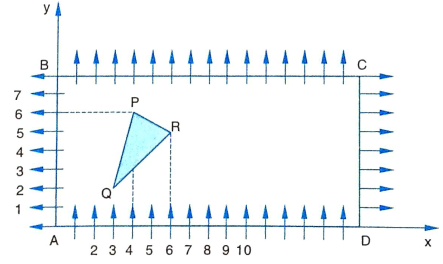
(i) The coordinates of A are
(a) $(0,1)$$\quad$(b) $(1,0)$$\quad$(c) $(0,0)$$\quad$(d) $(-1,-1)$
(ii) The coordinates of P are
(a) $(4,6)$$\quad$(b) $(6,4)$$\quad$(c) $(4,5)$$\quad$(d) $(5,4)$
(iii) The coordinates of R are
(a) $(6,5)$$\quad$(b) $(5,6)$$\quad$(c) $(6,0)$$\quad$(d) $(7,4)$
(iv) The coordinates of D are
(a) $(16,0)$$\quad$(b) $(6,0)$$\quad$(c) $(0,16)$$\quad$(d) $(16,1)$
→(i) The coordinates of A are
(a) $(0,1)$$\quad$(b) $(1,0)$$\quad$(c) $(0,0)$$\quad$(d) $(-1,-1)$
(ii) The coordinates of P are
(a) $(4,6)$$\quad$(b) $(6,4)$$\quad$(c) $(4,5)$$\quad$(d) $(5,4)$
(iii) The coordinates of R are
(a) $(6,5)$$\quad$(b) $(5,6)$$\quad$(c) $(6,0)$$\quad$(d) $(7,4)$
(iv) The coordinates of D are
(a) $(16,0)$$\quad$(b) $(6,0)$$\quad$(c) $(0,16)$$\quad$(d) $(16,1)$