Question
Recombinant DNA (rDNA) is a technology that uses enzymes to cut and paste together DNA sequences of interest. The recombined DNA sequences can be placed into vehicles called vectors that ferry the DNA into a suitable host cell where it can be copied or expressed.
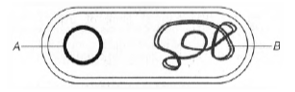
i. A bacterial cell is shown in the figure given below. Label the part 'A' and 'B'. Also, mention the use of part A in rDNA technology.
Image
ii. Suppose a linear DNA fragment and a plasmid has three restriction sites for EcoRI. How many fragments will be produced from linear DNA and plasmid, respectively?
Answer

i. In the above bacterial cell, i.e. A is plasmid B is chromosomal DNA. The plasmid is used as a vector in rDNA technology.
ii. If the enzyme EcoRl acts on both linear DNA and plasmid DNA, each having three recognition sites, the restriction enzyme will generate 3 fragments from plasmid DNA (as it is circular) and 4 fragments from linear DNA.

Need a full question paper?

Generate a complete, print-ready paper with questions like this in minutes — across 16+ boards, with answer keys.

Start Generating Free

Similar questions

  1. Draw a labelled diagram of L.S. of an embryo of grass (any six labels).
  2. Give reason for each of the following:
  1. Anthers of angiosperm flowers are described as dithecous.
  2. Hybrid seeds have to be produced year after year.
(a) Draw the diagram of human sperm and label the cellular component. Also mention the functions of three components.
(b) Where does the head of sperm remain embedded in spermatogenesis.
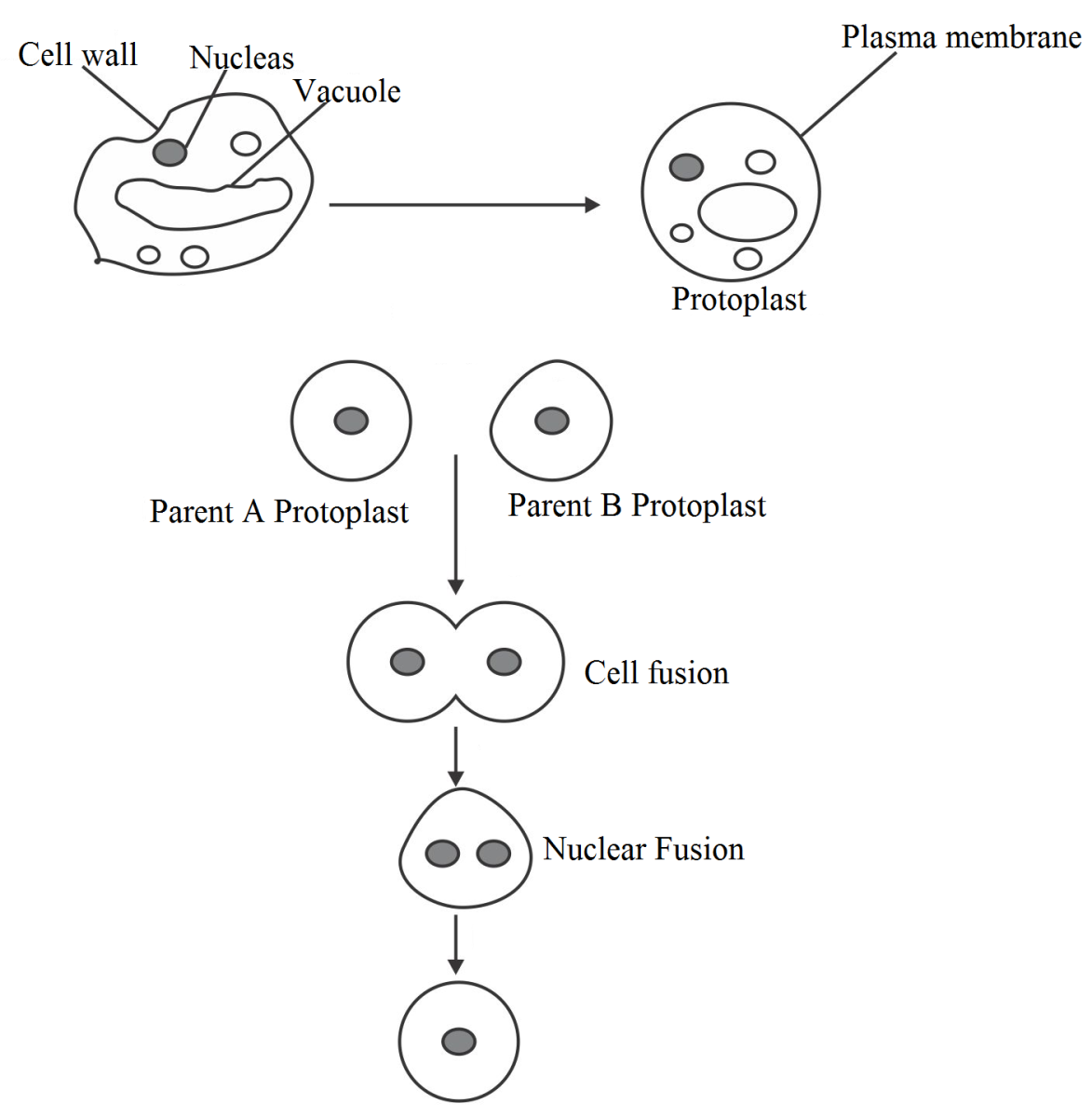
Figure given below represent a certain technique of tissue culture.
  1. Name the technique, as shown in the diagram.
  2. What are the enzymes used to digest plant cell wall?
  3. Name the fusinogen.
  4. What is the product of fusion of protoplasts?
Answer the following questions:
Why is banana called a parthenocarpic fruit? Would you call banana a true fruit? Give reason in support of your answer.
Given below is a table showing the genotypes and the phenotypes of blood groups in the human population.
Genotype
Phenotype
W
Y
$I^BI^O$
Z
$I^AI^B$
O
X
O
  1. Identify the genotype Wand X, and the phenotype Y and Z.
  2. Name the pattern of inheritance exhibited by the phenotypes Y and Z in the table.
  1. How is mature insulin different from proinsulin secreted by pancreas in humans?
  2. Explain how was human functional insulin produced using rDNA technology.
  3. Why is the functional insulin thus produced considered better than the ones used earlier by diabetic patients?
Enumerate the events in the ovary of a human female during:
Luteal phase of menstrual cycle.
What is foetal ejection reflex? Explain how it leads to parturition?
  1. Draw the pyramids of biomass in a pond and in a forest. Explain giving reasons why the two pyramids are different.
  2. Pyramid of energy is always upright. Explain.
What is integrated waste water management? Discuss its advantage.