MCQ
Relation between velocity and displacement is $v = x^2$. Find acceleration at $x = 3m$ :- ............. $\mathrm{m/s}^{2}$
  • A
    $6$
  • B
    $27$
  • $54$
  • D
    $0$

Answer

Correct option: C.
$54$
c
$\mathrm{v}=\mathrm{x}^{2}$

$\frac{\mathrm{dV}}{\mathrm{dx}}=2 \mathrm{x}$

$\frac{\mathrm{vdv}}{\mathrm{dx}}=\mathrm{v} \cdot 2 \mathrm{x}$

$a=2 v x=2 x^{2} x$

${a=2 x^{3}}$

${a=2(3)^{3}}$

${a=54 \mathrm{m} / \mathrm{s}^{2}}$

Need a full question paper?

Generate a complete, print-ready paper with questions like this in minutes — across 16+ boards, with answer keys.
Start Generating Free

Similar questions

A string under a tension of $129.6\,\, N$ produces $10\,\, beats /sec$  when it is vibrated along with a tuning fork. When the tension is the string is increased to $160\,\, N,$ it sounds in unison with same tuning fork. calculate fundamental freq. of tuning fork .... $Hz$
The increase in length is $l$ of a wire of length $L$ by the longitudinal stress. Then the stress is proportional to
The work done in joules in increasing the extension of a spring of stiffness $10\, N/cm$ from $4\, cm$ to $6\, cm$ is:
An object with a mass $10 \,kg$ moves at a constant velocity of $10 \,m/sec$. A constant force then acts for $4\, second$ on the object and gives it a speed of $2\, m/sec$ in opposite direction., the impulse acting on the object is ......... $newton \times \sec $
Two rods of different materials having coefficient of linear expansion $\alpha_1$and $\alpha_2$ and  Young's modulii $Y_1$ and $Y_2$ respectively are fixed between two rigid massive walls. The rods are heated such that they undergo the same increase in temperature. There is no bending of rods. If  $\alpha_1:\alpha_2= 2 : 3$, the thermal stress developed in two rods are equal provided $Y_1 : Y_2$ is equal to
A wheel completes $2000$ revolutions to cover the $9.5\, km$. distance. then the diameter of the wheel is
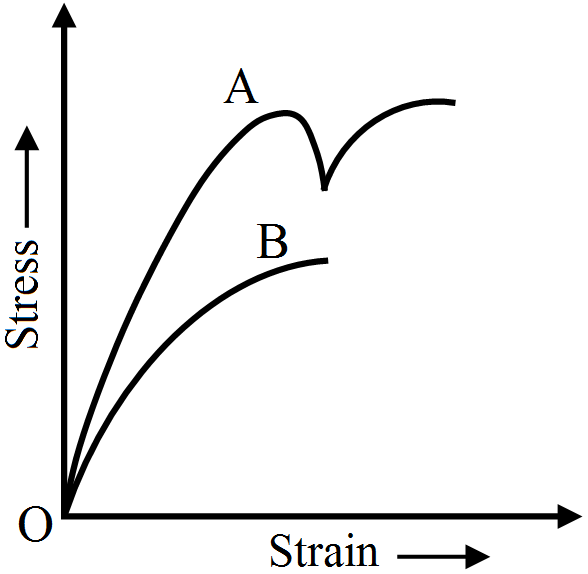
Stress-strain curves for the material A and B are shown below:

Then,
The specific heat relation for ideal gas is
A man of $50\, kg$ mass is standing in a gravity free space at a height of $10\, m$ above the floor. He throws a stone of $0.5\, kg$ mass downwards with a speed $2\, m/s$. When the stone reaches the floor, the distance of the man above the floor will be ...... $m$
If the radius of a planet is $R$ and its density is $\rho $, the escape velocity from its surface will be