MCQ
Relationship between above pair $(A)$ and $(B)$ is
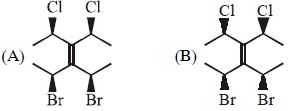
  • A
    Enantiomer
  • Diastereomers
  • C
    Identical
  • D
    Structural isomer

Answer

Correct option: B.
Diastereomers
b

Need a full question paper?

Generate a complete, print-ready paper with questions like this in minutes — across 16+ boards, with answer keys.

Start Generating Free

Similar questions

The enthalpy of combustion at $25\,^o C $ of $H_2$, cyclohexane $(C_6H_{12})$  and cyclohexene $(C_6H_{10})$  are $-241, -3920 $ and $-800\ KJ / mole$  respectively. The heat of hydrogenation of cyclohexene is.....$KJ / mole$
In a triple bond, there is sharing of :
In $1 L$ saturated solution of $AgCl \left[ K _{ sp }( AgCl )=1.6 \times 10^{-10}\right]$, $0.1$ mol of CuCl $\left[ K _{ sp }( CuCl )=1.0 \times 10^{-6}\right]$ is added. The resultant concentration of $Ag ^{+}$in the solution is $1.6 \times 10^{-x}$. The value of " $x$ " is
In conversion of lime-stone to lime,

$CaCO_3( s) \rightarrow CaO(s) + CO_2(g)$

the values of $\Delta H^o$ and $\Delta S^o$ are $+ 179.1\, kJ\, mol^{-1}$ and $160.2\, J/K$ respectively at $298\, K$ and $1\,bar.$ Assuming that $\Delta H^o$ and $\Delta S^o$ do not change with temperature, temperature above which conversion of lime stone to lime will be spontaneous is ............. $\mathrm{K}$

An organic compound on analysis gave the following results : $C = 54.5\%, \,O = 36.4\%, \,H = 9.1\%$. The Empirical formula of the compound is
Assertion : When a salt such as $NaCl$ dissolves, the $Na^+$ and $Cl^-$ ions leaving the crystal lattice acquire far greater freedom.
Reason : In thermodyanamic terms, the formation of solution occurs with a favourable change in free energy, i.e., $\Delta H$ has a high positive value and $T\Delta S$ a low negative value.
In which of the following, all atoms are coplanar?
Dipole moment of which ketone is maximum ?
Which of the following has largest bond angle ?
Consider the following reaction for which the change in enthalpy is positive

$2 A ( g ) + B ( g ) \rightleftharpoons C ( g )+ D ( g )$

Which of the following will not affect the equilibrium?