MCQ
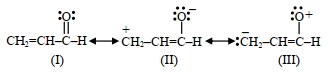
Relative stability of the contributing structures is :
- A$(I) $>$ (III) $>$ (II)$
- ✓$(I) $>$ (II) $>$ (III)$
- C$(II) $>$ (I) $>$ (III)$
- D$(III) $>$ (II) $>$ (I)$
$(2)$ +ve charge on less electronegative atom is more stable i.e., $\mathrm{C}^{\oplus}$ is more stable than $\mathrm{O}^{\oplus}$
$\therefore \quad$ Order is $\mathrm{I}>$ II $>$ $III$
Generate a complete, print-ready paper with questions like this in minutes — across 16+ boards, with answer keys.
$H - C\, \equiv CH\,\xrightarrow[{(ii)\,C{H_3}C{H_2}Br}]{{(i)\,NaN{H_2}\,/\,liq.\,N{H_3}}}\,X$
$\xrightarrow[{(ii)\,C{H_3}C{H_2}Br}]{{(i)\,NaN{H_2}\,/\,liq.\,N{H_3}}}\,Y$
$X$ and $Y$ are
$X$ $ = 1{s^2},\,\,2{s^2}2{p^6},\,\,3{s^2}3{p^6},\,\,4{s^2}$
and $Y$ $ = 1{s^2},\,\,2{s^2}2{p^6},\,\,3{s^2}3{p^5}$
The compound formed by combination of $X$ and $Y$ is