Question
Repeat part (a) of problem 6 if the push is applied horizontally and not parallel to the incline.

Answer


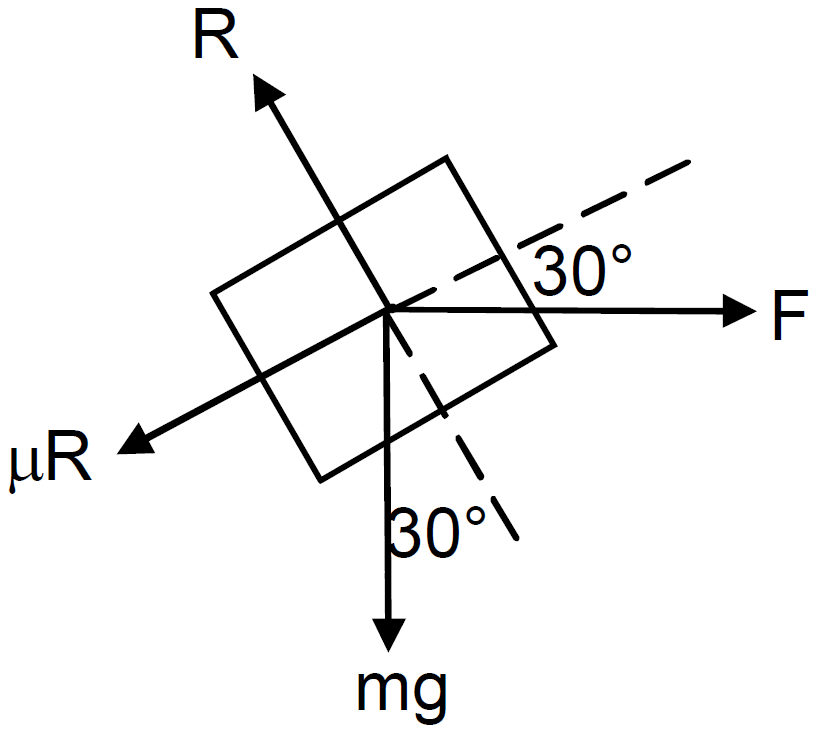
From the free body diagram
$\text{g}=10\text{m/s}^2,\text{m}=2\text{kg},\theta=30^{\circ},\mu=0.2$
$\text{R}-\text{mg}\cos\theta-\text{F}\sin\theta=0$
$\Rightarrow\text{R = mg}\cos\theta+\text{F}\sin\theta \ ...(1)$
And $\text{mg}\sin\theta+\mu\text{R}-\text{F}\cos\theta=0$
$\Rightarrow\text{mg}\sin\theta+\mu(\text{mg}\cos\theta+\text{F}\sin\theta)-\text{F}\cos\theta=0$
$\Rightarrow\text{mg}\sin\theta+\mu\text{ mg}\cos\theta+\mu\text{F}\sin\theta-\text{F}\cos\theta=0$
$\Rightarrow\text{F}=\frac{(\text{mg}\sin\theta+\mu\text{mg}\cos\theta)}{(\mu\sin\theta-\cos\theta)}$
$\Rightarrow\text{F}=\frac{2\times10\times\big(\frac{1}{2}\big)+0.2\times2\times10\times\big(\frac{\sqrt{3}}{2}\big)}{0.2\times\big(\frac{1}{2}\big)-\big(\frac{\sqrt{3}}{2}\big)}$
$=\frac{13.464}{0.76}=17.7\text{N}\approx17.5\text{N}$

Need a full question paper?

Generate a complete, print-ready paper with questions like this in minutes — across 16+ boards, with answer keys.
Start Generating Free

Similar questions

Find the wavelength of the radiation emitted by hydrogen in the transitions
(a) $n = 3$ to $n= 2$,
(b) $n = 5$ to $n = 4$ and
(c) $n = 10$ to $n = 9$.
If an object of mass $M$ moving with velocity $\mu$ has a direct elastic collision with an other stable object of mass $m$ then prove that the energy loss of the object of mass $M$ and the result of its intial energy will be $\frac{4 m M }{( M +m)^2}$
An operator sitting in his base camp sends a sound signal of frequency 400Hz. The signal is reflected back from a car moving towards him. The frequency of the reflected sound is found to be 410Hz. Find the speed of the car. Speed of sound in air = 324m/s.
What is called degree of freedom? How many types are there? Explain to them.
A block of mass $15kg$ is placed on a long trolley. The coefficient of static friction between the block and the trolley is $0.18$. The trolley accelerates from rest with $0.5ms^{-2}$ for $20s$ and then moves with uniform velocity. Discuss the motion of the block as viewed by (a) a stationary observer on the ground, (b) an observer moving with the trolley.
What is scalar product? Explain by giving examples. Explain the scalar product of perpendicular and parallel vectors with an example.
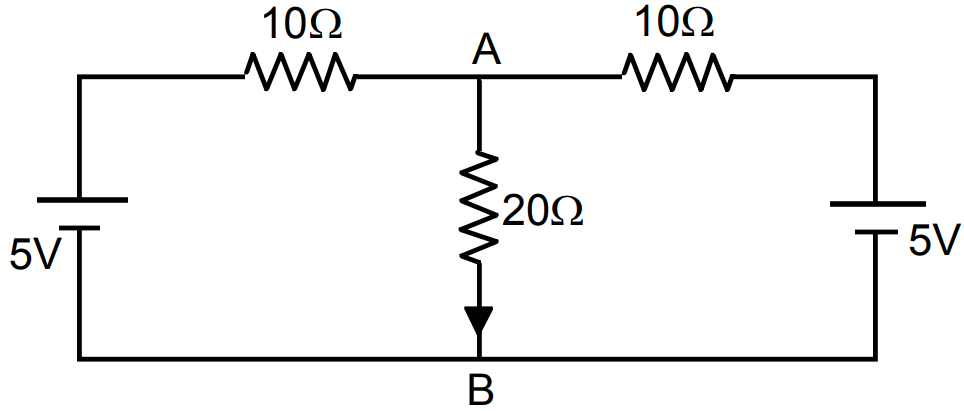
(a) Find the current in the $20\Omega$ resistor shown in the figure. (b) If a capacitor of capacitance $4\mu\text{F}$ is joined between the points A and B, what would be the electrostatic energy stored in it in steady state?
Define thermal conductivity and write its practical applications.
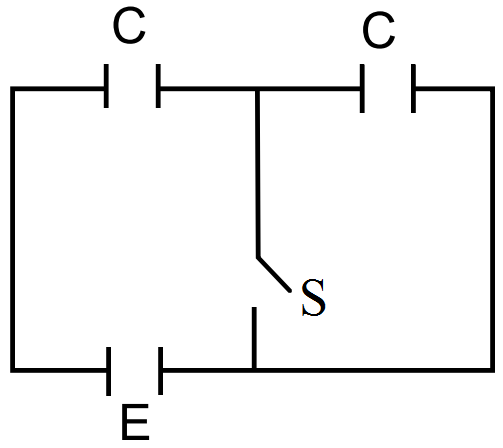
Consider the situation shown in figure. The switch S is open for a long time and then closed:
  1. Find the charge flown through the battery when the switch S is closed.
  2. Find the work done by the battery.
  3. Find the change in energy stored in the capacitors.
  4. Find the heat developed in the system.
Water leaks out from an open tank through a hole of area $2mm^2$ in the bottom. Suppose water is filled up to a height of 80cm and the area of cross-section of the tank is $0.4m^2$. The pressure at the open surface and at the hole are equal to the atmospheric pressure. Neglect the small velocity of the water near the open surface in the tank.
  1. Find the initial speed of water coming out of the hole.
  2. Find the speed of water coming out when half of water has leaked out.
  3. Find the volume of water leaked out during a time interval dt after the height remained is h. Thus find the decrease in height dh in terms of h and dt.
  4. From the result of part c find the time required for half of the water to leak out.