Question
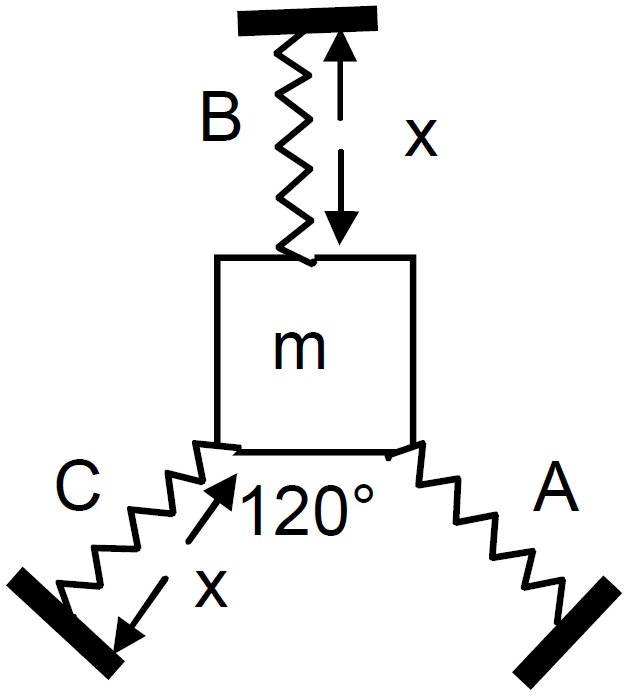
Repeat the previous exercise if the angle between each pair of springs is 120° initially.

Answer

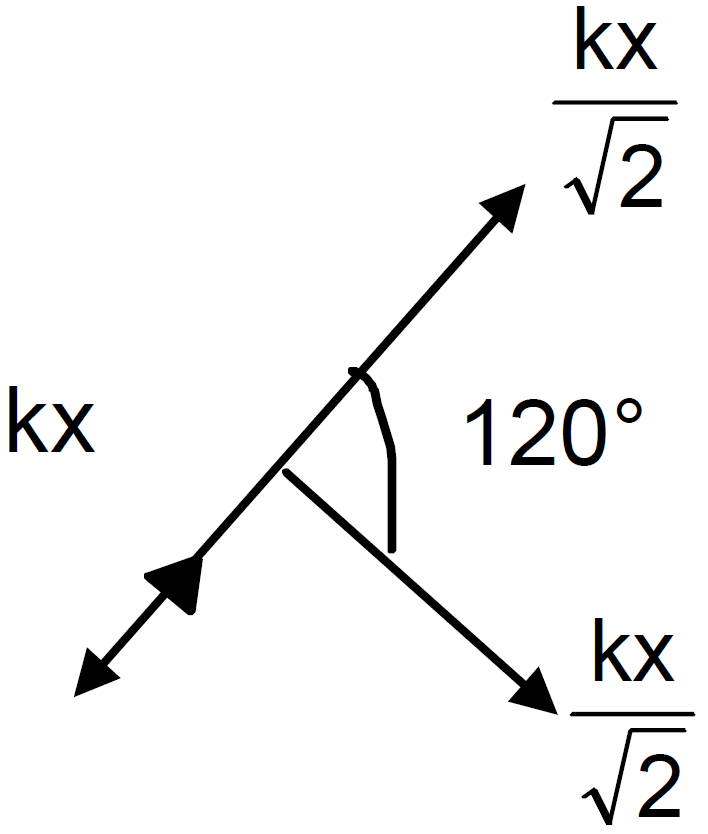
In this case, if the particle ‘m’ is pushed against ’C’ a by distance ‘x’.

Total resultant force acting on man ‘m’ is given by,

$\text{F}=\text{kx}+\frac{\text{kx}}{2}=\frac{3\text{kx}}{2}$

Because net force $\text{A }\&\text{ B}=\sqrt{\Big(\frac{\text{kx}}{2}\Big)^2+\Big(\frac{\text{kx}}{2}\Big)^2+2\Big(\frac{\text{kx}}{2}\Big)\Big(\frac{\text{kx}}{2}\Big)\cos120^\circ}=\frac{\text{kx}}{2}$

$\therefore\text{a}=\frac{\text{F}}{\text{m}}=\frac{3\text{kx}}{2\text{m}}$

$\Rightarrow\frac{\text{a}}{\text{x}}=\frac{3\text{k}}{2\text{m}}=\omega^2$

$\Rightarrow\omega=\sqrt{\frac{3\text{k}}{2\text{m}}}$

$\therefore$ time period $\text{T}=\frac{2\pi}{\omega}=2\pi\sqrt{\frac{2\text{m}}{3\text{k}}}$
Need a full question paper?

Generate a complete, print-ready paper with questions like this in minutes — across 16+ boards, with answer keys.

Start Generating Free

Similar questions

If one of the two electrons of a H2 molecule is removed, we get a hydrogen molecular ion $\text{H}^+_2​.$ In the ground state of an $\text{H}^+_2​,$ the two protons are separated by roughly 1.5 Å, and the electron is roughly 1 Å from each proton. Determine the potential energy of the system. Specify your choice of the zero of potential energy.
A monochromatic light source of intensity 6mW emits 8 × 10¹⁶ photons per second. This light ejects photoelectrons from a metal surface. The stopping potential for this setup is 2.0V. Calculate the work function of the metal.
Consider a head-on collision between two particles of masses m1 and m2. The initial speeds of the particles are u1 and u2 in the same direction. The collision starts 2 at t = 0 and the particles interact for a time interval $\triangle\text{t}.$ During the collision, the speed of the first particle varies as.

$\text{v}(\text{t})=\text{u}_1+\frac{\text{t}}{\triangle\text{t}}(\text{v}_1-\text{u}_1).$

Find the speed of the second particle as a function of time during the collision.

A person standing on a road sends a sound signal to the driver of a car going away from him at a speed of 72km/h. The signal travelling at 330m/s in air and having a frequencyof 1600Hz gets reflected d from the body of the car and returns. Find the frequency of the reflected signal as heard by the person.
In a pure semiconductor, the number of conduction electrons is 6 × 10¹⁹ per cubic metre. How many holes are there in a sample of size 1cm × 1cm × 1mm?
A charged capacitor of capacitance C is discharged through a resistance R. A radioactive sample decays with an average-life $\tau.$ Find the value of R for which the ratio of the electrostatic field energy stored in the capacitor to the activity of the radioactive sample remains constant in time.
Explain how Corpuscular theory predicts the speed of light in a medium, say, water, to be greater than the speed of light in vacuum. Is the prediction confirmed by experimental determination of the speed of light in water? If not, which alternative picture of light is consistent with experiment?
A circular coil of 16 turns and radius 10 cm carrying a current of 0.75 A rests with its plane normal to an external field of magnitude 5.0 × 10⁻² T. The coil is free to turn about an axis in its plane perpendicular to the field direction. When the coil is turned slightly and released, it oscillates about its stable equilibrium with a frequency of 2.0 s–1. What is the moment of inertia of the coil about its axis of rotation?
A resistance R and a capacitor C are connected in series to an ac source $\text{V}=\text{V}_0\sin\omega\text{t}.$
  1. Obtain the expression for the instantaneous current (I) in the circuit.
  2. Show graphically variations of V and I as a function of $\omega\text{t}.$
Two large, thin metal plates are parallel and close to each other. On their inner faces, the plates have surface charge densities of opposite signs and of magnitude 17.0 × 10⁻²² C/m2 . What is E:
  1. In the outer region of the first plate,
  2. In the outer region of the second plate, and
  3. Between the plates?