Question
Represent $\sqrt{4.7}$ geometrically on the number line.
Answer

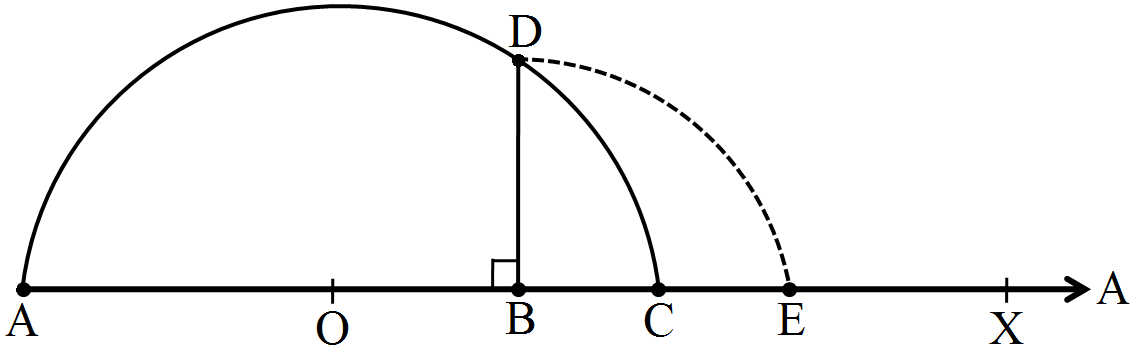
Draw a line segment $AB = 4.7$ units and extend it to $C$ such that $BC = 1$ unit.
Find the midpoint $O$ of $AC$. With $O$ as centre and $OA$ as radius, draw a semicircle.
Now, draw $\text{BD}\perp\text{AC},$ intersecting the semicircle at $D$.
Then, $\text{BD}=\sqrt{4.7}\text{units}.$ With $B$ as centre and $BD$ as radius, draw an arc, meeting $AC$ produced at $E$.

Then, $\text{BE}=\text{BD}=\sqrt{4.7}\ \text{units}.$

Need a full question paper?

Generate a complete, print-ready paper with questions like this in minutes — across 16+ boards, with answer keys.

Start Generating Free

Similar questions

In a cyclic quadrilateral $ABCD$ if $\text{m}\angle\text{A}=\big(\text{m}\angle\text{C}\big).$ Find $\text{m}\angle\text{A}.$
If measures opposite angles of a parallelogram are (60 - x)° and (3x - 4)°, then find the measures of angles of the parallelogram.
In $\triangle\text{ABC},$ side $AB$ is produced to $D$ so that $\text{BD}=\text{BC}.$ if $\angle\text{B}=60^\circ$ and $\angle\text{A}=70^\circ.$ Prove that: $(i) AD > CD (ii) AD > AC$
Five coins were simultaneously tossed $1000$ times and at each, toss the number of heads was observed. The number of tosses during which $0, 1, 2, 3, 4$ and $5$ heads were obtained are shown in the table below. Find the mean number of heads per toss.
No. of heads per toss
No. of tosses
$0$
$38$
$1$
$144$
$2$
$342$
$3$
$287$
$4$
$164$
$5$
$25$
Total
$1000$
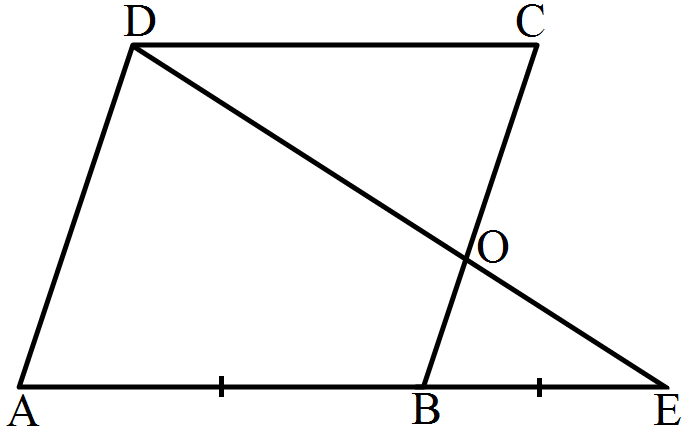
In the adjoining figure, $ABCD$ is a parallelogram in which $AB$ is produced to $E$ so that $BE = AB$. Prove that $ED$ bisects $BC$.
ABCD is a rhombus, EABF is a straight line such that EA = AB = BF. Prove that ED and FC when produced meet at right angles.
A quadrilateral $ABCD$ is inscribed in a circle such that $AB$ is a diameter and $\angle\text{ADC}=130^\circ.$ Find $\angle\text{BAC}.$
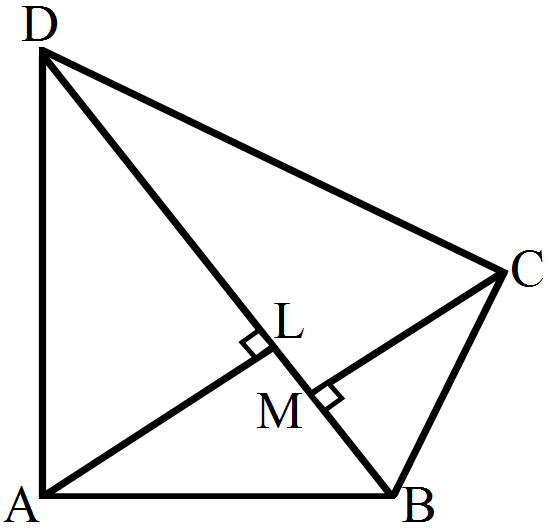
$BD$ is one of the diagonals of a quadrilaterl $ABCD$.
If $\text{AL}\perp\text{BD}$ and $\text{CM}\perp\text{BD},$show that
ar$($quadrilaterl $ABCD)$ $=\frac{1}{2}\times\text{BD}\times(\text{AL}+\text{CM}).$
Rationalise the denominator of the following: $\frac{3}{\sqrt{3}+\sqrt{5}-\sqrt{2}}$
Find the cube of the following binomial expressions: $\frac{1}{\text{x}}+\frac{\text{y}}{3}$