Question
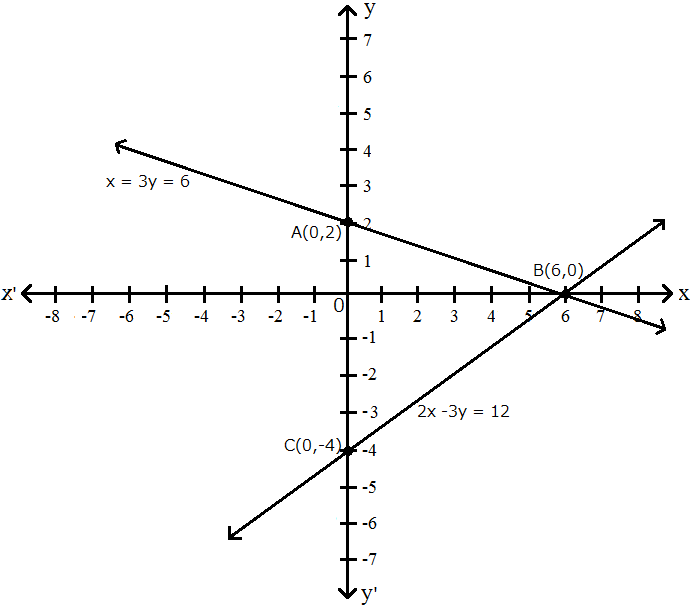
Represent the following pair of equations graphically and write the coordinates of points where the lines intersects $y-$axis.
$x + 3y = 6,$
$2x - 3y = 12.$

Answer

The given equations are
$x + 3y = 6 ......(i)$
$2x - 3y = 12 ........(ii)$
Putting $x = 0$ in equation $(i)$ we get,
$⇒ 0 + 3y = 6$
$⇒ y = 2$
$⇒ x = 0, y = 2$
Putting $y = 0$ in equation $(i)$ we get,
$⇒ x + 3 × 0 = 6$
$⇒ x = 6$
$⇒ x = 6, y = 0$
Use the following table to draw the graph.
$x$
$0$
$6$
$y$
$2$
$0$
The graph of $(i)$ can be obtained by plotting the two points $A(0, 2), B(6, 0).$
$2x - 3y = 12 ......(ii)$
Putting $x = 0$ in equation $(ii)$ we get,
$⇒ 2 × 0 - 3y = 12$
$⇒ y = -4$
$⇒ x = 0, y = -4$
Putting $y = 0 $ in equation $(ii)$ we get,
$⇒ 2x - 3 × 0 = 12$
$⇒ x = 6$
$⇒ x = 6, y = 0$
Use the following table to draw the graph.
$x$
$0$
$6$
$y$
$-4$
$0$
Draw the graph by plotting two points $C(0, -4), D(6, 0)$ from table.

Graph of lines represented by the equations $x + 3y = 6, 2x - 3y = 12$ meet y-axis at $A(0, 2), C(0, -4)$ respectively.

Need a full question paper?

Generate a complete, print-ready paper with questions like this in minutes — across 16+ boards, with answer keys.
Start Generating Free

Similar questions

Solve the following system of equations graphically:
$2x - 5y + 4 = 0,$
$2x + y - 8 = 0$
Sum of the area of two squares is $400cm^2$. If the difference of their perimeters is $16\ cm$, find the sides of two squares.
How many lead balls, each of radius $1\ cm$, can be made from a sphere of radius $8\ cm?$
The angles of a quadrilateral are in $AP$ whose common difference is $10^{\circ}$. Find the angles.
Hint: Let these angles be $x^{\circ},(x+10)^{\circ},(x+20)^{\circ}$ and $(x+30)^{\circ}$.
Their sum is $360^{\circ}$.
Two cylindrical vessels are filled with oil. Their radii are $15\ cm, 12\ cm$ and heights $20\ cm, 16\ cm$ respectively. Find the radius of a cylindrical vessel $21\ cm$ in height, which will just contain the oil of the two given vessels.
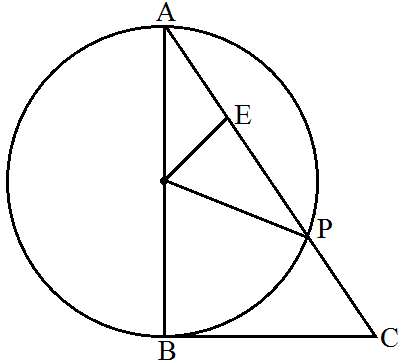
In the figure, $BC$ is a tangent to the circle with centre $O. OE$ bisects $AP$. Prove that $\triangle\text{AEO}\sim\triangle\text{ABC}.$
Construct a $\triangle\text{ABC},$ in which $BC = 5\ cm$, $\angle\text{C}=60^\circ$ and altitude from A is equal to $3\ cm$. Construct a $\triangle\text{ADE}$ similar to $\triangle\text{ABC},$ such that each side of $\triangle\text{ADE}$ is $\frac32$ times the corresponding side of $\triangle\text{ABC}$ Write the steps of construction.
$P$ and $Q$ are points on the sides $A B$ and $A C$ respectively of a $\triangle A B C$. If $A P=2 \ cm, P B=4 \ cm, A Q=3 \ cm$ and $Q C=6 \ cm$, show that $B C=3 P Q$.
Sum of the areas of two squares is $640m^2$. If the difference of their perimeters is $64\ m$. Find the sides of the two squares.
$A$ and $B$ each has some money. If $A$ gives $R s .30$ to $B$, then $B$ will have twice the money left with $A$. But, if $B$ gives $Rs. 10$ to $A$, then $A$ will have thrice as much as is left with $B$. How much money does each have?