MCQ
Resistivity of a semiconductor depends on
  • A
    Shape of semiconductor
  • Atomic nature of semiconductor
  • C
    Length of semiconductor
  • D
    Shape and atomic nature of semiconductor

Answer

Correct option: B.
Atomic nature of semiconductor
Resistivity is the intrinsic property, it doesn't depend upon length and shape of the semiconductors.

Need a full question paper?

Generate a complete, print-ready paper with questions like this in minutes — across 16+ boards, with answer keys.
Start Generating Free

Similar questions

A boy walks uniformally along the sides of a rectangular park of size $400 m \times 300 m$, starting from one corner to the other corner diagonally opposite. Which of the following statement is incorrect
The maximum energy in the thermal radiation from a hot source occurs at a wavelength of $11 \times 10^{-5} \mathrm{~cm}$. According to Wein's law, the temperature of the source (on Kelvin scale) will be $n$ times the wavelength at maximum energy is $5.5 \times 10^{-5} \mathrm{~cm}$. The value $n$ is temperature of another source (on Kelvin scale) for which the
A Galileo telescope has an objective of focal length $100 \mathrm{~cm}$ and magnifying power $50.$ The distance between the two lenses in normal adjustment will be
If $\mu_0$ be the relative permeability and $K_0$ the dielectric constant of a medium, its refractive index is given by
Minimum and maximum values of Poisson's ratio for a metal lies between
Initial pressure and volume of a gas are $P$ and $V$ respectively. First it is expanded isothermally to volume $4 \mathrm{~V}$ and then compressed adiabatically to volume $V$. The final pressure of gas will be
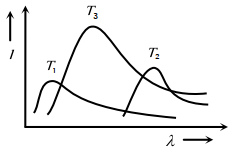
The plots of intensity versus wavelength for three black bodies at temperatures $T, T$ and $T$ respectively are as shown. Their temperature are such that

Image

A current $i$ passes through a wire of length $l$, radius of cross-section $r$ and resistivity $\rho$. The rate of heat generation is
Two conductors made of the same material are connected across a common potential difference. Conductor $A$ has twin thn d:nanater and twice the length of conductor $B$. The power deli conductors $P_A$ and $P_B$ respectively is such that to
An ideal gas $A$ and a real gas $B$ have their volumes increased from $V$ to $2 V$ under isothermal conditions. The increase in internal energy