MCQ
Reverberation of sound is due to:
  • A
    Multiple refractions
  • Multiple reflections
  • C
    Multiple diffractions
  • D
    Multiple polarization

Answer

Correct option: B.
Multiple reflections
Reverberation is the phenomenon of persistence of sound after it is stopped by surfaces such as furniture, people, walls, etc. within a closed space, causing multiple reflections. These reflections build up with each reflection and persist for a finite time and then decay gradually as they are slowly absorbed by the objects in the space enclosed.

Need a full question paper?

Generate a complete, print-ready paper with questions like this in minutes — across 16+ boards, with answer keys.
Start Generating Free

Similar questions

The idea ‘omins cellula e cellula’ which means that all living cells arise from preecisting cells was given by:
Two bodies of equal weight are kept at heights of $h$ and $1.5\ A,$ respectively. The ratio of their $PE$ is:
Name the non$-$nucleated blood cells.
Which is the most simple type of motion among the following?
The nucleus is separated from cytoplasm by:
Before playing the orchestra in a musical concert, a sitarist tries to adjust the tension and pluck the strings suitably. By doing so he is adjusting:
Water falls from a height of $60m$ at the rate of $15\ kg$ is operate a turbine. The soosses due to frictional forces are $10\%$ of energy. How much power is generated by the turbine$? ($Take, $g = 10m/ s^2)$
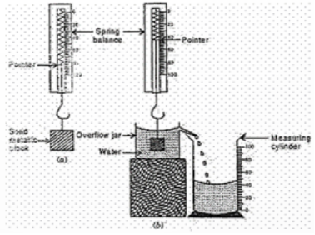
For performing an experiment to verify Archimedes principle, a student used a spring balance with a zero error of 4 g wt. He used to measure the weight of a solid metallic block as shown in the figure below. The solid metallic block was then lowered in water contained in an overflowing jar and the water displaced by this block was collected in graduated or measuring cylinder as shown in figure.
Image
The apparent loss in weight of the solid metallic block is:
The boiling points of diethyl ether, acetone and n-butyl alcohol are $35^{\circ} C , 56^{\circ} C$ and $118^{\circ} C$, respectively. Which one of the following correctly represents their boiling points in kelvin scale:
A bus moving along a straight line at $20m/s$ undergoes an acceleration of $4 \mathrm{~m} / \mathrm{s}^2$. After $2$ seconds, its speed will be: