Question
Ruler and compasses may be used in this question. All construction lines and arcs must be clearly shown and be of sufficient length and clarity to permit assessment.
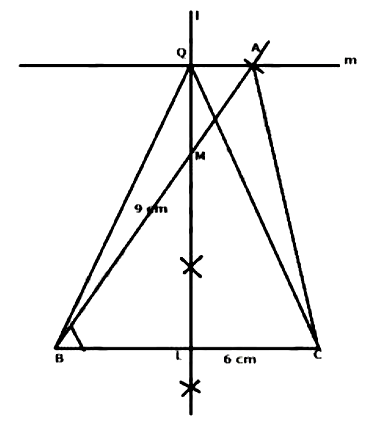
(i) Construct a ΔABC, in which BC = 6cm, AB = 9 cm and angle ABC = 60°.
(ii) Construct the locus of all points inside triangle ABC, which are equidistant from B and C.
(iii) Construct the locus of the vertices of the triangles with BC as base and which are equal in area to triangle ABC.
(iv) Mark the point Q, in your construction, which would make ΔQBC equal in area to ΔABC, and isosceles.
(v) Measure and record the length of CQ.
Answer


Steps of Construction:
(i) Draw a line segment BC = 6 cm.
(ii) At B, draw a ray BX making an angle 60 degree and cut off BA=9 cm.
(iii) Join AC. ABC is the required triangle.
(iv) Draw perpendicular bisector of BC which intersects BA in M, then any point on LM is equidistant from B and C.
(v) Through A, draw a line m || BC.
(vi) The perpendicular bisector of BC and the parallel line m intersect each other at Q.
(vii) Then triangle QBC is equal in area to triangle ABC. m is the locus of all points through which any triangle with base BC will be equal in area of triangle ABC.
On measuring CQ = 8.4 cm.

Need a full question paper?

Generate a complete, print-ready paper with questions like this in minutes — across 16+ boards, with answer keys.

Start Generating Free

Similar questions

If $(-3, 2), (1, -2) $ and $(5, 6)$ are the midpoints of the sides of a triangle, find the coordinates of the vertices of the triangle.
Show that $A (3, -2)$ is a point of trisection of the line segment joining the points $(2, 1)$ and $(5, -8).$
Also, find the co-ordinates of the other point of trisection.
ABCD is a parallelogram. A circle through vertices A and Bmeets side BC at point P and side AD at point Q. Show that quadrilateral PCDQ is cyclic.
Construct an isosceles right-angled triangle, having hypotenuse= 8 cm. Draw its lines of symmetry. 
In what ratio is the line joining $(2, -4)$ and $(-3, 6)$ divided by the line $y = O ?$
Ananth had Rs 50 shares of 'Esco' paying 6% dividend. He sold them at a market price of Rs 80 and invested the proceeds in buying Rs 100 shares of 'Y2K Software' at Rs 150 and paying 11% dividend. He thus increased his annual income by Rs 2,150. How many shares of 'Esco' did he sell?
Use graph paper for this question.
The table given below shows the monthly wages of some factory workers.
(i) Using the table, calculate the cumulative frequency of workers.
(ii) Draw the cumulative frequency curve.
Use 2 cm = ₹500, starting the origin at ₹6,500 on X-axis, and 2 cm = 100 worker at they Y-axis.
(iii) Use your graph to write down the median wages in ₹.
Wages in ₹
(CLass)
No. of workers (frequency)Cumulative frequency f(x)
6500 - 700010-
7000 - 750018-
7500 - 800022-
8000 - 850025-
8500 - 900017-
9000 - 950010-
9500 - 100008-
Prove.$\frac{\sin A+\cos A}{\cos A-\cos A}+\frac{\sin A-\cos A}{\sin A+\cos A}=\frac{2}{2 \sin ^2 A-1}$
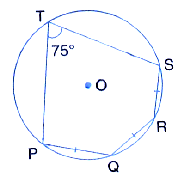
The given figure shows a circle with centre O. Also, PQ = QR = RS and ∠PTS = 75°. Calculate:
(i) ∠POS, (ii) ∠QOR, (iii) ∠PQR.
Find the sub-duplicate ratio of the following:
$\frac{1}{16}: \frac{1}{36}$