MCQ
$s-$character in $sp$ hybridised orbitals are
- A$\frac{1}{3}$
- ✓$\frac{1}{2}$
- C$\frac{1}{4}$
- D$\frac{2}{3}$
$s$-orbitals hold electrons closer to the atom they surround, so a hybridized orbital with $50 \,\%\, s$ character $(sp)$ holds electrons closer because it behaves more like an $s$ atomic orbital.
Generate a complete, print-ready paper with questions like this in minutes — across 16+ boards, with answer keys.
Here $W, Y$ and $Z$ are left, up and right elements with respect to the element $'X'$ and $'X'$ belongs to $16^{th}$ group and $3^{rd}$ period. Then according to given information the incorrect statement regarding given elements is
$X$ and $Y$ respectively are :-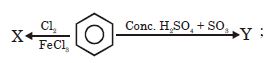
$CH _3\left( CH _2\right)_4 CH _3 \xrightarrow[HCl,\Delta]{Anhy.AlCl_3} X$
$C{O_2} + 2{H_2}O\, \rightleftharpoons {H_3}{O^ + } + HCO_3^ - $
for which the equilibrium constant is $3.8 \times 10^{-7}$ and $pH = 6.0$. The ratio of $[HCO_3^- ]$ to $[CO_2]$ would be :-
| List-$I$ (Elements) | List-$II$(Properties in their respective groups) |
| $A$ $\mathrm{Cl}, \mathrm{S}$ | $I$ Elements with highest electronegativity |
| $B$ $\mathrm{Ge}, \mathrm{As}$ | $II$ Elements with largest atomic size |
| $C$ $\mathrm{Fr}, \mathrm{Ra}$ | $III$ Elements which show properties of both metals and non metal |
| $D$ $\mathrm{F}, \mathrm{O}$ | $IV$ Elements with highest negative electron gain enthalpy |
Choose the correct answer from the options given below :