Question

Same current i = 2A is flowing in a wire frame as shown in figure. The frame is a combination of two equilateral triangles ACD and CDE of side 1m. It is placed in uniform magnetic field B = 4T acting perpendicular to the plane of frame. The magnitude of magnetic force acting on the frame is

(a) 24 N

(b) Zero

(c) 16 N

(d)  8 N

Answer

(a) 24 N

Need a full question paper?

Generate a complete, print-ready paper with questions like this in minutes — across 16+ boards, with answer keys.

Start Generating Free

Similar questions

Polarisation of light was first successfully explained by:
The electric flux through a certain area of dielectric is 8.76 × 10³t4. The displacement current through the area is 12.9pA at t = 26.1ms . Find the dielectric constant of the material.
A sheet of aluminium foil of negligible thickness is introduced between the plates of a capacitor. The capacitance of the capacitor:
What happens when some charge is placed on a soap bubble?

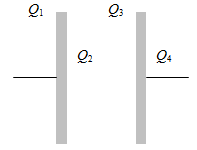
In an isolated parallel plate capacitor of capacitance C, the four surface have charges  and  as shown. The potential difference between the plates is

(a)

(b) 

(c)

(d)

Three resistances, each of 1 ohm, are joined in parallel. Three such combinations are put in series, then the resultant resistance will be

(a) 9 ohm

(b) 3 ohm

(c) 1 ohm 

(d)  

One metallic sphere A is given positive charge whereas another identical metallic sphere B of exactly same mass as of  A is given equal amount of negative charge. Then

(a) Mass of  A and mass of  B still remain equal

(b) Mass of  A increases

(c) Mass of  B decreases

(d) Mass of  B increases

The nuclear fusion reaction between deuterium and tritium takes place:

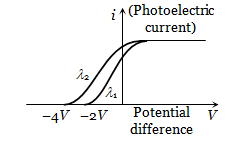
The maximum value of stopping potential in the following diagram is

(a) – 4V  

(b) – 1V

(c) – 3V   

(d) – 2V

Mark the correct statements for a particle going on a straight line:
  1. If the velocity and acceleration have opposite sign, the object is slowing down.
  2. If the position and velocity have opposite sign, the particle is moving towards the origin.
  3. If the velocity is zero at an instant, the acceleration should also be zero at that instant.
  4. If the velocity is zero for a time interval, the acceleration is zero at any instant within the time interval.