Question
Samples of two radioactive nuclides $A$ and $B$ are taken. $\lambda A$ and $\lambda B$ are the disintegration constants of $A$ and $B$ respectively. In which of the following cases, the two samples can simultaneously have the same decay rate at any time?
Answer

The two samples of the Two radioactive nuclides $A$ and $B$ can simultaneously have the same decay rate at any time if initial rate of decay of $A$ is twice the initial fate of decay of $B$ and $\lambda_\text{A}>\lambda_\text{B}$.
Also, when initial rate of decay of $B$ is same as rate of decay of $A$ at $t = 2h$ and $\lambda_\text{B}>\lambda_\text{A}$.

Need a full question paper?

Generate a complete, print-ready paper with questions like this in minutes — across 16+ boards, with answer keys.

Start Generating Free

Similar questions

When a charged body is brought near an electroscope:
Assertion  :   When charges are shared between any two bodies, no charge is really lost, but some loss of energy does occur.
Reason      : Some energy disappears in the form of heat, sparking etc.(a) If both assertion and reason are true and the reason is the correct explanation of the assertion.(b) If both assertion and reason are true but reason is not the correct explanation of the assertion.(c) If assertion is true but reason is false.(d) If the assertion and reason both are false.


The phenomenon of light bending due to change of medium is called:
What is a virtual image?
The load voltage is approximately constant when a zener diode is:
Two charges +4e  and +e are at a distance x apart. At what distance, a charge q must be placed from charge +e so that it is in equilibrium(a) x/2 (b) 2x/3 (c) x/3(d) x/6
       
A stream of electrons is projected horizontally to the right. A straight conductor carrying a current is supported parallel to the electron stream and above it. If the current in the conductor is from left to right, what will be the effect on the electron stream?
The rest energy involved in a mass of one atomic mass unit is _________ eV.
Which of the following series in the spectrum of hydrogen atom lies in the visible region of the electromagnetic spectrum?
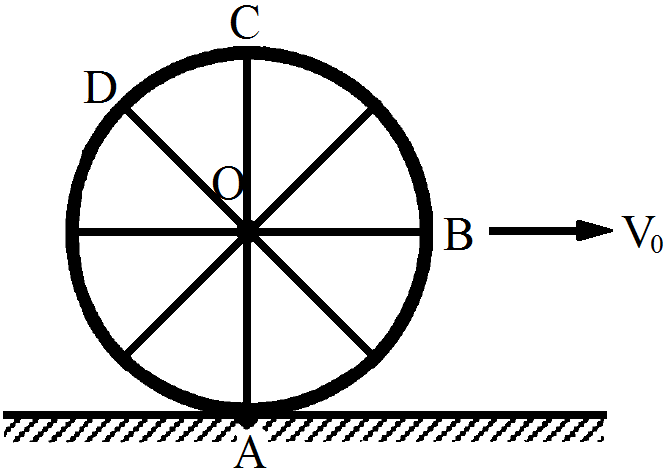
Consider a wheel of a bicycle rolling on a level road at a linear speed $v_0:$
  1. The speed of the particle $A$ is zero.
  2. The speed of $B, C$ and $D$ are all equal to $v_0.$
  3. The speed of $C$ is $2v_0.$
  4. The speed of $B$ is greater than the speed of $O.$