Question
Second ionization potential of $Li, Be$ and $B$ is in the order
Electronic configuration for these ions is:
$Li ^{+}: 1 s ^2$
$Be ^{+}: 1 s ^2\, 2 s ^1$
$B ^{+}: 1 s ^2\, 2 s ^2$
For, lithium and boron, electron is to be ejected from fully filled stable shells.
Further, it is difficult to remove electron from is shell of $Li$ because it is closer to the nucleus as compared to $2 s$ shell of $B$. It is much easier to remove electron from $Be$ because it will attain stable electronic configuration after losing this electron.
Thus, order is $Li \,> \,B\, >\, Be$
Generate a complete, print-ready paper with questions like this in minutes — across 16+ boards, with answer keys.
$(i)$ Diastereomers $(ii)$ Geometrical isomers
$(iii)$ Epimers $(iv)$ Anomers
$(v)$ Enantiomers

$CH_3-CH=CH-CH_2-OH$ $\xrightarrow[{{S}_{{{N}^{1}}}}]{HBr}$ $[P]$
In the given reaction the product $[P]$ is :
$[Figure]$ $\xrightarrow[{S_N2}]{{KOH}}$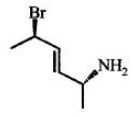
$PCl_5 \longrightarrow PCl_4^+ + Cl^-$
$[E (en)_2 (C_2O_4)]NO_2$ (where $(en)$ is ethylene diamine) are, respectively,