MCQ
Select Paramagnetic molecule

$(A)\,\, KO_2$

$(B)\,\,$ cis $-[Co(en)_2Cl_2]^+$

$(C)\,\, K_3[Co(Ox)_3]$

$(D)\,\,[CoCl_3]^{2-}$

  • A
    $A, B, C$
  • $A, D$
  • C
    $B, C, D$
  • D
    $A, C, D$

Answer

Correct option: B.
$A, D$
b
$K O_{2}$ is a paramagnetic molecule as it is a superoxide having $O_{2}^{-}$ ion. In (b) \&
(c), $C o^{3+}$ is present containing $6 d$ electrons. However all these electrons are
paired up due to presence of strong field ligands. $(d)$ has $C o^{2+}$ ions with $7 d$ electrons, out of which 3 are unpaired due to presence of weak field ligand $C l$. Hence $K O_{2}$ and $\left[ CoCl _{3}\right]^{2-}$ are paramagnetic molecules.

Need a full question paper?

Generate a complete, print-ready paper with questions like this in minutes — across 16+ boards, with answer keys.

Start Generating Free

Similar questions

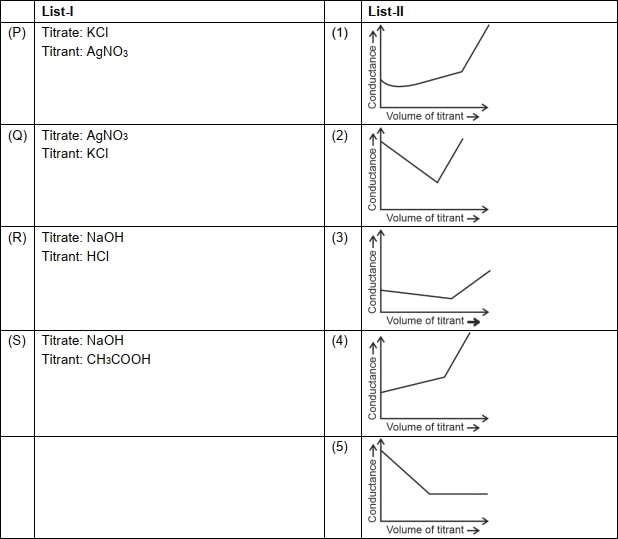
In a conductometric titration, small volume of titrant of higher concentration is added stepwise to a larger volume of titrate of much lower concentration, and the conductance is measured after each addition.

The limiting ionic conductivity ( $\Lambda 0$ ) values (in $mS m ^2 mol ^{-1}$ ) for different ions in aqueous solutions are given below:

Ions $Ag ^{+}$ $K ^{+}$ $Na ^{+}$ $H ^{+}$ $NO _3^{-}$ $CI ^{-}$ $SO _4^{2-}$ $OH ^{-}$ $CH_3COO ^{-}$
$\Lambda_0$ $6.2$ $7.4$ $5.0$ $35.0$ $7.2$ $7.6$ $16.0$ $19.9$ $4.1$

For different combinations of titrates and titrants given in $List-l$, the graphs of 'conductance' versus 'volume of titrant' are given in $List-II$.

Match each entry in $List-I$ with the appropriate entry in $List-II$ and choose the correct option.
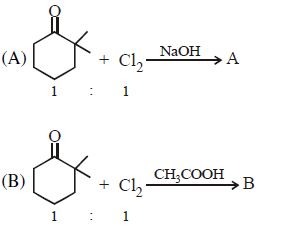
Organic product $A$ & $B$ are respectively -
On prolonged heating of ammonium cyanate or urea, we get
Which of the following is $\sigma $ and $\pi $ bonded organometallic compound
A blue colouration is not obtained when
The correct order of bond enthalpy $\left( kJ\,mol ^{-1}\right)$ is :
The charge of an electron is $ - 1.6 \times {10^{ - 19}}C.$ The value of free charge on $L{i^ + }$ ion will be
In a cell that utilises the reaction $Z{n_{(s)}} + 2H^+(aq) \to$    $Zn^{2+}(aq) + H_{2(g)}$   addition of ${H_2}S{O_4}$ to cathode compartment, will
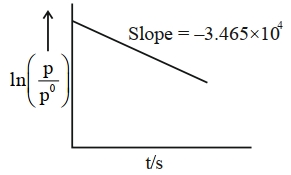
For the decomposition of azomethane. $CH _{3} N _{2} CH _{3}( g ) \rightarrow CH _{3} CH _{3}( g )+ N _{2}$ (g) a first order reaction, the variation in partial pressure with time at $600\,K$ is given as
For a reaction, $X(g) \to Y(g) + Z(g)$ the half life period is $ 10\,\min$. In What period of time would the concentration of $X$ be reduced to $ 10\%$ of original concentration ........... $\min$