MCQ
Select process in which $SO_2$ is Not evolved:
  • A
    When $Cu_2S$ is roasted
  • When $Cu_2S$ is heated with roasted $Cu_2S$
  • C
    When $FeS$ is partially roasted
  • D
    When partially roasted $FeS$ is heated with Silica
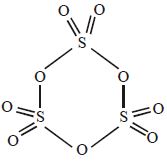
Answer

Correct option: B.
When $Cu_2S$ is heated with roasted $Cu_2S$
b

Need a full question paper?

Generate a complete, print-ready paper with questions like this in minutes — across 16+ boards, with answer keys.

Start Generating Free

Similar questions

Benzalacetone is the product of mixed aldol condensation between benzaldehyde $(C_6H_5CH = O)$ and acetone $[(CH_3)_2C = O]$. What is its structure ?
Which one of the following compounds will be most reactive for $S_N1$ reactions :
Which among the following is the simplest sugar
$STATEMENT-1$: Aniline on reaction with $\mathrm{NaNO}_2 / \mathrm{HCl}$ at $0^{\circ} \mathrm{C}$ followed by coupling with $\beta$-naphthol gives a dark blue coloured precipitate. and

$STATEMENT-2$: The colour of the compound formed in the reaction of aniline with $\mathrm{NaNO}_2 / \mathrm{HCl}$ at $0^{\circ} \mathrm{C}$ followed by coupling with $\beta$-naphthol is due to the extended conjugation.

Given the equilibrium constant $K_c$ of the reaction

$Cu(s) + 2Ag{^+}_{(aq)} \to Cu^{+2}_{(aq)} + 2Ag(s)$

is $10 \times 10^{15}$, calculate the $E_{cell}^o$ of the reaction of $298\,K$

[${2.303\,\frac{{RT}}{F}}$ at $298\,K$ $=0.059\,V$]

Match the vitamin given is Column I with the their chemical name given in Column II.

 Column – I Column - II
( i )Vitamin B6( P )Ascorbic acid
( ii )Vitamin B1( Q )Riboflavin
( iii )Vitamin B2( R )Thiamine
( iv )Vitamin C( S )Pyridoxine
For a first order reaction velocity constant, $K = {10^{ - 3}}{s^{ - 1}}$. Two third life for it would be ........... $\sec$
Complexes $\left(\mathrm{ML}_{5}\right)$ of metals $\mathrm{Ni}$ and $Fe$ have ideal square pyramidal and trigonal bipyramidal grometries, respectively. The sum of the $90^{\circ}, 120^{\circ}$ and $180^{\circ}\;\; \mathrm{L}-\mathrm{M}- \mathrm{L}$ angles in the two complexes is
$C{H_3}COCl\mathop {\xrightarrow{{2H}}}\limits_{Pd/BaS{O_4}} C{H_3}CHO + HCl;$

The above reaction is called

The reactivity of $2-$ bromo $-2-$ methylbutane $(I),\, 1-$ bromopentane $(II)$ and $2$ bromopentane $(III)$ towards $S_N2$ displacement is such that :