MCQ
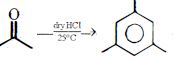
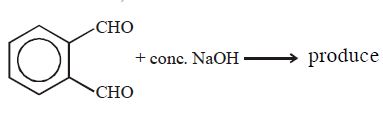
Select reaction with correct major product
- A
- ✓$HCHO\xrightarrow{{450{}^oC}}{H_2} + CO$
- C$MeCHO\xrightarrow[\Delta ]{{KOH}}MeCOOK + MeC{H_2}OH$
- D$PhCHO + HCHO\xrightarrow[\Delta ]{{NaOH}}PhCOONa + C{H_3}OH$
Generate a complete, print-ready paper with questions like this in minutes — across 16+ boards, with answer keys.
$NH_2-CH_2-CH_2-NH_2 +$ $\begin{array}{*{20}{c}}
{COO{C_2}{H_5}} \\
{|\,\,\,\,\,\,\,\,\,\,\,\,\,\,\,\,\,\,\,\,\,\,\,\,\,} \\
{COO{C_2}{H_5}}
\end{array}$ $\xrightarrow{{Pyridne}}$ $[X]$
$[X]$ will be :
$\left[\right.$ Given $\left.: \log _{10} 2=0.301, \ln 10=2.303\right]$
| Run | $[A]/mol\,L^{-1}$ | $[B]/mol\,L^{-1}$ | Initial rate of formation of $D/mol\,L^{-1}\,min^{-1}$ |
| $I.$ | $0.1$ | $0.1$ | $6.0 \times 10^{-3}$ |
| $II.$ | $0.3$ | $0.2$ | $7.2 \times 10^{-2}$ |
| $III.$ | $0.3$ | $0.4$ | $2.88 \times 10^{-1}$ |
| $IV.$ | $0.4$ | $0.1$ | $2.40 \times 10^{-2}$ |
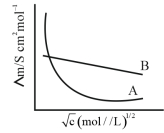
Based on the above data which one of the following is correct?

$(A)$ $\Lambda \stackrel{0}{ m }$ for electrolyte $A$ is obtained by extrapolation
$(B)$ For electrolyte B, vx $\Lambda m$ vs $\sqrt{ c }$ graph is a straight line with intercept equal to $\Lambda \stackrel{0}{ m }$
$(C)$ At infinite dilution, the value of degree of dissociation approach zero for electrolyte $B$.
$(D)$ $\Lambda \stackrel{0}{ m }$ for any electrolyte $A$ or $B$ can be calculated using $\lambda^{\circ}$ for individual ions.