MCQ
Select the appropriate property of an ideal gas
  • A
    Its molecules are infinitesimally small
  • B
    There are no forces of interaction between its molecules
  • C
    It strictly obeys the ideal gas laws
  • All of these

Answer

Correct option: D.
All of these
d
(d)

All of the statements are true for an ideal gas.

Need a full question paper?

Generate a complete, print-ready paper with questions like this in minutes — across 16+ boards, with answer keys.
Start Generating Free

Similar questions

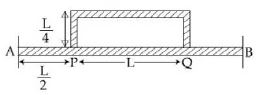
Temperature difference of $120\,^oC$ is maintained between two ends of a uniform rod $AB$ of length $2L$. Another bent rod $PQ$, of same cross-section as $AB$ and length $\frac{{3L}}{2}$,  is connected across $AB$ (See figure). In steady state, temperature difference between $P$ and $Q$ will be close to .......... $^oC$
A string of area of cross-section $4\,mm ^{2}$ and length $0.5$ is connected with a rigid body of mass $2\,kg$. The body is rotated in a vertical circular path of radius $0.5\,m$. The body acquires a speed of $5\,m / s$ at the bottom of the circular path. Strain produced in the string when the body is at the bottom of the circle is $\ldots . . \times 10^{-5}$. (Use Young's modulus $10^{11}\,N / m ^{2}$ and $g =10\,m / s ^{2}$ )
The maximum acceleration of a particle in $SHM$ is made two times keeping the maximum speed to be constant. It is possible when
A cylindrical tube, open at both ends, has a fundamental frequency ${f_0}$ in air. The tube is dipped vertically into water such that half of its length is inside water. The fundamental frequency of the air column now is
A girl weighing $50\ kg$ makes a high jump of $1.2m.$ What is her kinetic energy at the highest point? $(g = 10\ ms^{-2}$)
Two points move in the same straight line starting at the same moment from the same point in it. The first moves with constant velocity $u$ and the second with constant acceleration $f$. During the time elapses before the second catches, the first greatest distance between the particle is $........$
A stream-lined body falls through air from a height $h$ on the surface of liquid. Let $d$ and $D$ denote the densities of the materials of the body and the liquid respectively. If  $D > d$, then the time after which the body will be instantaneously at rest, is
An object starts from rest and moves with uniform acceleration $a.$ The final velocity of the particle in terms of the distance $x$ covered by it is given as:
$Assertion :$ Melting of solid causes no change in internal energy.
$Reason :$ Latent heat is the heat required to melt a unit mass of solid.
The angular speed of seconds needle in a mechanical watch is