MCQ
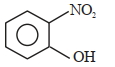
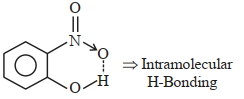
Select the compound from the following that will show intramolecular hydrogen bonding.
- A$\mathrm{H}_2 \mathrm{O}$
- B$\mathrm{NH}_3$
- C$\mathrm{C}_2 \mathrm{H}_5 \mathrm{OH}$
- ✓
Generate a complete, print-ready paper with questions like this in minutes — across 16+ boards, with answer keys.
$\mathrm{PbCl}_{2(\mathrm{s})} \rightleftharpoons \mathrm{Pb}_{(\mathrm{ag})}^{2+}+2 \mathrm{Cl}_{(\mathrm{aq})}^{-}$
Which of the following choices is correct for a mixture of $300\; \mathrm{mL}\;\; 0.134 \;\mathrm{M} \;\mathrm{Pb}\left(\mathrm{NO}_{3}\right)_{2}$ and $100\; \mathrm{mL}\;\; 0.4\; \mathrm{M}\; \mathrm{NaCl} ?$
$\mathrm{X}_2(g) \rightleftharpoons 2 \mathrm{X}(g)$
The standard reaction Gibbs energy, $\Delta_r G^{\circ}$, of this reaction is positive. At the stiur of the reaction, there is one mole of $X_2$ and no $X$. As the reaction proceeds, the number of roles of $X$ formed is given by $\beta$. Thus, $\beta_{\text {equitibrium }}$ is the number of moles of $\mathrm{X}$ formed at equilibrium. The reaction is carried out at a constant total pressure of 2 bar. Consider the gases to behave ideally. (Given : $R=0.083 \mathrm{~L} \mathrm{bar}^{-1} \mathrm{~mol}^{-1}$ )
($1$) The equilibrium constant $K_P$ for this reaction at $298 \mathrm{~K}$, in terms of $\beta_{\text {equilibs, um }}$, is
($A$) $\frac{8 \beta_{\text {equilibrium }}^2}{2-\beta_{\text {equilibrium }}}$ ($B$) $\frac{8 \beta_{\text {equititrium }}^2}{4-\beta_{\text {equilibrium }}^2}$ ($C$) $\frac{4 \beta_{\text {equilibrium }}^2}{2-\beta_{\text {equilibrium }}}$ ($D$) $\frac{4 \ell_{\text {equitibrium }}^2}{4-\beta_{\text {equilibrium }}^2}$
($2$) The $INCORRECT$ statement among the following, for this reaction, is
($A$) Decrease in the total pressure will result in formation of more moles of gaseous $\mathrm{X}$
($B$) At the start of the reaction, dissociation of gaseous $\mathrm{X}_2$ takes place spontaneously
($C$) $\beta_{\text {equilibrium }}=0.7$
($D$) $\quad K_c<1$
Given the answer question ($1$) and ($2$)