MCQ
Select the correct $M-C$ Bond order?
  • A
    $[Ni(CO)_4] > [Co(CO)_4]-> [Fe(CO)_4]^{-2}$
  • $[Ni(CO)_4] < [Co(CO)_4]-< [Fe(CO)4]^{-2}$
  • C
    $[Ni(CO)_4] < [Co(CO)_4]^-= [Fe(CO)4]^{-2}$
  • D
    $[Ni(CO)_4] = [Co(CO)_4]^-= [Fe(CO)4]^{-2}$

Answer

Correct option: B.
$[Ni(CO)_4] < [Co(CO)_4]-< [Fe(CO)4]^{-2}$
b
$M-C\, B.O./C-O\, B.L.\, \propto  \,-ve\,$ charge

Need a full question paper?

Generate a complete, print-ready paper with questions like this in minutes — across 16+ boards, with answer keys.
Start Generating Free

Similar questions

${E^o}$ for the cell $Zn|Z{n^{2 + }}(aq)||C{u^{2 + }}(aq)|Cu$ is $1.10\,V$ at ${25\,^o}C$, the equilibrium constant for the reaction $Zn + C{u^{2 + }}(aq)$ $\rightleftharpoons$ $Cu + Z{n^{2 + }}(aq)$ is of the order of
When $0.1\, mol$ $CoCl_3(NH_3)_5$ is treated with excess of $AgNO_3$, $0.2\, mol$ of $AgCl$ are obtained. Then compound is...
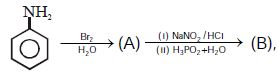
Product $(B)$ in this reaction is
Which of the following is not a consequence of the Lanthanoid contraction?
(i) Copper metal dissolves in $1M $ silver nitrate solution and crystals of silver metal get deposited.

(ii) Silver metal does not react with $1 M$  zinc nitrate solution

(iii) Zinc metal dissolves in $1M$  copper sulphate solution and copper metal gets depositedHence the order of decreasing strength of the three metals as reducing agents will be

An optically active compound $X$ has molecular formula $C_4H_8O_3.$ It evolves $CO_2$ with $NaHCO_3.$  $'X' $ Reacts with $LiAlH_4$ to give an achiral compound. $'X'$ is
In an atom, an electron is moving with a speed of $600 \,m/s$ with an accuracy of $0.005\%.$ Certainity with which the position of the electron can be located is $( h =6.6 \times 10^{-34} \,kg\, m^2s^{-1},$ mass of electron, $e_m= 9.1 \times 10^{-31}\, kg)$ :
For the reaction at $300\,K$

$A(g) + B(g) \to C(g)$  $\Delta U=\,-\,3\,Kcal$

                                             $\Delta S=\,-\,10\,cal/K$

value of $\Delta G$ will be ......$cal$

$Br_2 + 2{X^-}_{aq} \to X_2 + 2{Br^-}_{aq}$ above reaction is correct when $X^-$ is :
In which of the following reaction $CO_2$ gas will not be released ?