MCQ
Select the correct statement for work, heat and change in internal energy.
  • A
    Heat supplied and work done depend on initial and final states
  • B
    Change in internal energy depends on the initial and final states only
  • C
    Heat and work depend on the path between the two points
  • All of these

Answer

Correct option: D.
All of these
d
(d)

All statements are correct.

Need a full question paper?

Generate a complete, print-ready paper with questions like this in minutes — across 16+ boards, with answer keys.

Start Generating Free

Similar questions

In a transverse wave, the particles of the medium:
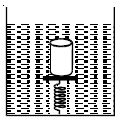
A cylindrical block of area of cross-section $A$ and of material of density $\rho$ is placed in a liquid of density one-third of density of block. The block compresses a spring and compression in the spring is one-third of the length of the block. If acceleration due to gravity is $g$, the spring constant of the spring is:
The decay constant for a radioactive nuclide is $1.5 \times 10^{-5} s ^{-1}$. Atomic of the substance is $60\,g$ mole $^{-1},\left( N _{ A }=6 \times 10^{23}\right)$. The activity of $1.0\,\mu g$ of the substance is $.......\,\times 10^{10}\,Bq$
In which of the following the final image is erect?
Polarised glass is used in sun glasses because
For a concave mirror, if virtual image is formed, the graph between $m$ and $u$ is of the form
A double convex lens is made of glass of refractive index $1.5$. If its focal length is $30 cm,$ then radius of curvature of each of its curved surface is
$A$ block of mass $M$ is placed on $a$ horizontal surface and it is tied with an inextensible string to $a$ block of mass, as shown in figure. A block of mass $m_0$ is also placed on $M$ If friction force exists between the block $M$ and the block $m_0$ and not between the block $M$ and the horizontal surface, then the minimum value of $\mu$ for which the block m remains stationary is
A uniform rod of length $l$ is being rotated in a horizontal plane with a constant angular speed about an axis passing through one of its ends. If the tension generated in the rod due to rotation is $T(x)$ at a distance $x$ from the axis, then which of the following graphs depicts it most closely?
Two long parallel wires are at a distance of $1$ metre. Both of them carry one ampere of current. The force of attraction per unit length between the two wires is