MCQ
Select the incorrect option?
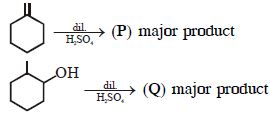
  • A
    $(P)$ and $(Q)$ are same
  • $(P)$ and $(Q)$ are positional isomers
  • C
    Formation of $(Q)$ involves hydride migration
  • D
    Formation of $(P)$ is electrophilic addition

Answer

Correct option: B.
$(P)$ and $(Q)$ are positional isomers
b

Need a full question paper?

Generate a complete, print-ready paper with questions like this in minutes — across 16+ boards, with answer keys.

Start Generating Free

Similar questions

Electrolysis of cold concentrated aqueous solution of potassium succinate yields
The energy of the electron in the first orbit of $H{e^ + }$ is $ - 871.6 \times {10^{ - 20}}J$. The energy of the electron in the first orbit of hydrogen would be
$RNA$ and $DNA$ are chiral molecules, their chirality is due to
Which of the following compounds is formed by addition of mineral acid to an aqueous solution of borax ?
$t _{87.5}$ is the time required for the reaction to undergo $87.5 \%$ completion and $t_{50}$ is the time required for the reaction to undergo $50 \%$ completion. The relation between $t_{87.5}$ and $t_{50}$ for a first order reaction is $t _{87.5}= x \times t _{50}$ The value of $x$ is $......$. (Nearest integer)
Assuming ideal behaviour, the magnitude of $log \, K$ for the following reaction at $25^{\circ} C$ is $x \times 10^{-1} .$ The value of $x$ is $...... .$ (Integer answer)

$3 HC \equiv CH _{( g )} \rightleftharpoons C _{6} H _{6(\ell)}$

[Given: $\Delta_{f} G ^{\circ}( HC \equiv CH )=-2.04 \times 10^{5}\, J mol ^{-1}$

$\Delta_{f} G ^{\circ}\left( C _{6} H _{6}\right)=-1.24 \times 10^{5}\, J mol ^{-1} ; R =8.314\,\left. J K ^{-1} mol ^{-1}\right]$

When $100 \ mL$ of $1.0 \ M \ HCl$ was mixed with $100 \ mL$ of $1.0 \ M \ NaOH$ in an insulated beaker at constant pressure, a temperature increase of $5.7^{\circ} C$ was measured for the beaker and its contents (Expt. $1$). Because the enthalpy of neutralization of a strong acid with a strong base is a constant $\left(-57.0 \ kJ \ mol ^{-1}\right)$, this experiment could be used to measure the calorimeter constant. In a second experiment (Expt. $2$), $100 \ mL$ of $2.0 \ M$ acetic acid $\left(K_a=2.0 \times 10^{-5}\right)$ was mixed with $100 \ mL$ of $1.0 M \ NaOH$ (under identical conditions to Expt. $1$) where a temperature rise of $5.6^{\circ} C$ was measured.

(Consider heat capacity of all solutions as $4.2 J g ^{-1} K ^{-1}$ and density of all solutions as $1.0 \ g mL ^{-1}$ )

$1.$ Enthalpy of dissociation (in $kJ mol ^{-1}$ ) of acetic acid obtained from the Expt. $2$ is

$(A)$ $1.0$ $(B)$ $10.0$ $(C)$ $24.5$ $(D)$ $51.4$

$2.$ The $pH$ of the solution after Expt. $2$ is

$(A)$ $2.8$ $(B)$ $4.7$ $(C)$ $5.0$ $(D)$ $7.0$

Give the answer question $1$ and $2.$

In which of the following process, highest energy is absorbed ?
Water is a
The formula of an oxyacid of phosphorus is ${H_3}P{O_4}$. It is a