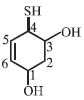
MCQ
Select the structure with correct numbering for $IUPAC$ name of the compound
  • A


  • C

  • D

Answer

Correct option: B.

b

Need a full question paper?

Generate a complete, print-ready paper with questions like this in minutes — across 16+ boards, with answer keys.

Start Generating Free

Similar questions

Which of the following has been arranged in order of increasing oxidation number of nitrogen ?
Given below are two statements : one is labelled as Assertion $A$ and the other is labelled as Reason $R:$

Assertion $A:$ Metallic sodium dissolves in liquid ammonia giving a deep blue solution, which is paramagnetic.

Reason $R:$ The deep blue solution is due to the formation of amide.

In the light of the above statements, choose the correct answer from the options given below :

The number of incorrect statement/s from the following is

$A$. The successive half lives of zero order reactions decreases with time.

$B$. A substance appearing as reactant in the chemical equation may not affect the rate of reaction

$C$. Order and molecularity of a chemical reaction can be a fractional number

$D$. The rate constant units of zero and second order reaction are $mol\, L ^{-1} s ^{-1}$ and $mol ^{-1} Ls ^{-1}$ respectively
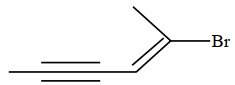
Choose the correct name for compound given below:
Given below are two statements :
Statement (I) : A spectral line will be observed for a $2 p_x \rightarrow 2 p_y$ transition.
Statement (II) : $2 p _{ x }$ and $2 p _{ y }$ are degenerate orbitals.
In the light of the above statements, choose the correct answer from the options given below :
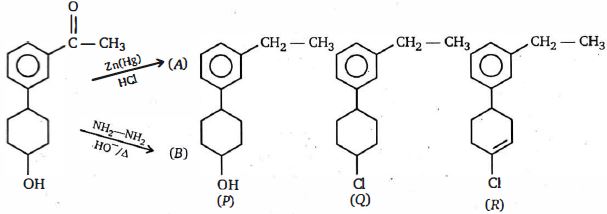
Identify product $(A)$ & $(B)$ from the given product $P, Q, R$
Radius of $1^{\text {st }}$ orbit of $H$ and some orbit of $Be ^{3+}$ is same . Energy of their orbit of $Be ^{3+}$ is ............$eV$
A salt $MX$ has $K_{sp}$ = $4 × 10^{-10}$ . What value of $K_{sp}$ must another salt $MX_3$ have if the molar solubility of the two salts is to be identical
$A, B$ and $C$ are three biomolecules. The results of the tests performed on them are given below

$\begin{array}{|c|c|c|c|}\hline {} &\text { Molisch's Test} & {\text { Barfoed Test}} & {\text { Biuret Test}} \\ \hline \text { A} & { Positive } & {\text { Negative }} & {\text { Negative }} \\ \hline \text { B } & {\text { Positive }} & {\text { Positive }} & {\text { Negative }} \\ \hline \text { C } & {\text { Negative }} & {\text { Negative }} & {\text { Positive }} \\ \hline\end{array}$

$A, B$ and $C$ are respectively

The position of both an electron and a helium atom is known within $1.0\,nm$ and the momentum of the electron is known within $50 \times {10^{ - 26}}\,kg\,m{s^{ - 1}}$. The minimum uncertainty in the measurement of the momentum of the helium atom is