MCQ
Select wrong statement about simple,harmonic motion
  • The body is uniformly accelerated
  • B
    The velocity of the body changes smoothly at all instants
  • C
    The amplitude of oscillation is symmetric about the equilibrium position
  • D
    The frequency of oscillation is independent of amplitude
Answer

Correct option: A.
The body is uniformly accelerated
a
(a)

In $S.H.M.$

$a=-\omega^2 x$

Thus acceleration varies linearly with time.

Need a full question paper?

Generate a complete, print-ready paper with questions like this in minutes — across 16+ boards, with answer keys.

Start Generating Free

Similar questions

$100$ coplanar forces each equal to $10 \,N$ act on a body. Each force makes angle $\pi /50$ with the preceding force. What is the resultant of the forces.......... $N$
A small steel ball is dropped into a long cylinder containing glycerine. Which one of the following is the correct representation of the velocity time graph for the transit of the ball?
A block of mass $m$ slides down the plane inclined at angle $30^{\circ}$ with an acceleration $\frac{ g }{4}$. The value of coefficient of kinetic friction will be :
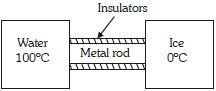
An insulated container is filled with ice at $0\,^oC$ , and another container is filled with water that is continuously boiling at $100\,^oC$ . In series of experiments, the containers are connected by various thick metal rods that pass through the walls of container as shown in the figure

In the experiment $I$ : a copper rod is used and all ice melts in $20$ minutes.

In the experiment $II$ : a steel rod of identical dimensions is used and all ice melts in $80$ minutes.

In the experiment $III$ : both the rods are used in series and all ice melts in $t_{10}$ minutes.

In the experiment $IV$ : both rods are used in parallel and all ice melts in $t_{20}$ minutes.

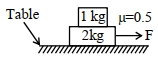
The coefficient of static friction between two blocks is $0.5$ and the table is smooth. The maximum horizontal force that can be applied to move the blocks together is $\ldots \ldots . N$. (take $\left.g=10\, {ms}^{-2}\right)$
Consider elastic collision of a particle of mass $m $ moving with a velocity $u$ with another particle of the same mass at rest. After the collision the projectile and the struck particle move in directions making angles ${\theta _1}$and ${\theta _2}$respectively with the initial direction of motion. The sum of the angles. ${\theta _1} + {\theta _2},$ is......$^o$
Air is pushed into a soap, bubble of radius r to double its radius. If the surface tension of the soap solution is S, the work done in the process is:
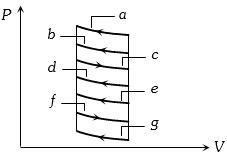
The $P-V$ diagram shows seven curved paths (connected by vertical paths) that can be followed by a gas. Which two of them should be parts of a closed cycle if the net work done by the gas is to be at its maximum value
A body of mass $10\, kg$ is dropped to the ground from a height of $10\, metres$. The work done by the gravitational force is ............. $\mathrm{J}$ $(g = 9.8\,m/{\sec ^2})$
A uniform rope of mass $6\,kg$ hangs vertically from a rigid support. A block of mass $2\,kg$ is attached to the free end of the rope. A transverse pulse of wavelength $0.06\,m$ is produced at the lower end of the rope. The wavelength of the pulse when it reaches the top is (in $m$ )