MCQ
$SER$ produces
  • A
    Protein
  • B
    Carbohydrate
  • Lipid
  • D
    Nucleic acid

Answer

Correct option: C.
Lipid
c

(c) The production of lipid is concern with the smooth ER and production of protein with RER.

Need a full question paper?

Generate a complete, print-ready paper with questions like this in minutes — across 16+ boards, with answer keys.

Start Generating Free

Similar questions

Corolloid roots are found in
Which of the following structures in Pinus are haploid
Which of the following are not correct ?
(i) Oxygen helps in releasing metabolic energy essential for growth activities.
(ii) Nutrients are required by plants for the synthesis of protoplasm and act as source of energy.
(iii) Light and gravity affect certain stages of growth.
(iv) Water oxidizes glucose to provide energy
(v) Long day plants flower if the night length shorter than a critical period.
(vi) Short-day plants flower when night length exceeds a critical dark period.
(vii) The process of flowering does not occur in dayneutral plants.
(viii) 17,500 new cells are produced per hour by a single maize root apical meristem.
(ix) With the help of length, growth of pollen tube is measured.
(x) The growth of the leaf is measured in terms of volume.
(xi) Cells in a watermelon may increase in size by upto 3,50,000 times.
Choose the correct option given below :-
Mark the given statements True (T) or False (F).
(i) In majority of the dicotyledonous plants, the direct elongation of the radical leads to the formation of secondary root which grows inside the soil.
(ii) In monocotyledonous plants, the primary root is short lived and is replaced by a large number of roots.
(iii) In some plants like grass, Monstera and banyan tree, roots arises from parts of the plant other than the radical and are called adventitious roots.
(iv) Roots hairs are present in region of elongation.
(v) The zone proximal to region of elongation is called the region of maturation.
(vi) Tap roots of carrot, turnip and adventitious roots of sweet potato, get swollen and store food.
(vii) Hanging structure that support a banyan tree are called stilt roots.
(viii) The stems of maize and sugarcane have supporting roots coming out of the upper nodes of the stem are called stilt roots.
(ix) In some plants such as Rhizophora growing in swampy areas, many roots come out of the ground and grow vertically upwards. Such roots are called pneumatophores and help to get oxygen for respiration.
(x) The regions of the stem where leaves are born are called nodes.
(xi) Underground stems of Zaminkand, Colocasia are modified to store food in them.
(xii) Tendrils which develop from axillary buds, are slender and spirally coiled and help plants to climb.
(xiii) A lateral branch with short internodes and each node bearing a rosette of leaves and a tuft of roots is found in terrestial plants like pistia and eichhornia.
(xiv) Leaves originate from shoot apical meristems and are arranged in an acropetal order.
(xv) A typical leaf consists of three main parts: leaf base, petiole and lamina
Choose the correct option given below :-
Which of the following statements is true regarding chemiosmotic hypothesis ?
(i) Protons or hydrogen ions that are produced by the splitting of water accumulate within the lumen of the thylakoids.
(ii) Primary accepter of electron which is located towards the outer side of the thylakoids membrane transfers its electron not to an electron carrier but to an H carrier.
(iii) The NADP reductase enzyme is located on the stroma side of the membrane.
(iv) Protons are also removed from the stroma by NADP.
(v) Due to removal of proton by NADP, within the chloroplast, protons in the stroma decrease in number, while in the lumen there is accumulation of protons. This creates a proton gradient across the thylakoid membrane.
(vi) Due to accumulation of protons in lumen of thylakoid measurable increase in pH in the lumen.
Flowers and lateral branches arise from the
The vegetative cell is
Persistent nucellus in the seed is known as
Choose incorrect sentences for chloroplast.

$(1)$ In chloroplast membranous system consisting of grana and the fluid stroma.

$(2)$ Pigments are present in stroma.

$(3)$ In stoma, enzymatic reactions in corporate $O_2$ into the plant leading to the synthesis of sugar.

$(4)$ Light is not required for formation of sugarin stroma.

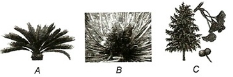
The correct names of gymnospermic plant $A, B$ and $C$ shown in figure below are