Question
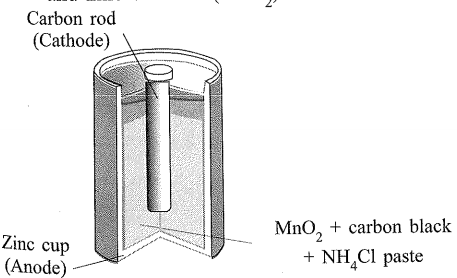
Short Note on dry cell ### Explain Leclanche cell.

Answer

→ The cell consists of a zinc container that also acts as anode, while the cathode is a carbon (graphite) rod surrounded by powered manganese dioxide and carbon.
→ The space between the electrodes is filled with a moist of paste of ammonium chloride $\left( NH _4 Cl \right)$ and zinc chloride $\left( ZnCl _2\right)$
Image
→ Dry cells are often used in devices like transistors, toys and clocks.
→ The electrode reactions are complex, by they can be written approximately as follows :
Anode $: Zn ( s ) \rightarrow Zn ^{2+}+2 e ^{-}$
Cathode : $MnO _2+ NH _4^{+}+ e ^{-} \rightarrow MnO ( OH )+ NH _3$
→ In the reaction at cathode, manganese is reduced from the +4 oxidation state to the +3 state.
→ Ammonia produced in the reaction forms a complex with $Zn ^{+2}$ to give $\left[ Zn \left( NH _3\right)_4\right]^{+2}$. The cell has a potential of nearly 1.5 V .

Need a full question paper?

Generate a complete, print-ready paper with questions like this in minutes — across 16+ boards, with answer keys.
Start Generating Free

Similar questions

Give the equations of reaction of phenol with the following compounds:
(i) Benzene diazonium chloride
(ii) Acetone
(iii) Phthalic anhydride.
  1. For the complex [Fe(H2O)6]3+, write the hybridization, magnetic character and spin of the complex. (At. number: Fe = 26)
  2. Draw one of the geometrical isomers of the complex [Pt(en)2Cl2]2+ which is optically inactive.
Give one example of each of the following:
(i) Synthetic polymer, (ii) Condensation polymer.
An optically active amino acid (A) can exist in three forms depending on the pH of the medium. The molecular formula of (A) is C3H7NO2.
  1. Write the structure of compound (A) in aqueous medium. What are such ions called?
  2. In which medium will the cationic form of compound (A) exist?
  3. In alkaline medium, towards which electrode will the compound (A) migrate in electric field?
100 g of liquid A (molar mass 140 g mol–1) was dissolved in 1000 g of liquid B (molar mass 180 g mol–1). The vapour pressure of pure liquid B was found to be 500 torr. Calculate the vapour pressure of pure liquid A and its vapour pressure in the solution if the total vapour pressure of the solution is 475 Torr.
  1. Which one of the following is a disaccharide: Starch, Maltose, Fructose, Glucose?
  2. What is the difference between fibrous protein and globular protein?
  3. Write the name of vitamin whose deficiency causes bone deformities in children.
(A), (B) and (C) are three non-cyclic functional isomers of a carbonyl compound with molecular formula C4H8O. Isomers (A) and (C) give positive Tollens’ test whereas isomer (B) does not give Tollens’ test but gives positive Iodoform test. Isomers (A) and (B) on reduction with Zn(Hg)/ conc. HCl give the same product (D).
  1. Write the structures of (A), (B), (C) and (D).
  2. Out of (A), (B) and (C) isomers, which one is least reactive towards addition of HCN?
Give the required equation for following conversions:
(i) Acetophenone to Benzoic acid
(ii) Propionic acid to Acetic acid.
Tert-Butylbromide reacts with aq. NaOH by SN1 mechanism while n-butylbromide reacts by SN2 mechanism. Why?
Define conductivity and molar conductivity for the solution of an electrolyte.
Discuss their variation with concentration.