Question
Short note on :Lactose

Answer

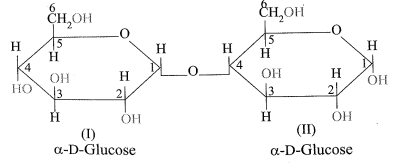
It is more commonly known as milk sugar since this disaccharide is found in milk.
It is composed of ẞ-D-galactose and ẞ-D-Glucose
Image
The linkage is between C1 of galactose and C4 of glucose.
Free aldehyde group may be produced at C-1 of glucose unit, hence it is also a reducing sugar.
Image

Need a full question paper?

Generate a complete, print-ready paper with questions like this in minutes — across 16+ boards, with answer keys.

Start Generating Free

Similar questions

Define an ideal solution and write one of its characteristics.
How will you carry out the following conversions?
  1. toluene → p-toluidine.
  2. p-toluidine diazonium chloride → p-toluic acid.
Compound ‘A’ with molecular formula C4H9Br is treated with aq. KOH solution. The rate of this reaction depends upon the concentration of the compound ‘A’ only. When another optically active isomer ‘B’ of this compound was treated with aq. KOH solution, the rate of reaction was found to be dependent on concentration of compound and KOH both.
  1. Write down the structural formula of both compounds ‘A’ and ‘B’.
  2. Out of these two compounds, which one will be converted to the product with inverted configuration.
What happens when the vapours of a primary, secondary and tertiary alcohol are passed over heated copper at 573 K temperature? Explain with chemical equation.
Discuss the classification of monohydric alcohols containing Csp2-OH bond.
Write the important structural and functional differences between DNA and RNA.
(i) Complete the following reaction :
$CH _2= CH - CH _2- Br \xrightarrow[\text { Peroxide }]{ HBr }$
(ii) How form n-propyl bromide from isopropyl bromide?
In a reaction between A and B, the initial rate of reaction (r0) was measured for different initial concentrations of A and B as given below:
A/mol L-1 0.20 0.20 0.40
B/mol L-1 0.30 0.10 0.05
r0/mol L-1 s-1 5.07 × 10-5 5.07 × 10-5 1.43 × 10-4
What is the order of the reaction with respect to A and B?
Define the following terms:
  1. Mole fraction.
  2. Isotonic solutions.
  3. Van't Hoff factor.
  4. Ideal solution.
Differentiate between molality and molarity of a solution. What is the effect of change in temperature of a solution on its molality and molarity?