Question
Short note on: Maltose

Answer

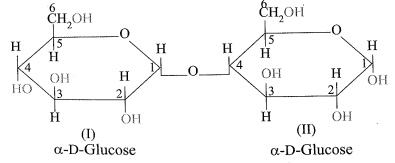
$\rightarrow$ Maltose is composed of two $a-D-$glucose.
$\rightarrow $ ​​​​​​​
Image
$\rightarrow$ In maltose $C_1$ of one glucose $(I)$ is linked to $C_4$ of another glucose unit $(II).$
$\rightarrow$ The free aldehyde group can be produced at $C_1$ of second glucose in solution and it shows reducing properties
​​​​​​​so, it is a reducing sugar.​​​​​​​
Image

Need a full question paper?

Generate a complete, print-ready paper with questions like this in minutes — across 16+ boards, with answer keys.

Start Generating Free

Similar questions

Calculate the amount of benzoic acid $(C_6H_5COOH)$ required for preparing $250\ mL$ of $0.15\ M$ solution in methanol.
If the price of electricity require to obtain $1$ gram $M g$ from the solution of $M g ^{ 2 + }$ ion is $Rs.5 . 0 0$, then what will the price of electricity required to obtain $10$ gram of $Al$ from $Al ^{3+} ? \ ($Atomic mass of $Al = 27$ and $M g =24)$
Define the following with a suitable example in each:
  1. Oligosaccharides
  2. Denaturation of protein
  3. Vitamins
How will you distinguish between the following pairs of compounds:
Chloroform and carbon tetrachloride.
Explain the structure and function of salt bridge of molten galvanic cell.
  1. Describe the following giving suitable examples:
  2. Give a chemical test to distinguish between ethanal and propanal.
  3. Cannizzaro reaction.
  4. Aldol condensation.
Draw structures of the following derivatives:
i. 2,4-Dinitrophenylhydrazone of benzaldehyde
ii. Cyclopropanone oxime
iii. Acetaldehydedimethylacetal
Arrange water, ethanol and phenol in increasing order of acidity and give reason for your answer.
Answer the following questions:
Compare non transition and transition elements on the basis of their.
  1. Variability of oxidation states.
  2. Stability of oxidation states.
Give reasons:
  1. $n-$Butyl bromide has higher boiling point than $t-$butyl bromide.
  2. Racemic mixture is optically inactive.
  3. The presence of nitro group $(–NO_2)$ at o/p positions increases the reactivity of haloarenes towards nucleophilic substitution reactions.