Question
Show by using the graphical method that:$\text{s}=\text{ut}+\frac{1}{2}\text{at}^2$
where the symbols have their usual meanings.
Answer

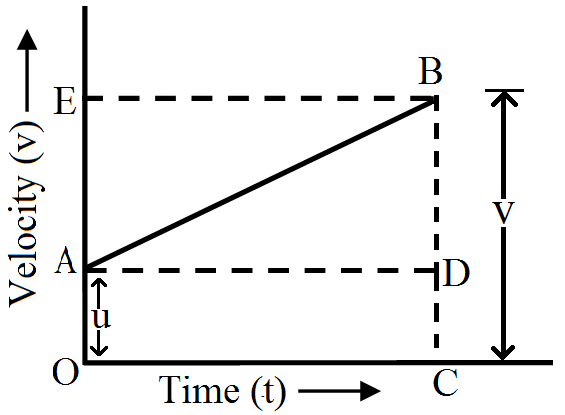
Consider the velocity-time graph of a body shown in figure. The body has an initial velocity u at a point A and then its velocity changes at a uniform rate from A to B in time t. In other words, there is a uniform acceleration a from A to B, and after time t its final velocity becomes v which is equal to BC in the graph. The time t is represented by OC. Suppose the body travels a distance s in time t. In the figure, the distance travelled by the body is given by the area of the space between the velocity-time graph AB and the time axis OC, which is equal to the area of the figure OABC. Thus: Distance travelled = Area of figure OABC = Area of rectangle OABC + area of triangle ABD Now, we will find out the area of rectangle OABC and area of triangle ABD.
  1. Area of rectangle OADC = OA × OC
= u × t
= ut
  1. Area of triangle ABD $=\Big(\frac{1}{2}\Big)\times\text{Area of rectangle AEBD}$
$=\Big(\frac{1}{2}\Big)\times\text{AD}\times\text{BD}$
$=\Big(\frac{1}{2}\Big)\text{at}^2$
Distance travelled, s = Area of rectangle OADC + Area of triangle ABD$\text{s}=\text{ut}+\frac{1}{2}\text{at}^2$

Need a full question paper?

Generate a complete, print-ready paper with questions like this in minutes — across 16+ boards, with answer keys.
Start Generating Free

Similar questions

Why are xylem and phloem called complex tissues? How are they different from one other?
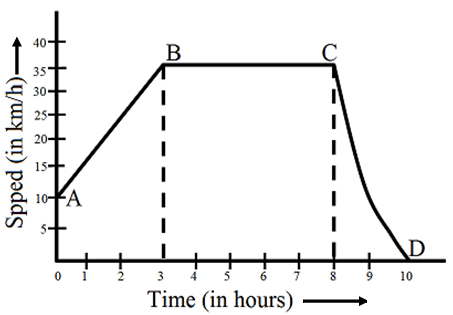
The graph given alongside shows how the speed of a car changes with time:
  1. What is the initial speed of the car?
  2. What is the maximum speed attained by the car?
  3. Which part of the graph shows zero acceleration
  4. Which part of the graph shows varying retardation?
  5. Find the distance travelled in first 8 hours.
  1. How does a boat float in water?
  2. A piece of steel has a volume of $12\ cm^3,$ and a mass of $96g$. What is its density: $(i)$ in $g/cm^{3 }\ (ii)$ in $kg/m^3$?
How will you separate a mixture containing kerosene and petrol (difference in their boiling points is more than 25ºC), which are miscible with each other?
What should be do to get maximum benefit from a crop field?
If the distance between two masses is increased by a factor of $5,$ by what factor would the mass of one of them have to be altered to maintain the same gravitational force? Would this be an increase or decrease in the mass?
Derive the unit of force using the second law of motion. A force of $5N$ produces an acceleration of $8\ m s^{–2}$ on a mass $m_1$ and an acceleration of $24\ m s^{–2}$ on a mass $m_2.$ What acceleration would the same force provide if both the masses are tied together $?$
How will you determine the melting point of ice experimentally with the help of a neat and labelled diagram?
How can you obtain pure water from a salt-water mixture (or salt-solution)? Draw a meat and labelled diagram of the apparatus you would use to obtain pure water from a salt-water mixture (or salt-solution).
What is a soundboard? Explain the working of a soundboard with the help of a labelled diagram.