Question
Show mathematically how Bohr's postulate of quantization of orbital angular momentum in hydrogen atom is explained by de-Broglie's hypothesis.

Answer

de Broglie wavelength, $\lambda = \frac{\text{h}}{\text{mv}}$
For electron moving in the nth orbit, $2 \pi\text{r} = \text{n}\lambda$
$\therefore2\pi\text{r} = \frac{\text{nh}}{\text{mv}}$
$\therefore\text{mvr} = \frac{\text{nh}}{2\pi} = \text{L}$ (orbital angular momentum)
This is Bohr’s Postulate of quantization of orbital angular momentum.

Need a full question paper?

Generate a complete, print-ready paper with questions like this in minutes — across 16+ boards, with answer keys.
Start Generating Free

Similar questions

a. It is not advisable to use a galvanometer as such to measure current directly. Why?
b. Why should the value of resistance connected in parallel to a galvanometer be low?
c. Is the reading shown by an ammeter in a circuit less than or more than the actual value of current flowing in the circuit? Why?
A silver wire has a resistance of 2.1 Ω at 27.5${ }^{\circ} C$, and a resistance of 2.7 Ω at 100 ${ }^{\circ} C$. Determine the temperature coefficient of resistivity of silver.
Draw equipotential surface due to the following :(i) Any electric dipole(ii) Two identical positive charges separated by some distance.
Draw a labelled ray diagram of a reflecting telescope. Mention its two advantages over the refracting telescope.
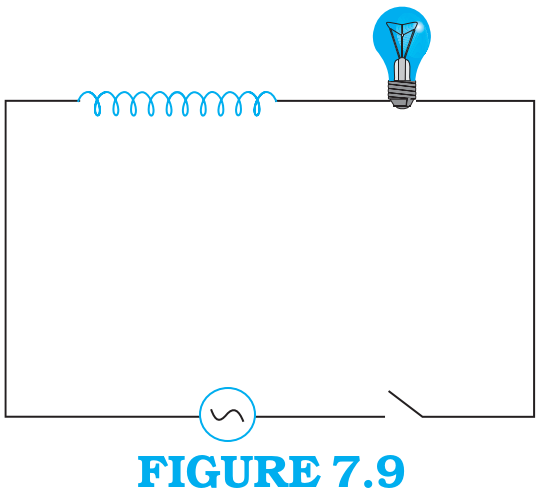
A light bulb and an open coil inductor are connected to an ac source through a key as shown in Fig. 7.9.
Image
The switch is closed and after sometime, an iron rod is inserted into the interior of the inductor. The glow of the light bulb (a) increases; (b) decreases; (c) is unchanged, as the iron rod is inserted. Give your answer with reasons.
A body builder exerts a force of 150N against a bullworker and compresses it by 20cm. Calculate the spring constant of the spring in the bullworker.
The pressure of the gas in a constant volume gas thermometer is 70kPa at the ice point. Find the pressure at the steam point.
Let $\vec{\text{A}}=3\vec{\text{i}}+4\vec{\text{j}}.$ Write four vector $\overrightarrow{\text{B}}$ such that $\overrightarrow{\text{A}}\neq\overrightarrow{\text{B}}$ but A = B.
X and Y are two parallel plate capacitors, whose plates have the same area and the same distance between them. There is air between the plates of $X$ and a dielectric material of dielectric constant $k=5$ between the plates of $Y$ (in the figure). (a) Calculate the potential diffe-rence between the plates X and Y . (b) What is the ratio of electrical potential energies stored in X and Y ?
Let $\overrightarrow{\text{A}}=5\vec{\text{i}}-4\vec{\text{j}}$ and $\overrightarrow{\text{B}}=-7.5\vec{\text{i}}+6\vec{\text{j}}.$
  1. Do we have $\overrightarrow{\text{B}}\text{k}\vec{\text{A}}?$
  2. Can we say $\frac{\overrightarrow{\text{B}}}{\overrightarrow{\text{A}}}=\text{k}?$