Question
Show that: $2x - 3$ is a factor of $x + 2x^3 - 9x^2 + 12.$

Answer

Let $p(x) = x + 2x^3 - 9x^2 + 12, g(x) = 2x - 3 g(x) = 2x - 3 = 0$
gives $\text{x}=\frac{3}{2}$ g(x) will be a factor of p(x) if $\text{p}\Big(\frac{3}{2}\Big)=0$ (Factor theorem)
Now, $\text{p}\Big(\frac{3}{2}\Big)=\frac{3}{2}+2\Big(\frac{3}{2}\Big)^3-9\Big(\frac{3}{2}\Big)^2+12$
$=\frac{3}{2}+2\Big(\frac{27}{8}\Big)-9\Big(\frac{9}{4}\Big)+12$
$=\frac{3}{2}+\frac{27}{4}-\frac{81}{4}+12$
$=\frac{6+27-81+48}{4}=\frac{0}{4}=0$
Since, $\text{p}\Big(\frac{3}{2}\Big)=0,$
So $g(x)$ is a factor of $p(x)$.

Need a full question paper?

Generate a complete, print-ready paper with questions like this in minutes — across 16+ boards, with answer keys.
Start Generating Free

Similar questions

In $\triangle\text{ABC},$ if $\angle\text{A}+\angle\text{B}=125^\circ$ and $\angle\text{A}+\angle\text{C}=113^\circ,$ find $\angle\text{A},\angle\text{B}$ and $\angle\text{C}.$
Evaluate: $\big[(16)^{\frac{1}{2}}\big]^{\frac{1}{2}}$
Find the median of the data: $133, 73, 89, 108, 94, 104, 94, 85, 100, 120$
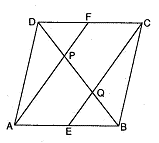
In a parallelogram $ABCD$, $E$ and $F$ are the mid-points of sides $AB$ and $CD$ respectively. Show that the line segments $AF$ and $EC$ trisect the diagonal $BD.$
Show that:$\Big(\frac{\text{a}^{\text{x}+1}}{\text{a}^{\text{y}+1}}\Big)^{\text{x}+\text{y}}\Big(\frac{\text{a}^{\text{y}+2}}{\text{a}^{\text{z}+2}}\Big)^{\text{y}+\text{z}}\Big(\frac{\text{a}^{\text{z}+3}}{\text{a}^{\text{x}+3}}\Big)^{\text{z}+\text{x}}=1$
If the temperature of a liquid can be measured in kelvin units as $x^\circ K$ or in fahrenheit units as $y^\circ F$, the relation between the two systems of measurement of temperature is given by the linear equation. $\text{y}=\frac{9}{5}(\text{x}-273)+32$
$i.$ find the temperature of the liquid in fahrenheit, if the temperature of the liquid is $313K.$
$ii.$ If the temperature is $158^\circ F$, then find the temperature in kelvin.
Factorise: $\sqrt{5}\text{x}^2+2\text{x}-3\sqrt{5}$
Rationales the denominator and simplify: $\frac{2\sqrt3-\sqrt5}{2\sqrt{2}+3\sqrt{3}}$
You know that the force applied on a body is directly proportional to the acceleration produced in the body. Write an equation to express this situation and plot the graph of the equation.
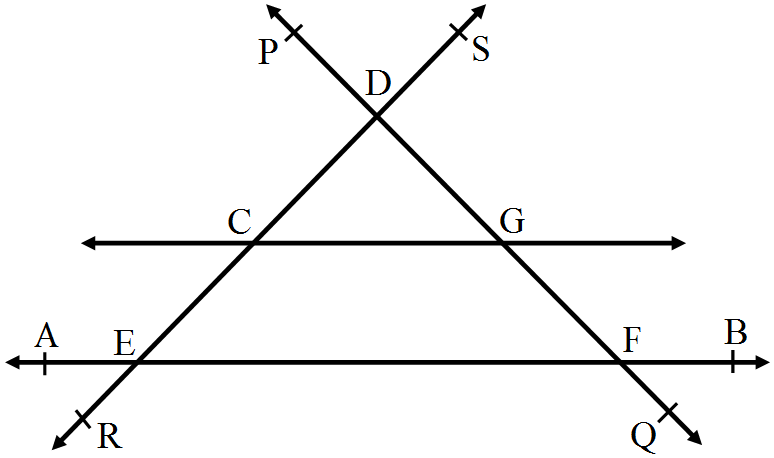
From the given figure, name the following:
$a.$ Three lines.
$b.$ One rectilinear figure.
$c$. Four concurrent points.