Question
Show that a force that does no work must be a velocity dependent force.

Answer

To show that a force that does no work must be a velocity dependent force, then we have to assume that work done by force is zero. As shown by the equation below:
$\text{dW}=\vec{\text{F}}.\vec{\text{dI}}=0$
We can write, $\vec{\text{dI}}=\vec{\text{v}}\text{dt But}\text{ dt}\neq0 $
$\Rightarrow\ \vec{\text{F}}.\vec{\text{v}}\text{dt}=0$
$\Rightarrow\ \vec{\text{F}}.\vec{\text{v}}=0$
So we can say that force F must be velocity dependent, this implies that angle between F and v is 90°. If the direction of velocity changes, then direction of force will also change.

Need a full question paper?

Generate a complete, print-ready paper with questions like this in minutes — across 16+ boards, with answer keys.
Start Generating Free

Similar questions

Write the product of equivalent capacitances when 10 capacitors, each having a capacitance of $10 \mu F$, are connected in series and then parallel connection.
What is obtained by fusion of two deuterons?
Two electric bulbs have the following specifications.
  1. 100W at 220V.
  2. 1000W at 220V.
Which bulb has higher resistance? What is the ratio of their resistances?
Distinguish between isotopes and isobars. Give one example for each of the species.
Explain why the reactance provided by a capacitor to an alternating current decreases with increasing frequency.
  1. Write the principle of working of a metre bridge.
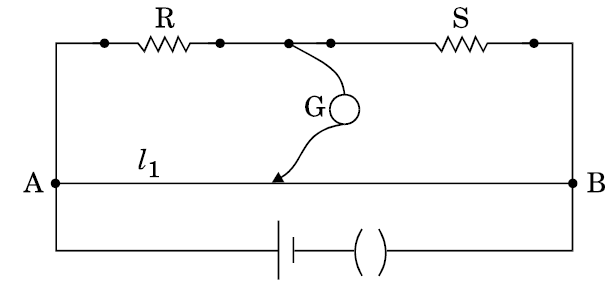
  2. In a metre bridge, the balance point is found at a distance $l_1$ with resistances R and S as shown in the figure.

An unknown resistance X is now connected in parallel to the resistance S and the balance point is found at a distance $l_2$. Obtain a formula for X in terms of $l_1$, $l_2$ and S.

A point charge is moving along a straight line with a constant velocity u. Consider a small area A perpendicular to the direction of motion of the charge (El). Calculate the displacement current through the area when its distance from the charge is x. The value of x is not large so that the electric field at any instant is essentially given by Coulomb's law.

Consider earth satellites in circular orbits. A geostationary satellite must be at a height of about 36000km from the earth's surface. Will any satellite moving at this height be a geostationary satellite? Will any satellite moving at this height have a time period of 24 hours?
Consider Galileo's method of measuring the speed of light using two lanterns. To get an accuracy of about 10%, the time taken by the experimenter in closing or opening the shutter should be about one tenth of the time taken by the light in going from one experimenter to the other. Assume that it takes $\frac{1}{100}$ second for an experimenter to close or open the shutter. How far should the two experimenters be to get a 10% accuracy? What are the difficulties in having this separation?
A toroid has a core (non-ferromagnetic) of inner radius 25 cm and outer radius 26 cm, around which 3500 turns of a wire are wound. If the current in the wire is 11 A, what is the magnetic field,
  1. Outside the toroid,
  2. Inside the core of the toroid and,
  3. In the empty space surrounded by the toroid.