Maharashtra BoardEnglish MediumSTD 12 SciencePhysicsREPEATER 20243 Marks
Question
Show that all harmonics are present in case of a stretched string.
✓
Answer
Consider a string stretched between two rigid supports and plucked.
Due to plucking, string vibrates and loops are formed in the string.
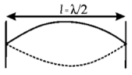
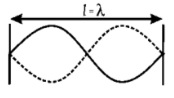
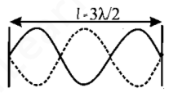
Vibrations of string are as shown in figure.
Let,
$P=$ number of loops
$l=$ length of string
$\therefore $ Length of one loop $=\frac{l}{p}.......(1)$
Two successive nodes form a loop.
Distance between two successive nodes is $\frac{\lambda}{2}$.
$\therefore $ Length of one loop $=\frac{\lambda}{2}....(2)$
From equation $(1)$ and $(2),$
$\therefore \frac{\lambda}{2}=\frac{l}{p}$
$\therefore \lambda=\frac{2l}{p}........(3)$
Velocity of trandverse wave is given by,
$v=\sqrt{\frac{r}{m}}$
Frequency of string is given by,
$n=\frac{v}{{\lambda}}$
Substituting $\lambda$ from equation $(3),$ we get
$n=\frac{\sqrt{\frac{T}{m}{{}}}}{\frac{2l}{p}}$
$\therefore \ n=\frac{p}{2l} \sqrt{\frac{r}{m}}........(4)$
For fundamental mode of first harmonic, $p=1$
$\therefore \ n=\frac{1}{21} \sqrt{\frac{7}{20}}$
This frequency is called fundamental frequency.
First overtone or second harmonic:
In this case, $p=2$.
$\therefore $ From equation (4), we get
$\therefore \ n_1=\frac{2}{2 l} \sqrt{\frac{T}{m}}=2 \times \frac{1}{2 l} \sqrt{\frac{T}{m}}$
$\therefore \ n_1=2 n$
Second overtone or third harmonic:
In this case, $p=3$.
$\therefore $ From equation $(4),$ we get
$\therefore n_2=\frac{3}{2 l} \sqrt{\frac{\gamma}{m}}=3 \times \frac{1}{2 l} \sqrt{\frac{T}{m}}$
$\therefore n_2=3 n$
Similarly for higher modes of vibrations of the string, the frequencies of vibrations are as $4 n$, $5 n, 6 n \ldots$ etc.
Thus, in the vibration of stretched string, frequencies of vibrations are $n, 2 n, 3 n, \ldots .$. so on.
Hence, all harmonics $($even as well as odd$)$ are present in the vibrations of stretched string.
$\therefore \ p^{\text {th }}$ harmonic is given by $n_p=p n$
Need a full question paper?
Generate a complete, print-ready paper with questions like this in minutes — across 16+ boards, with answer keys.