Question
Show that currents in two long, straight, parallel wires exert forces on each other. Derive the expression for the force per unit length on each conductor.
Answer

Case I: Both wires carry current in the same direction.
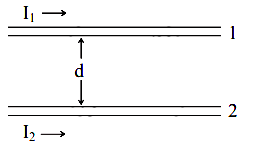
i. Consider two long parallel wires separated by distance $d$ and carrying current $I _1$ and $I _2$ respectively same direction as same as shown in the figure below:

Two long parallel wires, distance $d$ apart
ii. The magnetic field at the second wire due to the current $I_1$ in the first one, according to Biot - Savart's law is $B =\frac{\mu_0 I _1}{2 \pi d } \ldots$..(1)
iii. By the right-hand rule, the direction of this field is into the plane of the paper.
iv. Force on the wire 2 , because of the current $I_2$ and the magnetic field $B$ due to current in wire 1, applying Lorentz force law is,
$
F = I _2\left(\frac{\mu_0 I _1}{2 \pi d }\right) \int dl \ldots(2)
$
The direction of this force is towards wire 1, i.e., it will be an attractive force.
$v$. Force of attraction per unit length of the wire will be $\frac{ F }{ L }=\frac{\mu_0}{2 \pi} \frac{ I _1 I _2}{ d } \ldots$...(3)
Case II: Two wires carry current in opposite direction.
Force is of repulsive nature between antiparallel currents and the magnitude of the force of repulsion per unit length is, $\left|\frac{ F }{ L }\right|=\frac{\mu_0}{2 \pi} \frac{ I _1 I _2}{ d }$

Need a full question paper?

Generate a complete, print-ready paper with questions like this in minutes — across 16+ boards, with answer keys.
Start Generating Free

Similar questions

Explain the origin of magnetism in material, hence find a magnetic moment of an electron revolving around the nucleus of an atom.
A rectangular coil of $10$ turns, each of area $0.05 m ^2,$ is suspended freely in a uniform magnetic field of induction $0.01 T$. A current of $30 \ ( A$ is passed through$)$ it.
Image
$(i)$ What is the magnetic moment of the coil?
$(ii)$ What is the maximum torque experienced by the coil?
$(iii)$ What is the minimum torque experienced by the coil?
The dipole moment of a water molecule is $6.3 \times 10^{-30} Cm$.
A sample of water contains $1021$ molecules, whose dipole moments are all oriented in an electric field of strength $2.5 \times 10^5 N / C$.
Calculate the work to be done to rotate the dipoles from their initial orientation $\theta_1=0$ to one in which all the dipoles are perpendicular to the field, $\theta_2=90^{\circ}$.
Distinguish between progressive waves and stationary waves.
Define linear simple harmonic motion. Assuming the expression for displacement of a particle starting from extreme position, explain graphically the variation of velocity and acceleration w.r.t. time.
A pipe closed at one end can produce overtones at frequencies $640\ Hz, 896\ Hz$ and $1152\ Hz.$ Calculate the fundamental
frequency.
Two wires of the same material and same cross-section are stretched on a sonometer. One wire is loaded with $1.5\ kg$ and another is loaded with $6\ kg.$ The vibrating length of first wire is $60\ cm$ and its fundamental frequency of vibration is the same as that of the second wire. Calculate vibrating length of the other wire.
What is a reversible process? What is an irreversible process? Give four examples of an irreversible process. Explain in detail.
What is the fundamental difference between an electric dipole and a magnetic dipole?
What is an isobaric process? Obtain the expressions for the work done, change in internal energy and heat supplied in an isobaric process in the case of a gas.