Question
Show that for $\text{a}\geq1,\text{ f(x)}=\sqrt{3}\sin\text{x}-\cos\text{x}-2\text{ax}+\text{b}$ is decreasing in R.

Answer

We have,$\text{ f(x)}=\sqrt{3}\sin\text{x}-\cos\text{x}-2\text{ax}+\text{b}$
$\Rightarrow\ \text{f(x)}=\sqrt{3}\cos\text{x}-(-\sin\text{x})-2\text{a}$
$=\sqrt{3}\cos\text{x}+\sin\text{x}-2\text{a}$
$=2\Big[\frac{\sqrt{3}}{2}\cdot\cos\text{x}+\frac{1}{2}\cdot\sin\text{x}\Big]-2\text{a}$
$=2\Big[\cos\frac{\pi}{6}\cdot\cos\text{x}+\sin\frac{\pi}{6}\cdot\sin\text{x}\Big]-2\text{a}$
$=2\cos\Big(\frac{\pi}{6}-\text{x}\Big)-2\text{a}$ $\big[\therefore\cos(\text{A}-\text{B})=\cos\text{A}\cdot\text{B}+\sin\text{A}\cdot\sin\text{B}\big]$
$=2\Big[\cos\Big(\frac{\pi}{6}-\text{x}\Big)-\text{a}\Big]$
Since, $\cos\text{x}\in[-1,1]\text{ and a}\geq1$
$\therefore\ 2\Big[\cos\Big(\frac{\pi}{6}-\text{a}\Big)-\text{a}\Big]\leq0$
We know tha if $\text{f(x)}\leq0,$ then f(x) is a decreasing function.
Thus, f(x) is a decreasing function in R.

Need a full question paper?

Generate a complete, print-ready paper with questions like this in minutes — across 16+ boards, with answer keys.
Start Generating Free

Similar questions

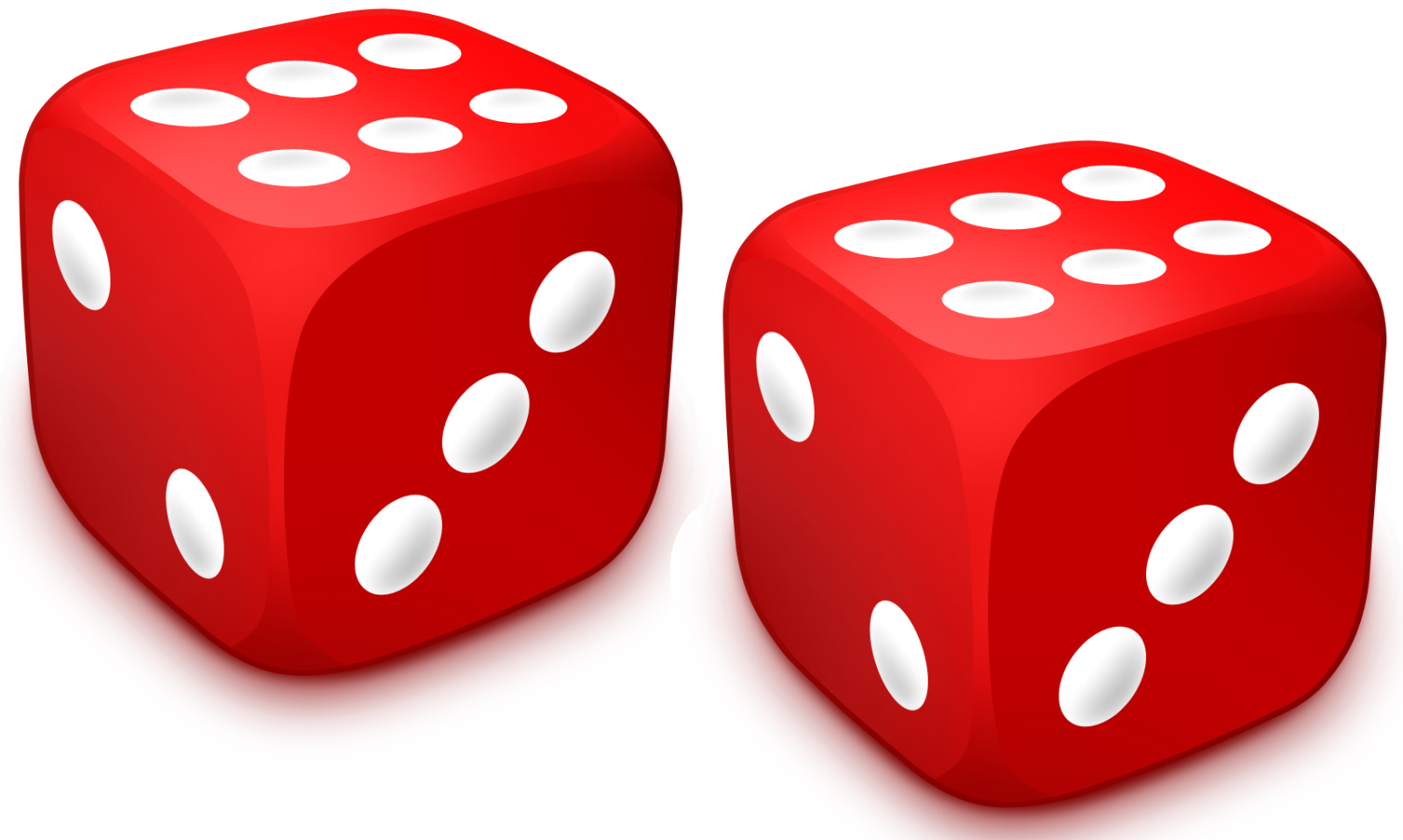
Varun and Jsha decided to play with dice to keep themselves busy at home as their schools are closed due to coronavirus pandemic. Varun throw a dice repeatedly until a six is obtained. He denote the number of throws required by X.

Based on the above information, answer the following questions.

  1. The probability that X = 2 equals.
  1. $\frac{1}{6}$

  2. $\frac{5}{6^2}$

  3. $\frac{5}{3^6}$

  4. $\frac{1}{6^3}$
  1. The probability that X = 4 equals.
  1. $\frac{1}{6^4}$

  2. $\frac{1}{6^6}$

  3. $\frac{5^3}{6^4}$

  4. $\frac{5}{6^4}$
  1. The probability that $\text{X}\geq2$ equals.
  1. $\frac{25}{216}$

  2. $\frac{1}{36}$

  3. $\frac{5}{6}$

  4. $\frac{25}{36}$

  1. The value of $\text{P}(\text{X}\geq6)$ is:
  1. $\frac{5^5}{6^5}$

  2. $1-\frac{5^3}{6^5}$

  3. $\frac{5^3\times61}{6^5}$

  4. $\frac{5^3}{6^4}$

  1. The probability that X > 3 equals.
  1. $\frac{36}{25}$

  2. $\frac{5^2}{6^2}$

  3. $\frac{5}{6}$

  4. $\frac{5^3}{6^3}$

In a bilateral cricket series between India and South Africa, the probability that India wins the first match is 0.6. If India wins any match, then the probability that it wins the next match is 0.4, otherwise the probability is 0.3. Also, it is given that there is no tie in any match.

Based on the above information answer the following questions.
  1. The probability that India won the second match, if lndia has already loose the first match is:
  1. 0.5
  2. 0.4
  3. 0.3
  4. 0.6
  1. The probability that India losing the third match, if India has already loose the first two matches is:
  1. 0.2
  2. 0.3
  3. 0.4
  4. 0.7
  1.  The probability that India losing the first two matches is:
  1. 0.12
  2. 0.28
  3. 0.42
  4. 0.01
  1. The probability that India winning the first three matches is:
  1. 0.92
  2. 0.96
  3. 0.94
  4. 0.096
  1. The probability that India winning exactly one of the first three matches is:
  1. 0.205
  2. 0.21
  3. 0.408
  4. 0.312
Let f : A → B and g : B → C be two functions defined on non-empty sets A, B, C, then gof : A → C be is called the composition of f and g defined as, $\text{gof}(\text{x})=\text{g}\{\text{f(x)}\}\forall\text{ x }\in\text{ A}.$
Consider the functions $\text{f}(\text{x})=\begin{cases}\sin\text{x},&\text{x}\geq0\\1-\cos\text{x},&\text{x}\leq0\end{cases},\text{g}(\text{x})=\text{e}^\text{x}$ and then answer the following questions.
  1. The function gof(x) is defined as:
  1. $\text{gof}(\text{x})=\begin{cases}\text{e}^\text{x}&,\text{x}\geq0\\1-\text{e}^{\cos\text{x}}&,\text{x}\leq0\end{cases}$
  2. $\text{gof}(\text{x})=\begin{cases}\text{e}^{\sin\text{x}}&,\text{x}\leq0\\\text{e}^{1-\cos\text{x}}&,\text{x}\geq0\end{cases}$
  3. $\text{gof}(\text{x})=\begin{cases}\text{e}^{\sin\text{x}}&,\text{x}\leq0\\1-\text{e}^{\cos\text{x}}&,\text{x}\geq0\end{cases}$
  4. $\text{gof}(\text{x})=\begin{cases}\text{e}^{\sin\text{x}}&,\text{x}\geq0\\\text{e}^{1-\cos\text{x}}&,\text{x}\leq0\end{cases}$
  1. $\frac{\text{d}}{\text{dx}}\{\text{gof}(\text{x})\}=$
  1. $[\text{gof}(\text{x})]'=\begin{cases}\cos\text{x}\cdot\text{e}^{\sin\text{x}}&,\text{x}\geq0\\\text{e}^{1-\cos\text{x}}\cdot\sin\text{x}&,\text{x}\leq0\end{cases}$
  2. $[\text{gof}(\text{x})]'=\begin{cases}\cos\text{x}\cdot\text{e}^{\sin\text{x}}&,\text{x}\geq0\\-\sin\text{x}\cdot\text{e}^{1-\cos\text{x}}&,\text{x}\leq0\end{cases}$
  3. $[\text{gof}(\text{x})]'=\begin{cases}\cos\text{x}\cdot\text{e}^{\sin\text{x}}&,\text{x}\geq0\\\sin\text{x}\cdot({1-\cos\text{x}})&,\text{x}\leq0\end{cases}$
  4. $[\text{gof}(\text{x})]'=\begin{cases}\cos\text{x}\cdot\text{e}^{\sin\text{x}}&,\text{x}\geq0\$1-{\sin\text{x}})\cdot\text{e}^{1-\cos\text{x}}&,\text{x}\leq0\end{cases}$
  1. R.H.D. of gof(x) at x = 0 is:
  1. 0
  2. 1
  3. -1
  4. 2
  1. L.H.D. of gof(x) at x = 0 is:
  1. 0
  2. 1
  3. -1
  4. 2
  1. The value of f'(x) at $\text{x}=\frac{\pi}{4}$ is:
  1. $\frac{1}{9}$
  2. $\frac{1}{\sqrt2}$
  3. $\frac{1}{2}$
  4. Not defined.
A differential equation is said to be in the variable separable form if it is expressible in the form f(x) dx = g(y) dy.
The solution of this equation is given by
$\int\text{f(x)dx}=\int\text{g(y)dy}+\text{c},$ where c is the constant of integration.
Based on the above information, answer the following questions.
  1. If the solution of the differential equation $\frac{\text{dy}}{\text{dx}}=\frac{\text{ax+3}}{\text{2y+f}}$ represents a circle, then the value of 'a' is:
  1. 2
  2. -2
  3. 3
  4. -4
  1. The differential equation $\frac{\text{dy}}{\text{dx}}=\frac{\sqrt{1-\text{y}^2}}{\text{y}}$ determines a family of circle with.
  1. Variable radii and fixed centre (0, 1)
  2. Variable radii and fixed centre (0, -1)
  3. Fixed radius 1 and variable centre on x-axis
  4. Fixed radius 1 and variable centre on y-axis
  1. If = y'+ 1, y(0) = 1, then y (In 2) =
  1. 1
  2. 2
  3. 3
  4. 4
  1. The solution of the differential equation $\frac{\text{dy}}{\text{dx}}=\text{e}^\text{x-y}+\text{x}^2\text{e}^\text{-y}$ is:
  1. $\text{e}^\text{x}=\frac{\text{y}^3}{3}+\text{e}^\text{y}+\text{c}$
  2. $\text{e}^\text{y}=\frac{\text{x}^2}{3}+\text{e}^\text{x}+\text{c}$
  3. $\text{e}^\text{y}=\frac{\text{x}^3}{3}+\text{e}^\text{x}+\text{c}$
  4. None of these
  1. If $\frac{\text{dy}}{\text{dx}}=\text{y}\sin2\text{x},\ \text{y}(0)=1,$ then its solution is:
  1. $\text{y}=\text{e}^{\sin^2}\text{x}$
  2. $\text{y}={\sin^2}\text{x}$
  3. $\text{y}={\cos^2}\text{x}$
  4. $\text{y}=\text{e}^{\cos^2}\text{x}$
If a real valued function f{x) is finitely derivable at any point of its domain, it is necessarily continuous at that point. But its converse need not be true.
For example, every polynomial, constant function are both continuous as well as differentiable and inverse trigonometric functions are continuous and differentiable in its domains etc.
Based on the above information, answer the following questions.
  1. If $\text{f}(\text{x})=\begin{cases}\text{x},\text{for x}\leq0\\0,\text{for x}>0\end{cases},$ then at x = 0
  1. f(x) is differentiable and continuous.
  2. f(x) is neither continuous nor differentiable.
  3. f(x) is continuous but not differentiable.
  4. None of these.
  1. If $\text{f}(\text{x})=|\text{x}-1|,\text{x }\in\text{ R},$ then at x = 1
  1. f(x) is not continuous.
  2. f(x) is continuous but not differentiable.
  3. f(x) is continuous and differentiable.
  4. None of these.
  1. f(x) = x3 is:
  1. Continuous but not differentiable at x = 3
  2. Continuous but not differentiable at x = 3
  3. Neither continuous nor differentiable at x = 3
  4. None of these.
  1. If $\text{f}(\text{x})=[\sin\text{x}],$ then which of the following is true?
  1. f(x) is continuous and differentiable at x = 0.
  2. f(x) is discontinuous at x = 0.
  3. f(x) is continuous at x = 0 but not differentiable.
  4. f(x) is differentiable but not continuous at $\text{x}=\frac{\pi}{2}.$
  1. If $\text{f}(\text{x})=\sin^{-1}\text{x},-1\leq\text{x}\leq1,$ then:
  1. f(x) is both continuous and differentiable.
  2. f(x) is neither continuous nor differentiable.
  3. f(x) is continuous but not differentiable.
  4. None of these.
If there is a statement involving the natural number n such that:
  1. The statement is true for n = 1
  2. When the statement is true for n = k (where k is some positive integer), then the statement is also true for n = k + 1.
Then, the statement is true for all natural numbers n.
Also, if A is a square matrix of order n, then A2 is defined as AA. In general, Am = AA .... A (m times). where m is any positive integer.
Based on the above information, answer the following questions.
  1. If $\text{A}=\begin{bmatrix}3&-4\\1&-1\end{bmatrix},$ then for any positive integer n,
  1. $\text{A}^\text{n}=\begin{bmatrix}3\text{n}&-4\text{n}\\\text{n}&-\text{n}\end{bmatrix}$
  2. $\text{A}^\text{n}=\begin{bmatrix}1+2\text{n}&-4\text{n}\\\text{n}&1-2\text{n}\end{bmatrix}$
  3. $\text{A}^\text{n}=\begin{bmatrix}3\text{n}&-8\text{n}\\1&-\text{n}\end{bmatrix}$
  4. $\text{A}^\text{n}=\begin{bmatrix}1+3\text{n}&-4\text{n}\\\text{n}&1-3\text{n}\end{bmatrix}$
  1. If $\text{A}=\begin{bmatrix}1&2\\0&1\end{bmatrix},$ then |An|, where $\text{n}\in\text{ N},$ is equal to:
  1. 2n
  2. 3n
  3. n
  4. 1
  1. If $\text{A}=\begin{bmatrix}1&0\\1&1\end{bmatrix}$ and $\text{I}=\begin{bmatrix}1&0\\0&1\end{bmatrix}$ then which of the following holds for all natural numbers $\text{n}\geq1?$
  1. A= nA - (n - 1)I
  2. An = 2n-1 A - (n - 1)I
  3. A= nA + (n - 1)I
  4. An = 2n-1 A + (n - 1)I
  1. Let $\text{A}=\begin{bmatrix}\text{a}&0&0\\0&\text{a}&0\\0&0&\text{a}\end{bmatrix}$ and $\text{A}^\text{n}=[\text{a}_{\text{ij}}]_{3\times3}$ for some positive integer n, then the cofactor of a13 is:
  1. an
  2. -an
  3. 2an
  4. 0
  1. If A is a square matrix such that |A| = 2, then for any positive integer n, |An| is equal to:
  1. 0
  2. 2n
  3. 2n
  4. n2
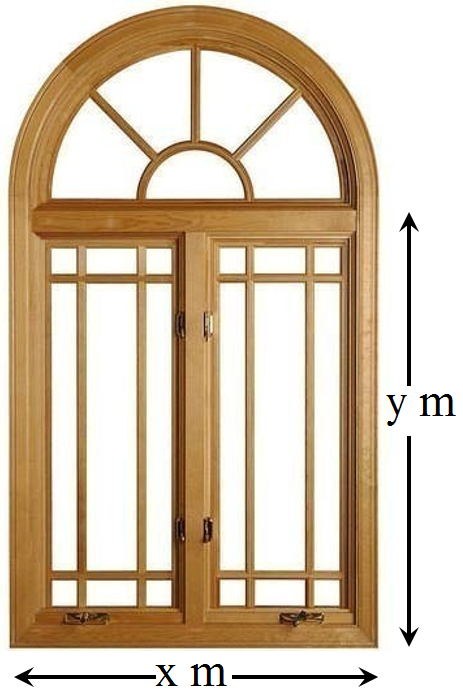
Rohan, a student of class XII, visited his uncle's flat with his father. He observe that the window of the house is in the form of a rectangle surmounted by a semicircular opening having perimeter 10m as shown in the figure.

Based on the above information, answer the following questions.
  1. If x and y represents the length and breadth of the rectangular region, then relation between x and y can be represented as.
  1. $\text{x}+\text{y}+\frac{\pi}{2}=10$
  2. $\text{x}+\text{2y}+\frac{\pi\text{x}}{2}=10$
  3. $\text{2x}+\text{2y}=10$
  4. $\text{x}+\text{2y}+\frac{\pi}{2}=10$
  1. The area (A) of the window can be given by.
  1. $\text{A}=\text{x}-\frac{\text{x}^3}{8}-\frac{\text{x}^2}{2}$
  2. $\text{A}=\text{5x}-\frac{\text{x}^2}{8}-\frac{\pi\text{x}^2}{8}$
  3. $\text{A}=\text{x}+\frac{\pi\text{x}^3}{8}-\frac{\text{3x}^2}{8}$
  4. $\text{A}=\text{5x}+\frac{\text{x}^3}{2}+\frac{\pi\text{x}^2}{8}$
  1. Rohan is interested in maximizing the area of the whole window, for this to happen, the value of x should be.
  1. $\frac{10}{2-\pi}$
  2. $\frac{20}{4-\pi}$
  3. $\frac{20}{4+\pi}$
  4. $\frac{10}{2+\pi}$
  1. Maximum area of the window is.
  1. $\frac{30}{4+\pi}$
  2. $\frac{30}{4-\pi}$
  3. $\frac{50}{4-\pi}$
  4. $\frac{50}{4+\pi}$
  1. For maximum value of A, the breadth of rectangular part of the window is.
  1. $\frac{10}{4+\pi}$
  2. $\frac{10}{4-\pi}$
  3. $\frac{20}{4+\pi}$
  4. $\frac{20}{4-\pi}$
A spherical ball of salt is dissolving in water in such a manner that the rate of decrease of the volume at any instant is propotional to the surface. Prove that the radius is decreasing at a constant rate.
In pre-board examination of class XII, commerce stream with Economics and Mathematics of a particular school, $50 \%$ of the students failed in Economics, 35\% failed in Mathematics and 25\% failed in both Economics and Mathematics. A student is selected at random from the class.

Image

(i) Find the probability that the selected student has failed in Economics, if it is known that he has failed in Mathematics?

(ii) Find the probability that the selected student has failed in Mathematics, if it is known that he has failed in Economics?
A football match is organised between students of class XII of two schools, say school A and school B. For which a team from each school is chosen. Remaining students of class XII of school A and Bare respectively sitting 
on the plane represented by the equation$ \vec{\text{r}}.(\hat{\text{i}}+\hat{\text{j}}+\hat{2\text{k}})=5$ and $ \vec{\text{r}}.(\hat{2\text{i}}-\hat{\text{j}}+\hat{\text{k}})=6$ to cheer up the team of their respective schools. 


Based on the above information, answer the following questions. 

  1. The cartesian equation of the plane on which students of school A are seated is:
  1. 2x - y + z = 8
  2. 2x + y + z = 8
  3. x + y + 2z = 5
  4. x + y + z = 5
  1. The magnitude of the normal to the plane on which students of school Bare seated, is:
  1. $\sqrt{5}$

  2. $\sqrt{6}$

  3. $\sqrt{3}$

  4. $\sqrt{2}$

  1. The intercept form of the equation of the plane on which students of school Bare seated is:
  1. $\frac{\text{x}}{6}+\frac{\text{y}}{6}+\frac{\text{z}}{6}=1$

  2. $\frac{\text{x}}{3}+\frac{\text{y}}{(-6)}+\frac{\text{z}}{6}=1$

  3. $\frac{\text{x}}{3}+\frac{\text{y}}{6}+\frac{\text{z}}{6}=1$

  4. $\frac{\text{x}}{3}+\frac{\text{y}}{6}+\frac{\text{z}}{3}=1$

  1. Which of the following is a student of school B?
  1. Mohit sitting at (1, 2, 1)
  2. Ravi sitting at (0, 1, 2)
  3. Khushi sitting at (3, 1, 1)
  4. Shewta sitting at (2, -1, 2)
  1. The distance of the plane, on which students of school Bare seated, from the origin is:
  1. 6 units
  2. $\frac{1}{\sqrt{6}}\text{ units}$

  3. $\frac{5}{\sqrt{6}}\text{ units}$

  4. $\sqrt{6}\text{ units}$