Question
Show that for small oscillations the motion of a simple pendulum is simple harmonic. Derive an expression for its time period. Does it depend on the mass of the bob?
Answer

Expression for time period:

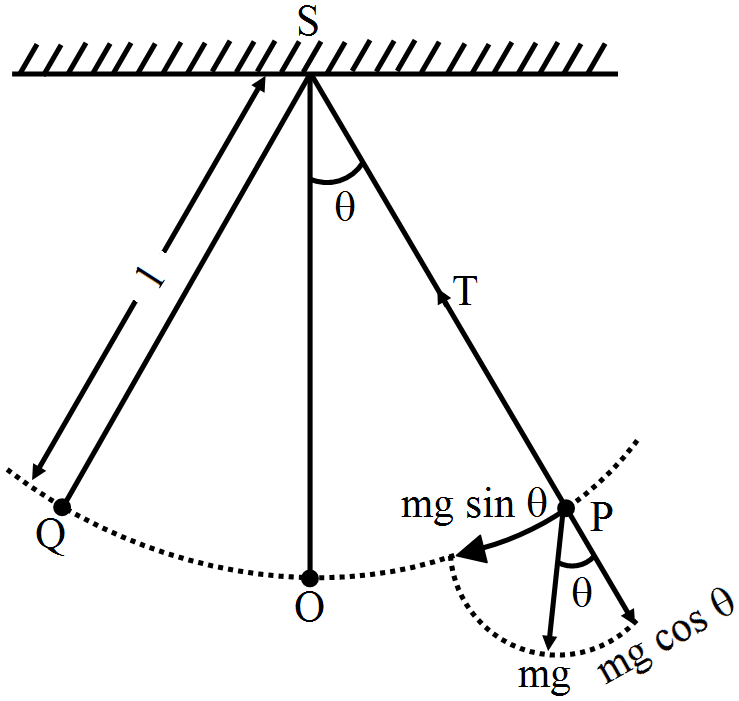
Let $m =$ Mass of the bob $l =$ Length of the simple pendulum $OP = x$ When the bob is displaced to point $P$ through small angle $\theta.$Two forces acting on the bob are:
  1. Weight $mg$ of the bob acting vertically downward.
  2. Tension $T$ in string along $PS$, resolving mg into two components.
  1. $\text{mg}\cos\theta$ opposite to tension $T$
  2. $\text{mg}\sin\theta$ directed towards $O.$
Tension in the string, $T =\text{mg}\cos\theta$
The force $mg \sin$ tends to bring back the bob to its mean position $O.$
$\therefore$ Restoring force acting on bob is $\text{F}=-\text{mg}\sin\theta-\text{ve}$ sign shows force is directed towards mean position: If $\theta$ is small, then
$\sin\theta=\theta\frac{(\text{arc OP})}{\text{l}}=\frac{\text{x}}{\text{l}}$
$\text{F = -mg}\theta=-\text{mg}\frac{\text{x}}{\text{l}}$
$\text{F}\propto$ displacement $(x)$ and $F$ is directed towards mean position $O$.
In $\text{S.H.M}$., Restoring force $\text{F}=-\text{kx} \ ...(\text{ii})$
Comparing $(i)$ and $(ii)\text{k}=\frac{\text{mg}}{\text{l}}$
Inertia factor $=$ Mass of bob $= m\text{T}=2\pi\sqrt{\frac{\text{Inertia factor}}{\text{Spring factor}}}$
$=2\pi\sqrt{\frac{\text{m}}{\frac{\text{mg}}{\text{l}}}}=2\pi\sqrt{\frac{\text{l}}{\text{g}}}$
$\text{T}=2\pi\sqrt{\frac{\text{l}}{\text{g}}}$
No. $T$ does not depend on the mass of the bob.

Need a full question paper?

Generate a complete, print-ready paper with questions like this in minutes — across 16+ boards, with answer keys.

Start Generating Free

Similar questions

The magnetic force on a charged particle is always perpendicular to its velocity. Can the magnetic force change the velocity of the particle? Speed of the particle?
A ring, a disc and a sphere all of the same radius and same mass roll down on an inclined plane from the same height h. Which of the three reaches the bottom (i) earliest (ii) latest?
How are fast neutrons slowed down with the use of moderators?
A man of mass 50kg starts moving on the earth and acquires a speed of 1.8m/s. With what speed does the earth recoil? Mass of earth = $6 \times 10^{24}kg$.
Rectangular film of soap solution is 6 cm long and 4 cm wide. To make its size $8 cm \times 5 cm$, how much work would have to be done against surface tension? If surface tension of soap solution is $40 \times 10^{-3} N / m$
What will be the ratio of the root mean square velocities of an ideal gas at temperatures of 270 K and 30K?
The charge on a proton is $+1.6 \times 10^{-19} \mathrm{C}$ and that on an electron is $-1.6 \times 10^{-19} \mathrm{C}$. Does it mean that the electron has a charge $3.2 \times 10^{-19} \mathrm{C}$ less than the charge of a proton?
The potential difference between the terminals of a 6.0V battery is 7.2V when it is being charged by a current of 2.0A. What is the internal resistance of the battery?
A 1 meter thick cement wall can withstand a pressure of $10^5 N / m ^2$. What should be the thickness of the wall at the base of a 200 m depth water of dam?
(Density of water $=10^3 kg / m ^3$ and acceleration due to gravity $=9.8 m / s ^2$ )
A $100pF$ capacitor is charged to a potential difference of $24V$. It is connected to an uncharged capacitor of capacitance $20pF$. What will be the new potential difference across the $100pF$ capacitor?