Question
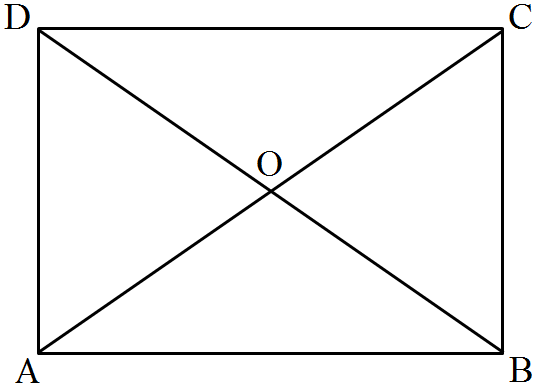
Show that in a quadrilateral ABCD, AB + BC + CD + DA > AC + BD

Answer

Given ABCD is a quadilateral,

Construction join diagonais AC and BD.

To show AB + BC + CD + DA > AC + BD 

In $\triangle\text{ABC},$ AB + BC > AC [Sum of two sides of a triangle is greater than the third side] ...(i)

In $\triangle\text{BCD},$ BC + CD > BD [Sum of two sides of a triangle is greater than the third side] ...(ii)

In $\triangle\text{CDA},$ CD + DA > AC [Sum of two sides of a triangle is greater than the third side] ...(iii)

In $\triangle\text{DAB},$ DA + AB + > BD [Sum of two sides of a triangle is greater than the third side] ...(iv)

On adding Eqs. (i), (ii), (iii) (iv), We get

2(AB + BC + CD + DA) > 2 (AC + BD)

⇒ AB + BC + CD + DA > AC + BD

Need a full question paper?

Generate a complete, print-ready paper with questions like this in minutes — across 16+ boards, with answer keys.
Start Generating Free

Similar questions

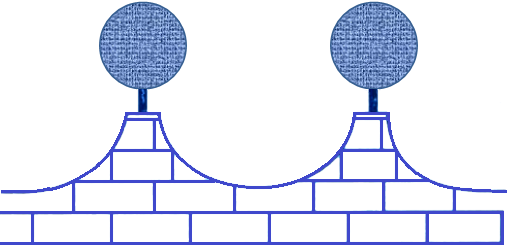
The front compound wall of a house is decorated by wooden spheres of diameter 21cm, placed on small supports as shown in the Fig. Eight such spheres are used for this purpose, and are to be painted silver. Each support is a cylinder of radius 1.5cm and height 7cm and is to be painted black. Find the cost of paint required if silver paint costs 25 paise per cm2 and black paint costs 5 paise per cm2.

Construct a right-angled triangle ABC whose base BC is 6cm and the sum of the hypotenuse AC and other side AB is 10cm.
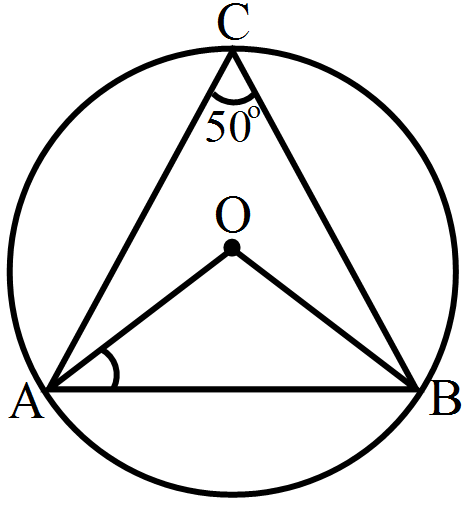
In the given figure, O is the centre of the circle. If $\angle\text{ACB}=50^\circ,$ find $\angle\text{OAB}.$

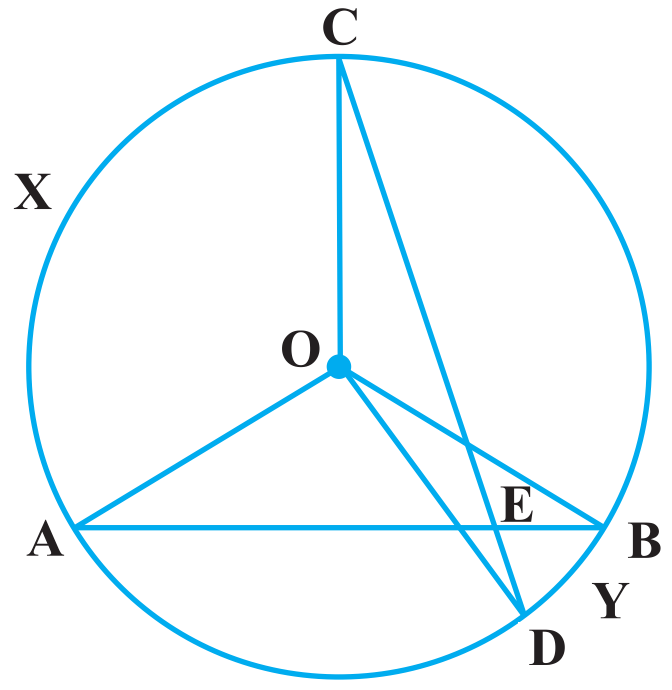
In Fig. AB and CD are two chords of a circle intersecting each other at point E. Prove that $\angle\text{AEC}=\frac{1}{2}$ (Angle subtended by arc CXA at centre + angle subtended by arc DYB at the centre).

The paint in a certain container is sufficient to paint on an area equal to 9.375m2, How many bricks of dimension 22.5cm × 10cm × 7.5cm can be painted out of this container?
Verify whether the indicated numbers are zeros of the polynomials corresponding to them in the following case:
p(x) = x3 - 6x2 + 11x - 6, x = 1, 2, 3
Draw the graph of y = |x|.
Find rational numbers a and b such that:
$\frac{\sqrt{3}+\sqrt{2}}{\sqrt{3}-\sqrt{2}}=\text{a}+\text{b}\sqrt{6}$
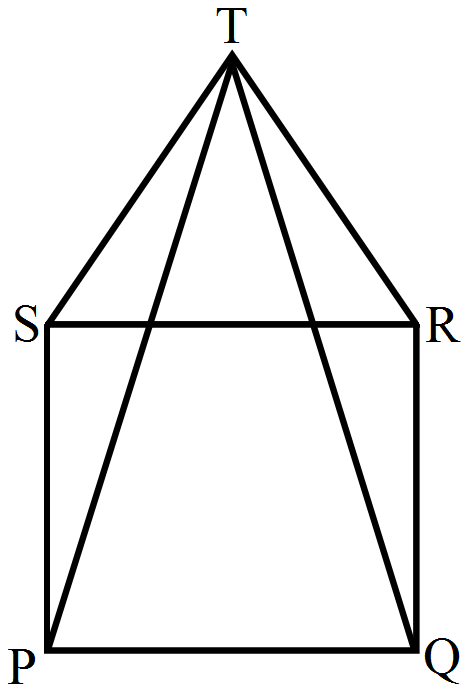
In fig. PQRS is a square and SRT is an equilateral triangle. Prove that:
  1. PT = QT.
  2. $\angle\text{TQR}=15^\circ.$

Draw different pairs of circles. How many points does each pair have in common? What is the maximum number of common points?