Rajasthan BoardEnglish MediumSTD 12 ScienceMATHSAppendix 25 Marks
Question
Show that in any triangle $\text{ABC}\ a = b\ \cos \ C + c\ \cos\ B$
✓
Answer
Let $p$ be the statement $\text{ABC}$ is any triangle and $q$ be the statement “
$a = b \cos C + c \cos B$
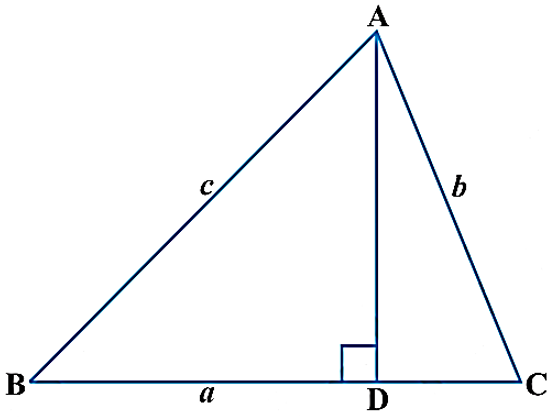
Let $\text{ABC}$ be a triangle. From $A$ draw $AD$ perpendicular to $BC (BC$ produced if necessary$).$
As we know that any triangle has to be either acute or obtuse or right$-$angled, we can split $p$ into three statements $r, s$ and $t,$ where
$r : \text{ABC}$ is an acute$-$angled triangle with $\angle C$ is acute.
$s : \text{ABC}$ is an obtuse$-$angled triangle with $\angle C$ is obtuse
$t : \text{ABC}$ is a right$-$angled triangle with $\angle C$ is a right angle.
Hence, we prove the theorem by three cases
case $(i)$When $C$ is acute Fig.
From the right$-$angled triangle $\text{ADB},$
$\frac{B D}{A B}=\cos E$
$\mathrm{BD}=\mathrm{AB} \cos \mathrm{B}$
$=c \cos B$
from the right$-$angled $\triangle ADC$
$\frac{C D}{\Delta C}=\cos C$
$CD = AC \cos C$
$= b \cos C$
$a = BD + CD$
$= c \cos B + b \cos C ...(1)$
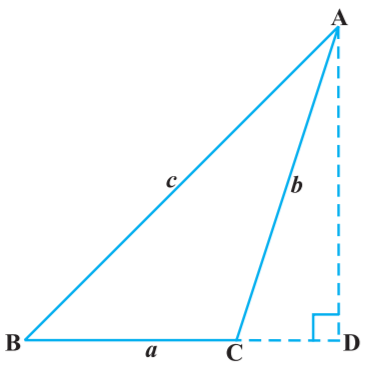
case$(ii)$ When $\angle C$ is obtuse in below figure.
From the right angled $\triangle ADB,$
$BD \over AB = \cos B$
i.e. $BD = AB \cos B$
$= c \cos B$ From the right angled $\triangle ADC,$
$\frac{C D}{A C}=\cos \angle ACD$
$= \cos (180^\circ - C) = - \cos C$ i.e. $CD = - AC \cos C = - b \cos C$
Now $a = BC = BD - CD$
i.e. $a = c \cos B - ( - b \cos C)$
$a = c \cos B + b \cos C ... (2)$
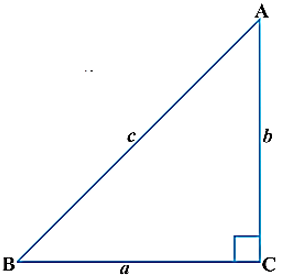
Case $(iii)$ When $\angle C$ is a right angle in the given figure.
From the right angled $\triangle ACB,$
$BC \over AB = cosB$
i.e. $BC = AB \cos B$
$a = c \cos B,$
and $b \cos C = b \cos 900 = 0.$
Thus, we may write $a = 0 + c \cos B$
$= b \cos C + c \cos B ... (3)$
From $(1), (2)$ and $(3)$. We assert that for any $\triangle ABC,$
$a = b \cos C + c \cos B$
By case $(i), r \Rightarrow q$ is proved.
By case $(ii), s \Rightarrow q$ is proved.
By case $(iii), t \Rightarrow q$ is proved.
Hence, from the proof by cases, $(r\ v\ s\ v\ t) \Rightarrow q$ is proved, i.e., $p \Rightarrow q$ is proved.
Need a full question paper?
Generate a complete, print-ready paper with questions like this in minutes — across 16+ boards, with answer keys.