Question
Show that it is not possible for a photon to be completely absorbed by a free electron.

Answer

If the i undergoes an elastic collision with a photon. Then applying energy conservation to this collision.We get, $\frac{\text{hc}}{\lambda}+\text{m}_0\text{c}^2=\text{mc}^2$
and applying conservation of momentum $\frac{\text{h}}{\lambda}=\text{mv}$
Mass of e $=\text{m}=\frac{\text{m}_0}{\sqrt{1-\frac{\text{v}^2}{\text{c}^2}}}$
from above equation it can be easily shown that
V = C
V = 0
both of these results have no physical meaning hence it is not possible for a photon to be completely absorbed by a free electron.

Need a full question paper?

Generate a complete, print-ready paper with questions like this in minutes — across 16+ boards, with answer keys.
Start Generating Free

Similar questions

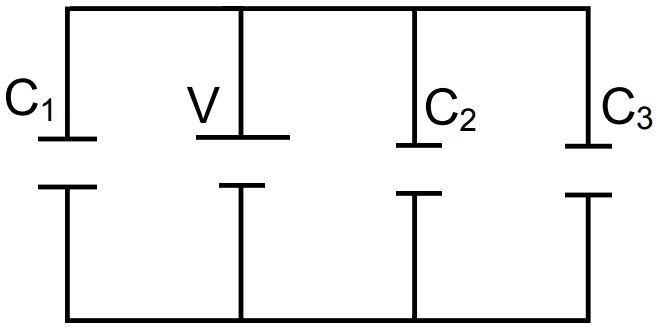
Find the charges on the three capacitors connected to a battery as shown in figure. Take $\text{C}_1=2.0\mu\text{F},\ \text{C}_2=4.0\mu\text{F},\ \text{C}_3=6.0\mu\text{F}$ and V = 12 volts.
The equation of a travelling sound wave is $\text{y}=6.0\sin(600\text{t}-1.8\text{x})$ where $y$ is measured in $10^{-5}m, t$ in second and $x$ in metre.
  1. Find the ratio of the displacement amplitude of the particles to the wavelength of the wave.
  2. Find the ratio of the velocity amplitude of the particles to the wave speed.
Find the magnetic field B due to a semicircular wire of radius 10.0cm carrying a current of 5.0A at its centre of curvature.
Two ideal monoatomic gases A and B at 27°C and 37°C are mixed. The number of moles in gas A are 2 and number of moles in gas B are 3. What will be the temperature of the mixture?
Distinguish between static friction, limiting friction and kinetic friction. How do they vary with the applied force, explain by diagram.
Given a + b + c + d = 0, which of the following statements are correct: a, b, c, and d must each be a null vector.
Two blocks of mares 10kg and 20kg are placed on the X-axis. The first mass is moved on the axis by a distance of 2cm. By what distance should the second mass be moved to keep the position of the centre of mass unchanged?
A particle starts from the origin, goes along the $X-$axis to the point $(20m, 0)$ and then returns along the same line to the point $(-20m, 0)$. Find the distance and displacement of the particle during the trip.
The potential energy of a particle of mass 1kg in motion along the x-axis is given by $\text{U}=4(1-\cos2\text{x})$ Here x is in metres. Find the period of small oscillations.
Two identical point masses, each of mass $M$ are connected to one another by a massless string of length $L$. $A$ constant force $F$ is applied at the mid-point of the string. If l be the instantaneous distance between the two masses, what will be the acceleration of each mass?