Question
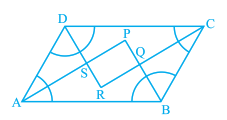
Show that the bisectors of angles of a parallelogram form a rectangle.
Answer


Let $P , Q , R$ and S be the points of intersection of the bisectors of $\angle A$ and $\angle B, \angle B$ and $\angle C, \angle C$ and $\angle D$, and $\angle D$ and $\angle A$ respectively of parallelogram $A B C D$.
$\text { In } \triangle A S D$
Since DS bisects $\angle D$ and AS bisects $\angle A$, therefore,
$\angle D A S+\angle A D S=\frac{1}{2} \angle A+\frac{1}{2} \angle D$
$=\frac{1}{2}(\angle A+\angle D)$
$=\frac{1}{2} \times 180^{\circ} \text { ( } \angle A \text { and } \angle D$ are interior angles on the same side of the transversal)
$=90^{\circ}$
Also, $\angle D A S+\angle A D S+\angle D S A=180^{\circ}$ (Angle sum property of a triangle)
$\text { or, } 90^{\circ}+\angle D S A=180^{\circ}$
or, $\angle D S A=90^{\circ}$
So, $\angle P S R=90^{\circ}$ (Being vertically opposite to $\angle D S A$ )
Similarly, it can be shown that $\angle A P B=90^{\circ}$ or $\angle S P Q=90^{\circ}$ (as it was shown for $\angle D S A$ ).
Similarly, $\angle P Q R=90^{\circ}$ and $\angle S R Q=90^{\circ}$.
So, PQRS is a quadrilateral in which all angles are right angles.
We have shown that $\angle P S R=\angle P Q R=90^{\circ}$ and $\angle S P Q=\angle S R Q=90^{\circ}$.
So both pairs of opposite angles are equal.
Therefore, PQRS is a parallelogram in which one angle (in fact all angles) is $90^{\circ}$ and so, PQRS is a rectangle.

Need a full question paper?

Generate a complete, print-ready paper with questions like this in minutes — across 16+ boards, with answer keys.

Start Generating Free

Similar questions

Factorise: $3\sqrt{3}\text{a}^3-\text{b}^3-5\sqrt{5}\text{c}^3-3\sqrt{15}\text{abc}$
If $a+b=10$ and $a b=21$, find the value of $a^3+b^3$
$P$ is any point on the diagonal $AC$ of a parallelogram $ABCD.$ Prove that $\text{ar}(\triangle\text{ADP})=\text{ar}(\triangle\text{ABP}).$
A bus stop is barricaded from the remaining part of the road, by using $50$ hollow cones made of recycled cardboard. Each cone has a base diameter of 40 cm and height $1 \ m$ . If the outer side of each of the cones is to be painted and the cost of painting is ₹ $12$ per $m ^2$, what will be the cost of painting all these cones? (Use $\pi=3.14$ and take $\sqrt{1.04}= 1.02)$
On a certain day, the temperature in a city was recorded as under.
Time
$5 a.m.$ $8 a.m.$
$11 a.m.$
$3 p.m.$
$6 p.m.$
Temperature (in °C)
$20$
$24$
$26$
$22$
$18$
Illustrate the data by a bar graph.
Verify whether the indicated numbers are zeros of the polynomials corresponding to them in the following case:
$f(x) = x^2 - 1, x = 1, -1$
In each of the following determine rational numbers a and b: $\frac{\sqrt3-1}{\sqrt3+1}=\text{a}-\text{b}\sqrt3$
Find five rational numbers between $\frac{3}{5}$ and $\frac{2}{3}.$
It being given that $\sqrt{3}=1.732,\sqrt{5}=2.236,\sqrt{6}=2.449$ and $\sqrt{10}=3.162,$ find to three places of decimal, the value of the following: $\frac{6}{\sqrt{5}+\sqrt{3}}$
Using the remainder theorem, find the remainder, when $p(x)$ is divided by $g(x)$, where, $p(x) = x^3 - 6x^2 + 9x + 3, g(x) = x - 1.$