Question
Show that the curve $\frac{\text{x}^2}{\text{a}^2+\lambda_1}+\frac{\text{y}^2}{\text{b}^2+\lambda_1}=1$ and $\frac{\text{x}^2}{\text{a}^2+\lambda_2}+\frac{\text{y}^2}{\text{b}^2+\lambda_2}=1$ intersect at right angles.

Answer

we have $\frac{\text{x}^2}{\text{a}^2+\lambda_1}+\frac{\text{y}^2}{\text{b}^2+\lambda_1}=1\ ...(1)$$\frac{\text{x}^2}{\text{a}^2+\lambda_2}+\frac{\text{y}^2}{\text{b}^2+\lambda_2}=1\ ...(2)$
Now we can find the slope of both the curve by differentiating w.r.t.x,
$\Rightarrow\frac{2\text{x}}{\text{a}^2+\lambda_1}+\frac{2\text{y}\frac{\text{dy}}{\text{dx}}}{\text{b}^2+\lambda_1}=0\text{ and }\frac{2\text{x}}{\text{a}^2+\lambda_2}+\frac{2\text{y}\frac{\text{dy}}{\text{dx}}}{\text{b}^2+\lambda_2}=0$
$\Rightarrow\frac{\text{dy}}{\text{dx}}=-\frac{\text{x}}{\text{y}}\times\frac{\text{b}^2+\lambda_1}{\text{a}^2+\lambda_1}\text{ and }\frac{\text{dy}}{\text{dx}}=-\frac{\text{x}}{\text{y}}\times\frac{\text{b}^2+\lambda_2}{\text{a}^2+\lambda_2}$
$\Rightarrow\text{m}_1=-\frac{\text{x}}{\text{y}}\times\frac{\text{b}^2+\lambda_1}{\text{a}^2+\lambda_1}\text{ and }\Rightarrow\text{m}_1=-\frac{\text{x}}{\text{y}}\times\frac{\text{b}^2+\lambda_2}{\text{a}^2+\lambda_2}$
Substracting (2) from (1), we get,
$\text{x}^2\Big(\frac{1}{\text{a}^2+\lambda_1}-\frac{1}{\text{a}^2+\lambda_2}\Big)+\text{y}^2\Big(\frac{1}{\text{b}^2+\lambda_1}-\frac{1}{\text{b}^2+\lambda_2}\Big)=0$
$\Rightarrow\frac{\text{x}^2}{\text{y}^2}=\frac{\lambda_2-\lambda_1}{(\text{b}^2+\lambda_1)(\text{b}^2+\lambda_2)}\times\frac{1}{\frac{\lambda_1-\lambda_2}{(\text{e}^2+\lambda_1)(\text{e}^2+\lambda_2)}}$
now,
$\text{m}_1\times\text{m}_2=\frac{\text{x}^2}{\text{y}^2}\times\frac{\text{b}^2+\lambda_1}{\text{a}^2+\lambda_1}\times\frac{\text{b}^2+\lambda_2}{\text{a}^2+\lambda_2}$
$=\frac{\lambda_2-\lambda_1}{(\text{b}^2+\lambda_1)(\text{b}^2+\lambda_2)}\times\frac{(\text{a}^2+\lambda_1)(\text{a}^2+\lambda_2)}{\lambda_1-\lambda_2}\times\frac{\text{b}^2+\lambda_1}{\text{a}^2+\lambda_1}\times\frac{\text{b}^2+\lambda_1}{\text{a}^2+\lambda_1}$
$=-1$
Hence, (1) and (2) cuts orthogonally.

Need a full question paper?

Generate a complete, print-ready paper with questions like this in minutes — across 16+ boards, with answer keys.
Start Generating Free

Similar questions

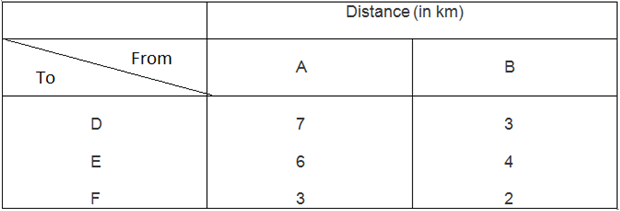
An oil company has two depots, $A$ and $B$, with capacities of $7000$ litres and $4000$  litres respectively. The company is to supply oil to three petrol pumps, $D, E, F$ whose requirements are $4500, 3000$ and $3500$ litres respectively. The distance (in km) between the depots and petrol pumps is given in the following table:

Assuming that the transportation cost per km is Rs. $1.00$ per litre, how should the delivery be scheduled in order that the transportation cost is minimum?
Find the local maxima and local minima, if any, of the following function. Find also the local maximum and the local minimum values, as the case may be:
$\text{f}\text{(x)} =\sin \text{x}-\cos \text{x}, 0< \text{x}< 2\pi$
Three shopkeepers $A, B$ and $C$ go to a store to buy stationery. $A$ purchases $12$ dozen notebooks, $5$ dozen pens and $6$ dozen pencils. $B$ purchases $10$ dozen notebooks, $6$ dozen pens and $7$ dozen pencils. $C$ purchases $11$ dozen notebooks, $13$ dozen pens and $8$ dozen pencils. $A$ notebook costs $40$ paise, a pen costs $₹ 1.25$ and a pencil costs $35$ paise. Use matrix multiplication to calculate each individual's bill.
If $a, b, c$ are real numbers such that $\begin{vmatrix}\text{b}+\text{c}&\text{c}+\text{a}&\text{a}+\text{b}\\\text{c}+\text{a}&\text{a}+\text{b}&\text{b}+\text{c}\\\text{a}+\text{b}&\text{b}+\text{c}&\text{c}+\text{a}\end{vmatrix}=0,$ then show that either $a + b + c = 0$ or $a = b= c$.
Find $\frac{\text{dy}}{\text{dx}},$ when
$\text{x}=\text{a}(\cos\theta+\theta\sin\theta)$ and $\text{y}=\text{a}(\sin\theta-\theta\sin\theta-\theta\cos\theta)$
Show that the relation R defined by R = {(a, b): a - b is divisible by 3; a, b ∈ Z} is an equivalence relation.
In what ratio deose the x-axies divide the area of the region bounded by the parabolas $y = 4x - x^2$ and $y = x^2 - x$?
Without expanding, show that the values of the following determinant are zero: $\begin{vmatrix}(2^{\text{x}}+2^{-\text{x}})^2&(2^{\text{x}}-2^{-\text{x}})^2&1\\(3^{\text{x}}+3^{-\text{x}})^2&(3^{\text{x}}-3^{-\text{x}})^2&1\\(4^{\text{x}}+4^{-\text{x}})^2&(4^{\text{x}}-4^{-\text{x}})^2&1\end{vmatrix}$
If $\text{x}=\text{a}\Big(\frac{1+\text{t}^2}{1-\text{t}^2}\Big)\text{ and y}=\frac{2\text{t}}{1-\text{t}^2},$ find $\frac{\text{dy}}{\text{dx}}$
Evaluate: $\int\frac{\text{x sin}^{-1}\text{x}}{{\sqrt{\text{x-1}^{2}}}}\text{dx}.$