Question
Show that the equation $2(a^2 + b^2)x^2 + 2(a + b)x + 1 = 0$ has no real roots, when $\text{a}\neq\text{b}.$

Answer

The quadric equation is $2(a^2 + b^2)x^2 + 2(a + b)x + 1 = 0$
Here, $a = 2(a^2 + b^2), b = 2(a + b)$ and $c = 1$
As we know that $D = b^2 - 4ac$
Putting the value of $a = 2(a^2 + b^2), b = 2(a + b)$ and c$ = 1$
$\Rightarrow D = {2(a + b)}^2 - 4 \times 2(a^2 + b^2) \times 1$
$\Rightarrow D = 4(a^2 + 2ab + b^2) - 8(a^2 + b^2) \times 1$
$\Rightarrow D = 4a^2 + 8ab + 4b^2 - 8a^2 - 8b^2$
$\Rightarrow D = 8ab - 4a^2 - 4b^2$
$\Rightarrow D = -4(a^2 - 2ab + b^2)$
$\Rightarrow D = -4(a - b)^2$
We have, $\text{a}\neq\text{b}$
$\Rightarrow\text{a}-\text{b}\neq0$
Thus, the value of $D < 0$
Therefore, the roots of the given equation are not real.
Hence, proved.

Need a full question paper?

Generate a complete, print-ready paper with questions like this in minutes — across 16+ boards, with answer keys.

Start Generating Free

Similar questions

Draw a circle with radius 3.3cm. Draw a chord PQ of length 6.6cm . Draw tangents to the circle at points P and Q. Write your observation about the tangents.
Marbles of diameter 1.4cm are dropped into a cylindrical beaker of diameter 7cm, containing some water. Find the number of marbles that should be dropped into the beaker so that the water level rises by 5.6cm.
Verity that $3, -2, 1$ are the zeros of the cubic polynomial $p(x) = x^3 - 2x^2 - 5x + 6$ and verify the relation between its zeros and coefficients.
An incomplete distribution is given below:
Variable
10-20
20-30
30-40
40-50
50-60
60-70
70-80
Frequency
12
30
-
65
-
25
18
You are given that the median value is 46 and the total number of items is 230.
  1. Using the median formula fill up missing frequencies.
  2. Calculate the AM of the completed distribution.
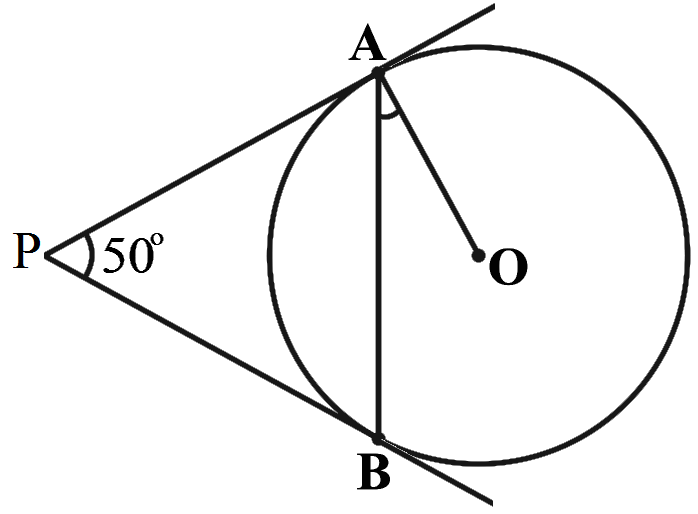
In the given figure, PA and PB are two tangents to the circle with centre O. If $ \text{APB} = 50^\circ$ then what is the measure of $\angle\text{OAB}.$
In a $\triangle\text{ABC},\angle\text{B}=90^\circ,\text{AB}=24\text{cm}$ and BC = 7cm.
Find:
  1. $\sin\text{A}$
  2. $\cos\text{A}$
  3. $\sin\text{C}$
  4. $\cos\text{C}.$
Divide $24$ in three parts such that they are in AP and their product is $440$.
Solve the following quadratic equations by factorization:
$\frac{4}{\text{x}}-3=\frac{5}{2\text{x}+3},$ $\text{x}\neq-0,-\frac{3}{2}$
Peter throws two different dice together and finds the product of the two numbers obtained. Rina throws a die squares the number obtained. Who has the better chance to get the number 25?
The following table shows the daily wages of workers in a factory:
Daily wages (in Rs). 0-100 100-200 200-300 300-400 400-500
Number of workers. 40 32 48 22 8
Find the median daily wage income of the workers.